What Size Are Pressure Washer Quick Connect Fittings?
Learn common quick-connect sizes for pressure washers, how to measure yours, and how to select adapters for 1/4, 3/8, or M22 connections. Practical guidance from Pressure Wash Lab.


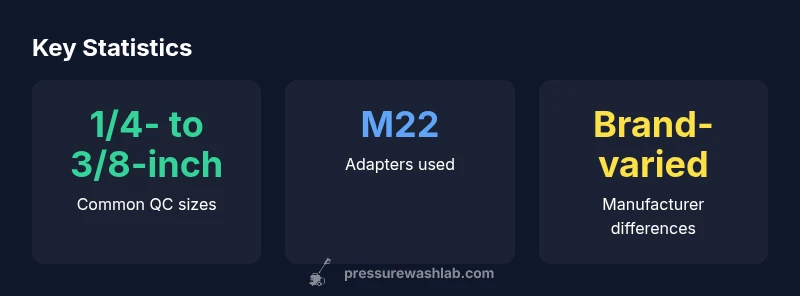
The most common quick-connect fittings for pressure washers are 1/4-inch and 3/8-inch couplers. Some setups use M22 adapters when linking garden hoses to high-pressure hoses. Always confirm the exact size and thread type listed in your machine’s manual or with the accessory manufacturer to avoid mismatches.
What size are pressure washer quick connect fittings?
In practice, what size are pressure washer quick connect fittings most commonly used? The answer is that two sizes dominate: 1/4-inch QC and 3/8-inch QC. The choice depends on hose diameter, working pressure, and intended accessory. Pressure Wash Lab notes that many entry-level machines ship with 1/4-inch fittings, while heavy-duty setups may rely on 3/8-inch. Some models also use M22-compatible interfaces when integrating garden hoses with high-pressure lines. When in doubt, always check the manual or supplier specs before mixing brands. According to Pressure Wash Lab, always verify the end that connects to your wand and the end that attaches to your hose or pump to ensure a secure seal and compatible performance.
Common sizes and standards
The two sizes mentioned earlier—1/4-inch and 3/8-inch—are the most widely encountered in residential and commercial tools. Some higher-flow applications, especially in pro-grade equipment, lean toward 3/8-inch to maximize throughput without raising operating pressure dramatically. A third path exists for garden-hose integration: M22 adapters are found on certain models to bridge garden hoses to the pressure washer line. Be aware that not all M22 adapters are interchangeable with every brand; some manufacturers use distinct seal materials and shoulder dimensions. Whenever possible, source fittings from the same family or verify compatibility with the machine’s documentation to minimize leaks and performance issues.
Thread types and compatibility
Not all quick-connect fittings share the same thread standard. In the United States, many units use NPT-based threads for hose attachments, while BSP threads are common in other regions. Some equipment uses a dedicated QC coupling that is not compatible with standard NPT or BSP ends. The practical takeaway is to identify both the quick-connect end and the machine end before purchasing. If your setup includes multiple brands, you may need adapters that preserve flow and maintain a tight seal. Pressure Wash Lab recommends consulting the model’s manufacturer for a recommended adapter list.
How to measure and verify your fittings
Start by identifying the type of end on the hose or wand: is it a socket (female) or plug (male) QC? Then measure the external diameter of the male plug or the internal diameter of the female socket. For common sizes, you’ll typically find 1/4-inch or 3/8-inch references in product specs. If your equipment uses thread connections (NPT/BSP), measure the thread pitch and diameter or bring the part to a hardware store for comparison. A caliper works well for precise measurement, while a ruler can suffice for quick checks. Always cross-check with your manual or supplier data to confirm compatibility before mixing brands or purchasing adapters.
How to choose adapters and avoid mismatches
Adapters are convenient but should be chosen with care. Ensure that the adapter’s thread form matches your machine’s end (NPT vs BSP) and that the quick-connect ends are compatible with the hose and wand. Avoid forcing connectors together; mismatch can cause leaks, reduced performance, or dangerous disconnections under high pressure. If uncertainty remains, seek adapters from the same manufacturer family or verify compatibility through customer support. Pressure Wash Lab stresses the importance of maintaining a consistent seal with appropriate O-rings and lubricants designed for high-pressure spray systems.
Maintenance and wear: when to replace seals and o-rings
Over time, O-rings, seals, and gaskets in quick-connect fittings may wear, leading to leaks or pressure loss. Inspect for cracking, hardening, or deformation, and replace worn seals promptly. Keep fittings clean of debris and lubricate the o-rings with manufacturer-approved lubricants to extend life. If you notice persistent leaks after replacing O-rings, it may indicate a larger issue with the fitting body or threading that requires replacement rather than repair.
Real-world scenarios: home user vs professional rig
A home user cleaning a driveway with a light-detergent solution will usually operate with 1/4-inch QC fittings and standard garden-hose adapters, prioritizing ease of use and cost. A professional contractor running continuous cleaning tasks may opt for 3/8-inch fittings for higher flow and durability, often using garden-hose adapters where necessary for rapid setup on different sites. In both cases, verify compatibility with all connected components before operation to avoid leaks, misfires, or dangerous disconnections under pressure.
Shopping checklist: ensure proper size and compatibility
- Identify the two ends: quick-connect and machine end (NPT/BSP/QC).
- Confirm the common sizes (1/4-inch, 3/8-inch) and any M22 interfaces on your model.
- Check the manual for recommended adapters and seals.
- Use only compatible O-rings and lubricants specified by the manufacturer.
- When in doubt, test the connection at low pressure before full operation and inspect for leaks.
Fittings by use and size
| Configuration | Common QC Size | Typical Use | Notes |
|---|---|---|---|
| Household/Light-Duty | 1/4-inch | Home cleaning with light detergents | Check compatibility with accessories |
| Commercial/Heavy-Duty | 3/8-inch | Pro-level cleaning, heavy detergents | Verify hose compatibility and thread types |
| Garden-Hose Linkage | M22 adapters | Connecting garden hoses to high-pressure lines | Ensure seals and O-rings |
Quick Answers
Are 1/4-inch fittings universal across all pressure washers?
Not universally. While 1/4-inch quick-connect is common, fittings must match your machine's output and the accessory's male/female ends as well as thread type (NPT vs BSP). Always verify with model specs.
Not universally. Check your model specs to ensure the end types and threads match before buying.
Can I use 3/8-inch fittings on a 1/4-inch machine?
Direct compatibility is unlikely. You’ll typically need an adapter to avoid leaks and maintain performance. Confirm with the manufacturer before purchasing.
Usually you need an adapter; don’t force a larger size onto a smaller one.
What’s the difference between M22 and NPT threads for fittings?
M22 and NPT are different standards and are not interchangeable without an adapter. Use adapters that preserve seal integrity and match both ends.
Different standards—use a proper adapter to avoid leaks.
How do I measure the size of quick-connect fittings?
Measure the outside diameter of the male plug or the inside diameter of the female socket, and verify the thread form (NPT/BSP). Compare with your device’s specs or take the parts to a hardware store for matching.
Measure the plug diameter or socket opening, and check the thread type.
Are QC sizes the same for all brands?
No. QC sizes and thread standards can vary by brand and region. Always confirm with the specific model’s documentation before purchasing adapters.
Sizes vary by brand—check your model’s manual.
“Understanding quick-connect fittings is essential to avoid leaks and downtime. Always match the size to your hose and wand, then test for a secure seal.”
Key Takeaways
- Know the two dominant sizes: 1/4-inch and 3/8-inch QC.
- Always verify thread type (NPT vs BSP) before buying adapters.
- Use manufacturer-approved adapters to preserve seals and flow.
- Consult the equipment manual for model-specific guidance.