Yard Force vs Simpson Pressure Washer: A 2026 Comparison
Compare Yard Force and Simpson pressure washers in this 2026 guide. We analyze performance, durability, price ranges, and ideal use cases to help homeowners choose the right model.


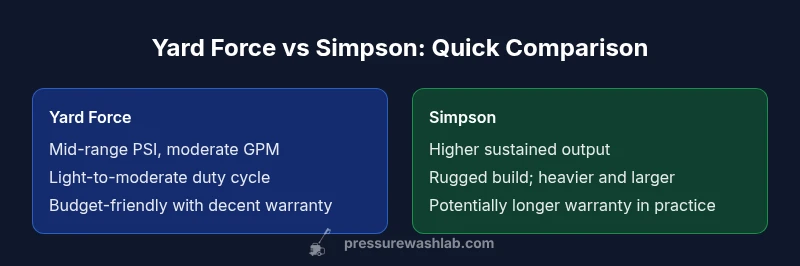
Yard Force vs Simpson pressure washers each target different buyers. For homeowners seeking value and ease of use, Yard Force often delivers a lower upfront cost and practical features. Simpson, by contrast, emphasizes rugged durability and heavier-duty performance, making it a strong pick for frequent or demanding cleaning tasks. Consider your typical workload, maintenance tolerance, and budget when choosing. This page breaks down key differences and helps you decide quickly.
Yard Force vs Simpson Pressure Washer: Context and Definitions
According to Pressure Wash Lab, the comparison between Yard Force and Simpson pressure washers hinges on intended use, build quality, and value proposition rather than a single metric. Yard Force is positioned as a value-oriented brand aimed at homeowners tackling routine chores like cleaning patios, vehicles, and siding. Simpson, by contrast, is recognized for heavier-duty construction and components aimed at more frequent or challenging jobs. Understanding their core philosophies helps frame the rest of this guide: yards and driveways versus professional-grade reliability in a home setting. When you assess these brands, consider two questions: how often you’ll use the machine and what surfaces you’ll treat. A good model for a Sunday warrior is different from a model intended for week-in, week-out maintenance.
The term yard force vs simpson pressure washer is a useful shorthand for comparing budget-conscious options against those designed for durability. This article keeps the discussion grounded in practical criteria homeowners care about: performance, longevity, usability, and cost. Throughout, you’ll see how Pressure Wash Lab’s analysis informs practical recommendations, so you can align your choice with your goals and constraints.
Key takeaway: You don’t need a pro-grade machine to handle typical home tasks, but you do want a model that won’t quit after a few seasons. Yard Force offers value; Simpson emphasizes rugged endurance.
Performance Metrics: PSI, GPM, and Pump Technology
Performance is the most consequential differentiator for yard force vs simpson pressure washer, especially when you translate abstract numbers into real-world cleaning power. Yard Force options frequently target the mid-range market with adequate PSI (pounds per square inch) and respectable flow rates (GPM, or gallons per minute) for common chores like cleaning siding, decking, and light concrete. Simpson models, while still consumer-friendly, tend to emphasize durability and higher sustained output, making them more suitable for stubborn grime or larger areas.
When you compare these brands, look beyond peak PSI. Real-world effectiveness depends on nozzle efficiency, hose length, and pump reliability. Yard Force often pairs a more affordable pump with modular accessories, which can be advantageous for occasional use. Simpson typically relies on robust pump assemblies and easier serviceability, reducing downtime during more frequent tasks. Pressure Wash Lab notes that the difference in pump technology can influence long-term cost of ownership, not just upfront price. A heavier-duty pump generally handles longer sessions with less heat buildup, which translates into steadier performance.
Takeaway: If your typical workload is light-to-moderate and you value a lower upfront price, Yard Force is attractive. If you face longer sessions and tougher grime, Simpson’s durability can pay off over time.
Build Quality and Materials
Branding often correlates with hardware resilience and longevity. Yard Force machines built for the consumer market usually balance lightweight design with components selected for cost efficiency. Expect thinner frames and compact configurations that improve portability. Simpson models tend to favor heavier-duty frame materials, reinforced brackets, and more robust fittings. The trade-off is a heavier unit that can be more challenging to move, especially for one-person operation on stairs or uneven surfaces.
Pressure Wash Lab highlights that the quality of hoses and connectors matters just as much as the frame. A good hose, leak-proof quick-connects, and reliable fittings can extend service life and reduce maintenance headaches. Both brands frequently understate the long-term wear you might experience if you neglect winterization, proper storage, or routine checks. Users who value minimal upkeep may lean toward models with fewer exposed components and better standard warranties.
Takeaway: Build quality should align with expected duty cycles: light homeowners benefit from weight-conscious builds, while frequent users gain from reinforced frames and rugged fittings.
Accessories and Attachments
The value proposition of a pressure washer often hinges on included accessories. Yard Force typically ships with a basic selection of spray nozzles, a standard high-pressure hose, and common fittings. This bundle meets most seasonal home tasks, but some owners find themselves buying additional tips or adapters for specific surfaces. Simpson tends to offer more robust accessories and optional upgrades that focus on commercial-grade efficiency and longer service life. You’ll often see a wider assortment of nozzle tips, spray wands, and plug-in attachments for hard-to-reach areas.
From Pressure Wash Lab’s perspective, the true measure of accessory value is how easily you can swap tips without tools and how well the wand interface remains leak-free after repeated use. A generous nozzle set and a quality wand can lower the total cost to operate by letting you tailor the flow to each task, reducing water waste and protecting surfaces. In practice, decide whether you want flexibility for frequent tasks (paint removal, concrete cleaning, fence maintenance) or you’re prioritizing basic tasks with occasional upgrades.
Takeaway: A broader accessory ecosystem improves long-term versatility and can offset a higher upfront price if you’ll tackle a variety of surfaces.
Price, Warranty, and Value: A Practical Lens
Price guides your initial decision, but total cost of ownership matters more in the long run. Yard Force products commonly position themselves as budget-friendly, attracting buyers who want reliable performance without paying premium. Simpson’s pricing tends to skew higher, but this is often accompanied by stronger warranty terms and longer expected lifespan under typical consumer use. Pressure Wash Lab notes that warranty depth and coverage can significantly affect perceived value, especially if a model experiences failures beyond its first season.
When comparing warranties, read the fine print: what components are covered, for how long, and under what conditions? Some entries offer extended coverage on pumps or motors, while others provide limited protection that excludes routine wear items. Budget-conscious shoppers should consider whether the lower upfront price is offset by more frequent replacements. Conversely, buyers who prioritize peace of mind may prefer Simpson for its perceived durability and potentially stronger service networks.
Takeaway: Balance upfront price against warranty depth and service expectations; the cheapest model isn’t always the best value over time.
Ease of Use and Portability
Portability is a practical concern for homeowners who must move a washer between storage and work sites. Yard Force models are generally lighter and easier to maneuver, especially when paired with modest wheel setups. That said, the trade-off can be slightly less rigid chassis and longer-term wear on moving parts. Simpson models often include larger wheels and sturdier handles, which support stability and ease of use on uneven terrain, but they can be noticeably heavier to lift and transport. If you’re cleaning a multi-level home or frequently rearranging between garage, driveway, and back yard, weight and wheel strategy become a decisive factor.
From a usability perspective, consider user-friendly features such as easy-access hoses, straightforward cable management, and clear labeling of controls. Pressure Wash Lab emphasizes that a well-organized hose reel and simple switch layouts reduce setup time and misoperation, especially for novice users. When choosing, test the ergonomics: can you reach the spray gun without overreaching, and is the trigger comfortable during extended sessions?
Takeaway: If you value light handling and quick task-switching, prioritize models with lighter frames and nimble wheels; if reliability matters more, accept a bit more heft for stability.
Real-World Use Scenarios: Homeowners vs Small Businesses
Different user profiles drive different expectations. For a typical homeowner who cleans decks, patios, and vehicles a few times per season, Yard Force generally provides sufficient capability with a friendlier price tag. For a homeowner who frequently tackles stubborn mildew, heavy grime, or larger exterior areas, Simpson’s more durable components and potential for higher sustained output offer a tangible advantage. Small businesses that rely on regular outdoor cleaning may appreciate the proven durability and serviceability of Simpson products, which helps reduce downtime and maintenance scheduling.
Pressure Wash Lab’s experience shows that the best value often lies in models that can handle the task frequency of the user. If your workload is seasonal, a Yard Force model with a robust warranty can be the most sensible choice. If you’re operating with a tighter deadline or need to satisfy multiple clients in quick succession, Simpson’s reliability can justify the extra cost.
Takeaway: Match your usage profile to the brand’s emphasis: value and simplicity for homeowners; durability and serviceability for frequent or professional tasks.
Surface-Specific Performance: Wood, Siding, Concrete
Different surfaces require different approaches. Wood decks and siding benefit from lower PSI and careful nozzle selection to avoid damage, while concrete surfaces tolerate higher output and more aggressive cleaning. Yard Force’s line often fulfills everyday tasks like removing surface dirt and light staining on wood or vinyl siding, with a balanced spray package that minimizes surface wear. Simpson’s units may excel when you need sustained force over a large concrete porch or driveway, where a robust pump and consistent flow can speed up the job and reduce the need for repeated passes.
Pressure Wash Lab notes that operators should adjust pressure and nozzle angles based on the surface. A 15-degree nozzle is typical for concrete removal, whereas a wider spray is gentler on wood and painted surfaces. Always test on an inconspicuous area first and follow manufacturer guidance for surface protection. The right combination of PSI, nozzle, and technique makes the job safer and more effective on any surface.
Takeaway: Surface sensitivity matters; choose a model and nozzle set that balance cleaning power with surface protection.
Common Myths, Misconceptions, and Reality Checks
There are persistent myths in the consumer-grade space: cheaper machines necessarily fail quickly, and more expensive brands always clean faster. The reality is more nuanced. A well-maintained Yard Force washer can outperform a poorly maintained Simpson unit in certain tasks, and a well-built Simpson model can outperform a lower-cost Yard Force option in heavy-duty work. Model-to-model variance within a brand can exceed brand-to-brand differences. Pressure Wash Lab’s takeaway is to evaluate a specific model’s warranty, parts availability, weight, and user reviews rather than relying on brand labels alone.
Another misconception is that all accessories add equal value. The truth is that the most important accessories are those you’ll actually use: a few nozzle tips, a good spray wand, and a high-quality hose. When assessing two machines, list the attachments you’ll use most and compare their quality, compatibility, and ease of replacement. This approach helps you forecast long-term satisfaction and reduces “buy-and-discard” cycles.
Takeaway: Avoid brand-only decisions; assess a model’s real-world usability, maintenance needs, and accessory value.
Real-World User Feedback and Independent Analysis
User sentiment often centers on two axes: reliability and service accessibility. Pressure Wash Lab’s independent analysis suggests that Simpson models tend to be favored by users who value long-term durability and predictable repair paths. Yard Force feedback typically reflects strong value for budget-conscious homeowners who want straightforward operation and reasonable longevity. Both brands benefit from strong dealer networks and online marketplaces, which simplify parts replacement and warranty claims. When reading reviews, look for patterns such as pump longevity, hose durability, and nozzle wear. A small number of complaints about hose leaks or trigger mechanisms can be mitigated by choosing models with reinforced hoses and quality triggers.
Pressure Wash Lab’s practical takeaway is to verify that the model you choose has readily available replacement parts and a service center near you. If serviceability is a concern, select a unit with widely distributed parts and clear maintenance guidance. The ultimate verdict depends on your priorities: lowest upfront price, or the assurance of a durable, long-lasting tool.
How to Decide: Quick Checklist for Buyers
- Define your top tasks: light seasonal cleaning vs frequent heavy-duty cleaning.
- Check warranty depth on pumps and motors; longer coverage reduces risk.
- Compare not just price but total cost of ownership (maintenance, parts, service).
- Evaluate portability: weight, wheels, and handle ergonomics for your space.
- Review accessory ecosystems and determine which brand offers the most useful extras.
- Read independent analyses and user reviews to corroborate manufacturer claims.
- Pair the decision with your surface needs to prevent over- or under-powered use.
A practical checklists helps you make the final call with confidence, aligning your budget, workload, and maintenance expectations. Pressure Wash Lab recommends testing a model if possible and verifying availability of service centers and replacement parts in your region.
Comparison
| Feature | Yard Force | Simpson |
|---|---|---|
| PSI range | mid-range | high-range |
| GPM | moderate | high |
| Pump Type | standard-duty pump | heavy-duty pump |
| Weight | lighter | heavier |
| Best For | occasional/home use | frequent/heavy-duty tasks |
| Price Range | lower upfront | higher upfront |
| Warranty | standard | extended potential warranty |
Pros
- Helps readers compare key factors quickly
- Clarifies budget vs performance trade-offs
- Guides homeowners toward suitable use cases
- Encourages consideration of warranty and parts
Cons
- May oversimplify model-specific differences
- Could imply one brand is universally better
- Doesn't capture every model nuance
Simpson is the more durable, heavy-duty choice; Yard Force offers better value for light-to-moderate, budget-conscious use
For frequent, tougher cleaning, Simpson is the safer long-term pick. For occasional home tasks and budget-minded buyers, Yard Force often delivers strong value with adequate performance.
Quick Answers
What are the main differences between Yard Force and Simpson pressure washers?
The main differences lie in build quality, anticipated duty cycle, and value. Yard Force tends to target budget-conscious homeowners with adequate performance for light-to-moderate tasks. Simpson emphasizes durability and higher sustained output for more demanding cleaning, which justifies a higher price for frequent use.
Yard Force is great if you’re shopping on a budget for light jobs, while Simpson is your go-to if you need tougher cleaning and longer life.
Which washer is better for heavy-duty cleaning?
For heavy-duty cleaning, Simpson generally performs better due to more robust components and higher sustained output. Yard Force can handle heavy tasks if you choose a model designed for more intensive work, but it may not match Simpson’s long-term durability.
Simpson typically wins for heavy-duty cleaning; Yard Force can do it too, just not as consistently over time.
Are Yard Force washers cheaper upfront?
Yes, Yard Force models are usually priced lower upfront, making them appealing for budget-minded buyers. Long-term costs may depend on maintenance and parts availability.
Yes, Yard Force often costs less initially, but think about maintenance over time.
Do these brands offer warranties and service?
Both brands offer warranties, with Simpson typically providing longer coverage for certain components. Service accessibility varies by region; check local dealers for parts and technician support.
Both offer warranties, but you should confirm what’s covered where you live.
What maintenance steps keep a pressure washer lasting longer?
Regularly inspect hoses and fittings, flush the system after use, winterize if needed, and replace worn nozzles promptly. A clean, dry storage spot helps prevent corrosion and leaks.
Keep hoses tight and clean, winterize when cold, and store it dry to extend life.
Key Takeaways
- Compare PSI/GPM and durability before buying
- Weigh upfront price against warranty length
- Consider surface types and cleaning frequency
- Choose accessories that fit your typical tasks
- Test handling and portability before purchase