Pressure Wash vs Sanding: A Side-by-Side Comparison for Exterior Prep
Explore how pressure wash instead of sanding stacks up for exterior prep. This analytical guide weighs surface types, paint removal effectiveness, time, cost, and risk, with practical steps to decide the best approach for homeowners and pros.


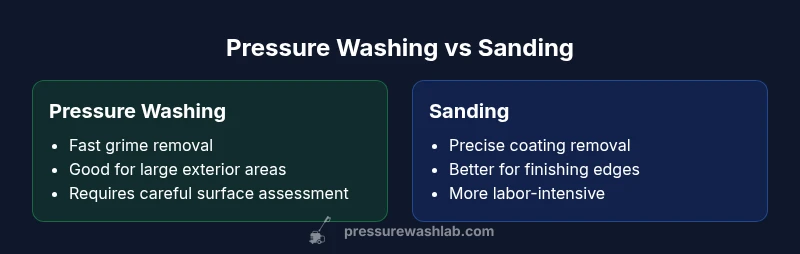
For most exterior prep projects, pressure wash instead of sanding provides faster surface cleaning and broader material compatibility, especially on concrete and masonry, while sanding remains preferable for precise edge work and finishing details. Combine the two when coatings are thick or layered, using pressure washing to remove grime first and sanding to refine edges and stubborn areas.
Understanding the Core Idea: pressure wash instead of sanding
The phrase pressure wash instead of sanding captures a fundamental choice in exterior prep. Pressure washing uses high-velocity water to blast away grime, flaking paint, and mildew, often with detergents tailored to the job. It excels on flat, outward-facing surfaces like siding, brick, and concrete, where loose grime is the primary obstacle. However, it’s not a universal solution. Some coatings are too thick, layered, or adhered to delicate substrates for safe removal with a spray. In those cases, sanding or chemical strippers may be necessary. Throughout this article we compare both methods objectively, emphasizing when one method outperforms the other and how to blend approaches for durable results. The keyword pressure wash instead of sanding appears here to anchor the discussion in practical decision-making for homeowners and DIY enthusiasts alike.
When sanding is still a valid option
Sanding offers precise control when coatings are uneven, peeling, or deeply etched into wood or delicate surfaces. It creates a clean, even base for paints or sealants where a textured surface would otherwise show through after a wash. Sanding is more labor-intensive and generates dust that requires containment and cleanup. For historic homes or intricate trim, sanding can preserve architectural details that a high-pressure spray might damage. In addition, certain finishes, such as enamel or polyurethane on softer woods, benefit from the fine abrasion that sanding provides. Even when you begin with a pressure wash instead of sanding, you may end up sanding in strategic areas to achieve a perfectly smooth final coat.
Surface compatibility: wood, siding, and concrete considerations
Different substrates react differently to pressure washing and sanding. Concrete and masonry tolerate aggressive cleaning and benefit from detergents and high-volume rinses. Vinyl and fiber-cement siding respond well to lower pressures and wider nozzles to minimize edge damage while removing surface grime. Wood, especially soft woods or old finishes, is more vulnerable to gouging or water intrusion. In such cases, sanding might be safer and more effective for coating removal. The decision to pressure wash instead of sanding should be guided by surface type, coating layer thickness, and the desired finish quality.
Paint and finish removal: effectiveness and limits
Pressure washing can dislodge loose paint and surface grime, but stubborn layers may require follow-up methods. Sanding removes coatings layer-by-layer with physical abrasion, delivering a uniform base for primer and paint. If you’re removing multiple layers, plan a staged approach: clean with pressure washing to reveal problem areas, then sand where the old finish remains stubborn or embedded into grain or texture. The result is better long-term adhesion and a more even final appearance. Avoid relying solely on either method for heavy removal on delicate substrates.
Time, labor, and cost considerations
A pressure wash project typically consumes less manual labor per square foot than sanding, especially for large surfaces. The upfront cost of renting or owning a pressure washer is offset by rapid coverage. Sanding, by contrast, demands more time and physical effort, particularly on expansive facades or decks. While sanding can reduce the need for heavy cleanup and protect sensitive surfaces, it increases dust, noise, and potential for human error. Understanding these dynamics helps readers decide when pressure wash instead of sanding is the optimal move, and when to reserve sanding for refinishing edges, corners, and detailed trim.
Safety, PPE, and environmental factors
Pressure washing requires protective eyewear, hearing protection, and slip-resistant footwear. Detergent use raises concerns about runoff and plant exposure, so containment strategies and eco-friendly cleaners are recommended. Sanding generates wood dust that can irritate lungs and eyes; dust control measures are essential, particularly on interior-adjacent or occupied spaces. An analytical approach weighs risk trade-offs: high-pressure cleaning accelerates jobs but calls for careful surface assessment to avoid damage. This balanced perspective helps homeowners and pros decide whether to pressure wash instead of sanding for exterior prep tasks.
Step-by-step planning: from assessment to execution
Begin with a surface assessment: identify coatings, moisture conditions, substrate type, and nearby vegetation. Test a small patch to observe coating response and surface integrity. If you decide to pressure wash instead of sanding, start with a low-pressure setting and wide nozzle, gradually increasing as needed. Apply an appropriate detergent, dwell briefly, and rinse thoroughly. After cleaning, inspect for remaining finish and plan targeted sanding where necessary. Document the process, because a clear plan minimizes rework and ensures predictable results.
When to combine methods: a practical blended approach
Most projects benefit from a blended approach: use pressure washing to remove grime and expose the coating’s true condition, then sand where adhesion is uncertain or edges need refinement. This hybrid strategy leverages the speed of washing while preserving control over final appearance. By sequencing steps carefully, you reduce the risk of recessed finishes or uneven textures and improve coating longevity. Pressure wash instead of sanding becomes a strategic choice rather than a blanket rule.
Maintenance and long-term outcomes after pressure washing
Clean surfaces are crucial for long-term protection. After pressure washing, apply primers or sealants promptly to minimize weathering. Inspect for water intrusion or wood damage that could worsen with moisture exposure. Regular maintenance—cleaning, resealing, and periodic inspections—extends the life of coatings and reduces spot repairs. A well-planned, maintenance-focused approach makes pressure wash instead of sanding a durable, efficient workflow for most exterior refreshes.
Case examples: homeowner scenarios and decision logic
Scenario A: A vinyl-sided house with light mildew and dirt benefits from a careful pressure wash, followed by minimal sanding where joints show wear. Scenario B: An old wooden deck with peeling stain requires initial washing to remove grime, then selective sanding on raised grain and rough boards. Scenario C: Historic clapboard with lead-based paint demands a professional assessment; a blended approach ensures safety and compliance. Each case illustrates how the choice between pressure washing and sanding hinges on surface condition, coatings, and the final finish required.
Final takeaway: choosing the right path for durable results
Across scenarios, the question remains: should you press forward with pressure wash instead of sanding, or reserve sanding for finishing precision? The answer hinges on surface type, coating thickness, and the level of surface refinement desired. When applied thoughtfully, pressure washing accelerates exterior prep without sacrificing finish quality. For most homeowners and contractors, an informed blend—pressure wash to remove grime, sanding where detail matters—offers the best overall outcome.
Comparison
| Feature | Pressure washing | Sanding |
|---|---|---|
| Best surface types | Concrete/masonry, brick, vinyl siding, fiber cement | Wood (especially soft wood), intricate trim, edges |
| Paint/finish removal effectiveness | Removes grime and some paint; often requires follow-up methods for thick coatings | Removes coatings layer-by-layer with precision |
| Time to complete | Faster on large areas; can cover whole surfaces in a short period | Slower; manual labor dominates, especially on large areas |
| Dust and debris | Low dust, mostly water-based debris with wash runoff | High dust; requires containment and dust control |
| Surface risk | Potential for gouging soft surfaces if misused; risk mitigated with proper settings | Lower risk of surface damage when using controlled abrasion |
| Equipment needs | Pressure washer with nozzles, detergents, possibly extension wands | Sanding tools (orbital, hand sanders), sanding discs, masks |
| Best for | Speedy cleanup and basic coating removal; exterior grime clearance | Finishing touch and precise coating removal for edges |
| Cost range | Moderate to low upfront cost with rental options | Moderate; labor-intensive but predictable material cost |
Pros
- Drastically reduces cleaning time on large exterior surfaces
- Low physical strain compared to extensive sanding work
- Works well with eco-friendly detergents and surface cleaners
Cons
- Can damage soft substrates if misapplied or too aggressive
- Limited effectiveness on multi-layer coatings without subsequent methods
- Requires runoff management and protective measures for plants
Pressure washing is typically the first choice for exterior prep, with sanding reserved for detail work and stubborn coatings
For most homeowners and pros, starting with pressure wash instead of sanding accelerates prep. Use sanding selectively to refine edges and tackle resistant coatings for the best long-term finish.
Quick Answers
Can I pressure wash painted wood without damaging the surface?
Yes, but you must use a low to moderate pressure setting and a wide nozzle to minimize gouging. Start with a test patch and avoid direct, prolonged spray on any one spot. If peeling or blistering occurs, switch to sanding or chemical methods for finish removal.
You can pressure wash painted wood if you start gentle and test first; stop if you see peeling, and consider sanding for hard-to-remove areas.
Will pressure washing remove paint completely on exterior surfaces?
Pressure washing can remove a significant portion of loose paint and grime but often won’t strip thick, bonded coatings. Expect to follow with sanding or chemical strippers on stubborn layers. The most durable results usually come from a staged approach.
It removes most surface grime and some paint, but thick coatings often need follow-up methods.
What surface types respond best to pressure washing?
Hard, non-porous surfaces like masonry, brick, and fiber cement respond well. Vinyl siding tolerates spray better than wood. Wood requires gentler settings to prevent damage. Always perform a patch test on any new surface.
Hard surfaces respond best; please test on wood before wide application.
When should I choose sanding over pressure washing?
Choose sanding when coatings are thick, multi-layered, or deeply bonded where a smooth finish is essential. Sanding is also preferable for detailed trim and edges. A blended approach often yields the best long-term durability.
Sanding is better for thick coatings and detailed edges; blending can give the best results.
What safety precautions are essential for both methods?
Wear eye and hearing protection, gloves, and appropriate footwear. For pressure washing, protect plants and use eco-friendly detergents. For sanding, use a dust mask or respirator and ensure area containment to reduce dust spread.
Protect yourself with PPE and manage runoff and dust carefully.
Can I DIY a blended approach, or should I hire a pro?
A blended approach is feasible for many DIY projects, especially on straightforward exteriors. For tall structures, complicated coatings, or historical properties, consulting a professional is wise to avoid damage and ensure compliance.
A blended DIY approach works for simple jobs; for complex projects, consider a pro.
Key Takeaways
- Assess surface type and coating thickness before choosing method
- Use pressure wash instead of sanding for grime removal on large areas
- Reserve sanding for edges, detailed trim, and stubborn coatings
- Plan a blended workflow to maximize speed and durability
- Prioritize safety, PPE, and environmental protection throughout