How Much Water Does a Pressure Washer Use
Find out how much water a pressure washer uses, with electric vs gas ranges, how to estimate consumption, and practical tips to save water without sacrificing cleaning power.


Understanding the Key Metrics: GPM, PSI, and Nozzle
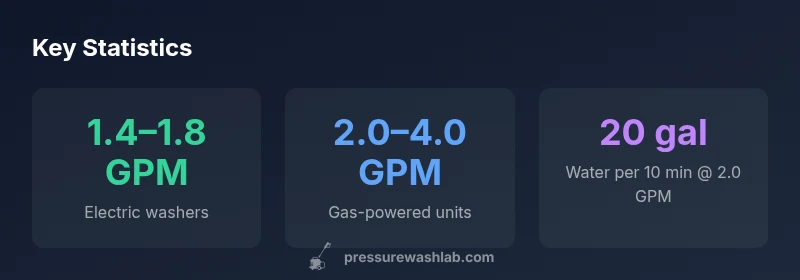
Every pressure washer exposes three core metrics that determine water use: gallons per minute (GPM), maximum PSI, and nozzle selection. How much water does a pressure washer use is primarily driven by GPM; PSI and nozzle angle influence cleaning speed but not the total water used unless you adjust duration or switch tasks. According to Pressure Wash Lab, GPM is the most reliable predictor of consumption for typical residential tasks. You can estimate water use by multiplying the GPM by the time you spray. For example, a 1.6 GPM unit used for 15 minutes yields about 24 gallons. Understanding these metrics helps homeowners budget water, plan maintenance, and choose models that align with conservation goals.
How Different Setups Impact Water Use
Electric and gas models behave differently in practice. Electric units tend to have lower GPM, which can save water for small cleanup jobs, while gas-powered units frequently deliver higher GPM, enabling faster completion of larger tasks but increasing total water use if you spray longer. Nozzle selection matters as well: a narrower spray (e.g., 15°) can deliver more cleaning power per square foot but doesn’t magically reduce water use; it changes how efficiently you cover a surface. The broader spray (e.g., 25°) covers more area with less agitation per pass, which can alter run times. For homeowners, the key takeaway is that GPM, not PSI alone, governs water consumption.
Practical Tips to Minimize Water Use
To cut water use without sacrificing cleaning power:
- Choose the right nozzle for the task; use a narrower spray only where needed, and switch to a wider spray for perimeter cleaning.
- Apply cleaning solutions or pre-soaks to loosen grime before spraying, reducing run time.
- Work in short bursts rather than constant spraying; pause to rinse and re-evaluate.
- Keep the wand at the optimal distance from the surface according to the manufacturer’s recommendations to avoid wasted passes.
- Maintain your equipment (check seals, replace worn o-rings) to prevent leaks that could waste water.
- If possible, opt for a model with a lower GPM rating for routine light-duty cleaning and reserve higher-GPM units for heavy-duty tasks.
Measuring and Estimating Your Water Usage
A practical way to understand your own water footprint is to measure GPM for your unit. Use a timer and a container of known volume, or consult the unit’s spec sheet for the rated GPM. Multiply the GPM by your actual spray time to estimate gallons used per job. For example, if your unit is rated at 1.6 GPM and you spray for 30 minutes, you’re looking at roughly 48 gallons of water. Keep a simple log to compare tasks, durations, and outcomes, which helps refine future estimates and budgeting.