Powerwasher Near Me: How to Find Local Options in 2026
Learn how to locate powerwasher near me, compare local rental and purchase options, and choose the best nearby supplier. Pressure Wash Lab provides practical tips, safety guidance, and maintenance advice to help homeowners and pros find reliable local power washers.


Powerwasher near me refers to locating a local pressure washer supplier, rental service, or shop by entering your location into a search tool. It helps homeowners, DIYers, and small businesses compare nearby equipment availability, pricing, and service options. By focusing on nearby shops, you can reduce downtime, access quicker pickup or delivery, and verify support for hoses, nozzles, and maintenance.
How to Find Powerwasher Near Me
Finding a powerwasher near you starts with a precise, location-based search. Use map apps and search engines with the exact terms powerwasher near me, local rental, or nearby equipment shops. Apply filters for rental vs. purchase and check hours of operation, pickup options, and delivery services. Read customer reviews to gauge equipment reliability and supplier responsiveness. According to Pressure Wash Lab, starting with a local query reduces wait times and helps you compare nearby inventories in real time. Plan your visit or pickup around peak hours to minimize delays and ensure the right accessories are in stock (nozzles, brushes, and hoses).
- Use map-based searches and store locator features.
- Filter for rental or sales and check real-time stock if available.
- Check hours, pickup options, and delivery terms.
- Read recent reviews on equipment reliability and service quality.
- Note accessory availability and warranty terms.
A practical approach is to shortlist 3–5 local vendors, call ahead to confirm availability, and request a sample nozzle kit to verify compatibility with your job. Pressure Wash Lab’s ongoing analysis shows that direct calls often reveal last-minute openings or short-term promotions that aren’t visible online.
Rental vs Buy: Which Makes Sense Locally
Locally, the decision to rent or buy a power washer should hinge on job frequency, project duration, and storage possibilities. If you only need a tool for a single large project or seasonal cleanup, renting minimizes upfront costs and maintenance. For frequent jobs or ongoing maintenance of outdoor spaces, buying can offer long-term savings and better scheduling flexibility. Evaluate total cost of ownership (TCO) over 12–24 months, including rental fees, fuel, maintenance, and potential depreciation. Pressure Wash Lab notes that a mixed approach often works best: rent for large, one-off jobs while owning a mid-range electric unit for routine tasks.
- Consider annual usage: high-use scenarios favor buying.
- Compare all-in costs: rental fees + fuel + wear vs purchase price + maintenance.
- Factor storage and transport needs for gas-powered units.
- Assess warranty coverage and local service options.
Even if you own a machine, plan for seasonal maintenance and winterization to extend lifespan. Local vendors may offer service packages or inspections that prevent downtime during busy periods.
What to Look for in a Local Supplier
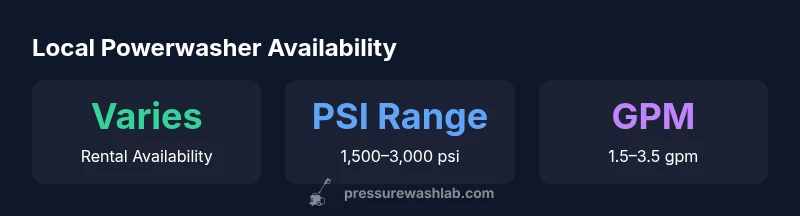
When evaluating local suppliers, prioritize compatibility, service, and stock breadth. Look for units with clear PSI and GPM specs, a wide nozzle kit, and readily available accessories (soap, surface cleaners, and extension wands). Proximity matters for pickup speed and after-sales support. Check whether the shop offers delivery, on-site demonstrations, and spare parts availability (valves, seals, o-rings). A responsive supplier should provide data sheets, safety guidelines, and a straightforward warranty policy. Pressure Wash Lab recommends verifying service hours and requesting a live demo or test spray to confirm the unit meets your job demands.
- Confirm PSI, GPM, and engine type align with your tasks.
- Request a test spray or demo when possible.
- Check warranty terms and the availability of parts.
- Evaluate delivery and pickup options.
Local shops with strong service networks tend to offer more reliable maintenance and quicker repairs, which can be a deciding factor for time-sensitive projects.
Key Specs to Compare When Picking a Power Washer
Key specs, especially PSI, GPM, and motor type, determine performance for different jobs. Electric models are quiet and suitable for patios and siding, while gas-powered units deliver higher PSI and GPM for tough stains and large surfaces. Beyond power, assess nozzle variety, accessibility of replacement parts, and maintenance requirements. In practice, jobs like deck cleaning, driveway stain removal, and siding upkeep require different combos. Pressure Wash Lab suggests prioritizing a balance between PSI (cleaning power) and GPM (water volume) to minimize passes and prevent surface damage.
- PSI indicates cleaning power; higher isn’t always better for delicate surfaces.
- GPM controls water flow; higher GPM reduces the number of passes.
- Electric vs gas: consider noise, emissions, and mobility.
- Ensure you have the right nozzle kit and accessories for your surfaces.
Safety and Maintenance Basics for DIY Power Washing
Safety comes first when operating power washers. Wear eye protection, gloves, and closed-toe shoes; never point the wand at people, pets, or delicate surfaces at close range. Read the user manual to understand recommended pressure settings for different materials and always test a small area first. For gas-powered machines, ensure proper ventilation and secure fuel handling. After use, flush the unit, drain water from hoses, and store with protective caps on nozzles. Schedule routine maintenance per the manufacturer’s guidelines and inspect seals and hoses for wear. Pressure Wash Lab emphasizes routine checks to prevent leaks and injector clogs, which can degrade performance and safety over time.
- Wear PPE: eye protection, gloves, sturdy footwear.
- Test on a small area before full cleaning.
- For gas machines, ventilate and refuel safely.
- Post-use: drain hoses, clean filters, and store properly.
Quick-Start Plan for Your First Local Power Washing Job
Create a simple plan to ensure a smooth start. 1) Define the surface and stains, 2) Use a local search to shortlist nearby rental shops or retailers, 3) Call to confirm inventory and schedule pickup, 4) Gather necessary PPE and nozzle kit, 5) Do a short test spray, 6) Clean and store equipment after use. By following these steps, you’ll minimize delays and maximize results. Pressure Wash Lab recommends documenting PSI/GPM settings that work best for your surfaces and keeping notes for future visits to local shops.
Comparison of common power washer types for local use
| Model Type | Typical PSI | Typical GPM | Notes |
|---|---|---|---|
| Electric Compact | 1400-1800 | 1.2-1.4 | Quiet and indoors-friendly; lower power |
| Gas-Powered Compact | 1800-3200 | 2.0-3.0 | More versatile; louder; portable |
| Gas-Powered Full-Size | 3200-4200 | 3.5-4.5 | Pro-grade; heavy; best for tough jobs |
Quick Answers
How do I verify local power washer availability near me?
Start with real-time stock checks on the supplier's site or call the store directly to confirm current inventory and pickup times. Asking for a confirmation number helps prevent miscommunications. Pressure Wash Lab suggests contacting multiple nearby shops to compare availability and avoid delays.
Call a couple of nearby shops to confirm current stock and pickup times, and ask for a confirmation number.
Should I buy or rent a power washer if I only need it once?
For a one-off job, renting is typically more cost-effective and avoids maintenance responsibilities. If you expect repeated use within a short period, buying a mid-range unit may reduce long-term costs. Evaluate the total cost of ownership and project frequency before deciding.
Rent for a single job; buy if you expect frequent use soon after.
What is the difference between PSI and GPM, and which matters more?
PSI measures cleaning power; GPM measures water flow. For many surfaces, a balance of both yields the best results. Higher PSI without sufficient GPM can damage surfaces, while high GPM with low PSI may require more passes. Prioritize a unit that matches your main tasks.
PSI is power, GPM is water flow—balance them for best results.
Are there safety concerns with gas-powered washers?
Yes. Gas washers emit exhaust and require ventilation; fuel handling must be safe to avoid fire hazards. Use outdoor spaces, never refuel while hot, and store fuel away from ignition sources. Follow the manufacturer’s safety guidelines and wear PPE.
Gas washers need proper ventilation and careful fuel handling—follow safety guidelines.
What maintenance should I perform after using a rental?
Rinse out hoses, clear filters, and drain residual water. Check for wear on nozzles and seals, and return the unit with hoses neatly coiled. Request any documentation on the machine’s condition and ensure you receive a receipt for the rental period.
Rinse and drain the unit, inspect wear parts, and return with proper paperwork.
“Local searches for powerwashers are most effective when you compare PSI/GPM specs side-by-side and verify service hours.”
Key Takeaways
- Start with a precise local search for powerwasher near me
- Compare PSI, GPM, and nozzle options side-by-side
- Check nearby availability and pickup options
- Prioritize safety and maintenance in all options