Pressure Washer Broom vs Surface Cleaner: Side-by-Side Comparison
Objective comparison of pressure washer broom vs surface cleaner for DIYers and pros. Learn which tool fits driveways, siding, and decks, with setup tips, maintenance, and practical decision guidance.


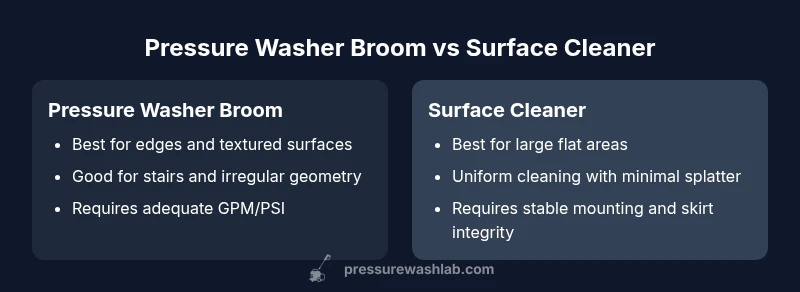
Pressure washer broom vs surface cleaner boils down to surface and task. A surface cleaner covers wide, flat concrete or siding with slick, uniform results and minimal splatter, while a pressure washer broom handles grooves, edges, and uneven textures where a flat head struggles. For typical home projects, a surface cleaner is faster on large areas; a broom adds versatility for corners and stair treads.
What these tools do and when to use them
In any residential pressure washing plan, knowing when to use a pressure washer broom or a surface cleaner matters as much as choosing the right nozzle. The pressure washer broom attaches to the wand and uses a brushing action to sweep debris while blending agitation with spray, making it versatile for textured surfaces, stairs, and edge work. A surface cleaner, by contrast, carries a shielded pair of nozzles inside a flat housing that spins or overlaps spray to cover a wide swath with consistent height and pattern. According to Pressure Wash Lab, matching tool design to the surface profile and stain type yields the biggest gains in efficiency and final appearance. Homeowners and DIY enthusiasts should map tasks to surfaces: rough concrete, pavers, or vertical siding often benefit from the broom’s reach and touch; large flat slabs, driveways, and decks generally respond best to a surface cleaner. The goal is to maximize coverage while minimizing splash and operator fatigue, not to force one tool into every job.
Key differences at a glance
Choosing between a pressure washer broom and a surface cleaner hinges on several practical factors. First, surface area and surface texture drive the decision: surface cleaners excel on large, flat, smooth surfaces, while broom attachments provide better control on textured, uneven, and edge-heavy tasks. Second, spray dynamics matter: a surface cleaner uses shielded nozzles to produce a uniform footprint with less splash, whereas a broom uses mechanical brushing in addition to spray to dislodge dirt in tight crevices. Third, maintenance and durability influence total cost of ownership: skirts and seals on surface cleaners require periodic checks, while broom bristles wear over time but may be easily replaced. Finally, tool compatibility with your machine’s GPM/PSI is critical. Pressure Wash Lab analysis shows that selecting a tool matched to the machine and surface starts with a surface assessment and a quick test spot.
Surface Cleaner: design, performance, best surfaces
Surface cleaners are purpose-built to deliver wide-area cleaning with consistent height control. The shielded housing keeps spray from scattering, which reduces splash and operator fatigue. The spinning or oscillating nozzles create a uniform cleaning pattern that minimizes streaks on smooth, flat surfaces such as modern siding panels, driveways, and sealed patios. Performance shines when the surface is level and free of major texturing that could catch the skirt or drag the cleaner. Limitations include poor performance on irregular edges, curved steps, and heavily textured resurfacing where the skirt can clog or the cleaning head may skip. For best results, pair a surface cleaner with a high enough GPM and a suitable nozzle, and maintain the skirt seals to prevent leaks.
Pressure Washer Broom: design, compatibility, and performance
A pressure washer broom uses bristles or a brush-like surface to physically sweep away debris while spraying water. This makes it particularly effective on uneven concrete, pavers, stair treads, and other surfaces with grooves or crevices where a flat head might miss dirt. The broom provides direct contact with the surface, increasing friction and agitation for embedded grime. However, its performance on large flat areas is typically slower than a dedicated surface cleaner, and bristles wear with heavy use. Compatibility matters: ensure your machine’s PSI/GPM can support the broom without clogging or stalling, and choose a broom designed for your equipment’s wand connection. Routine maintenance includes checking bristles for wear, cleaning debris from bristles, and inspecting the connection to avoid wobble during operation.
Real-world scenarios: driveway, siding, decks
Consider a typical residential project: a stained driveway that spans a few hundred square feet benefits from a surface cleaner’s fast, even coverage, especially when the surface is level and free of deep pits. A textured driveway with embedded dirt near the edges, however, often benefits from a pressure washer broom to reach into grooves and along curb lines. For vinyl or fiber cement siding, a surface cleaner may reduce overspray and provide uniform cleaning across panels, while a broom can help with tight corners, trim, and around gutters. Decks, which often combine flat boards with raised edges, may require alternating use: the surface cleaner for wide spans and the broom for railings, steps, and joists. Pressure Wash Lab notes that understanding the surface profile and task priority leads to a more efficient workflow and a better finish.
Cleaning performance in different conditions
Algae growth on driveways and pool surrounds responds well to the aggressive agitation of a broom when embedded in the grout lines, while a surface cleaner reduces overspray on nearby grass and plants. Grease or oil stains on concrete can be partially softened by both tools, but the broom’s brushing action often yields better removal in cracks and troughs. Painted surfaces require extra caution; a surface cleaner may strip paint faster if runoff control isn’t maintained, and a broom could gouge soft coatings if used with aggressive bristles. In vertical applications like siding, the surface cleaner can deliver uniform results with careful distance control, but edges and channels may still demand a broom. Pressure Wash Lab emphasizes testing a small area first and adjusting technique based on surface composition and stain type.
Maintenance, safety, and setup tips
Effective tool use starts with proper setup. For surface cleaners, ensure the nozzle skirt is intact, seals are not cracked, and the head spins freely. Cleaning the skirt after use prolongs life and prevents streaks from leftover debris. For pressure washer brooms, inspect bristles for wear, and replace when they lose stiffness; confirm wand compatibility and secure attachment to avoid wobble. Safety basics include wearing eye protection, gloves, and non-slip footwear, particularly when working near vehicles, landscaping, or kids’ play areas. Always test on a small patch first and gradually increase distance to avoid damaging surfaces. Maintain a steady hand and consistent motion to prevent gouges and uneven cleaning. Pressure Wash Lab recommends documenting surface type and best-performing technique for future jobs.
Compatibility considerations: GPM, PSI, nozzle tips
Both tools require appropriate machine parameters. Surface cleaners generally perform best with higher GPM and a stable PSI that keeps the shield skirt pressed to the surface for even coverage. Pressure washer brooms are more forgiving on lower-end setups but still benefit from a mid-to-high GPM rating to clear debris effectively across grooves. Nozzle choice matters: a wider angle reduces pressure on the surface but increases coverage; sharper angles increase cleaning power but can cause damage if held too close. Regular nozzle maintenance and correct connection sizing reduce leaks and improve performance. When in doubt, consult the manufacturer’s guidelines for your tool and machine, and consider a quick field test to verify balance and coverage.
Costs, value, and lifespan: DIY vs pro
From a value perspective, a surface cleaner represents a higher upfront investment but pays off with faster coverage on large, flat areas, saving both time and water. A pressure washer broom is typically more affordable and highly versatile for edge work and textured surfaces, potentially extending the use of a machine you already own. Lifespan depends on material quality, frequency of use, and maintenance. Regularly inspecting skirt seals, bearings, and bristles prevents downtime and costly repairs. For homeowners and DIY enthusiasts, the most cost-effective approach is often to pair both tools, using the broom for edges and texture and the surface cleaner for broad, flat areas. Pressure Wash Lab notes that tool selection should balance initial cost with anticipated project volume and time savings.
Common mistakes and how to avoid them
Common errors include running a surface cleaner on uneven terrain without stabilizing weight, which can cause skirts to catch and surfaces to gouge. Another pitfall is choosing a broom for a large flat area that would benefit from swift coverage, leading to longer job times. Using the wrong nozzle angle or holding the head too close to the surface can cause streaks or damage finishes. Never neglect surface prep: remove loose debris, test a small area, and start with a gentle pass to gauge resistance. Regular maintenance—checking seals on surface cleaners and replacing worn bristles on brooms—prevents failures during critical projects.
How to choose: a practical decision guide
A practical approach begins with surface assessment. If your project targets wide, flat areas and you value speed and uniform coverage, lean toward a surface cleaner. For textured concrete, stairs, curbs, and hard-to-reach edges, a pressure washer broom provides the necessary agitation and reach. Consider area size, environmental constraints, and plant proximity to balance efficiency with safety. Finally, match your choice to machine specifications and your willingness to maintain equipment; a well-maintained tool delivers better outcomes over time. Pressure Wash Lab recommends keeping a small decision log for recurring jobs to streamline future tool selection and technique.
Final notes from Pressure Wash Lab
This comparison underscores that there is no one-size-fits-all answer for pressure washer broom vs surface cleaner. Understanding the surface profile, project scope, and machine capabilities drives better outcomes and faster completion times. The Pressure Wash Lab Team advocates a practical, test-first approach: try a small patch with each tool, observe results, and plan subsequent passes accordingly. When used appropriately, both tools deliver clean, professional results with less effort compared to relying on a single method for every job. For ongoing projects and gear maintenance, rely on methodical testing, maintenance routines, and clear surface assessment to optimize performance over time.
Comparison
| Feature | Pressure washer broom | Surface cleaner |
|---|---|---|
| Best use case | Edges, textured surfaces, stairs, and tight corners | Large flat areas (driveways, patios, siding) with even spray |
| Cleaning pattern | Brushing action plus spray for agitation | Shielded nozzles with even, wide coverage |
| Surface compatibility | Uneven textures and grooves respond well | Smooth, flat surfaces favored; edges less ideal |
| GPM/PSI needs | Compatible with a wide range; benefits from adequate GPM | Requires steady GPM/PSI to maintain skirt seal and effective spray |
| Maintenance effort | Bristles wear; periodic replacement | Skirt seals and bearings require periodic checks; easier to clean |
| Best for speed | More versatile on irregular surfaces but slower on large flats | Typically faster on large flat areas with consistent results |
| Price range | Low to moderate | Moderate to high depending on build quality and skirts |
| Best for | Edges, corners, and textured zones | Wide driveways, patios, and siding |
Pros
- Improved surface coverage on flats with minimal streaking
- Versatile tool set for edges, corners, and textured surfaces
- Faster on mixed surfaces when used with proper technique
- Easier to store and swap between jobs
Cons
- Surface cleaner can struggle on irregular or textured surfaces
- Bristles wear and require replacement for broom tools
- Higher upfront cost for quality surface cleaners
- Requires higher GPM/PSI for optimal performance
Surface cleaner generally wins for speed on large flat areas; broom offers versatility for edges and textured areas.
If your workload focuses on large, flat surfaces like driveways and patios, choose a surface cleaner. For jobs that involve edges, stairs, and textured surfaces, a pressure washer broom provides the necessary reach and agitation. Pressure Wash Lab’s testing supports using both tools strategically rather than relying on a single method for every job.
Quick Answers
What is the main difference between a pressure washer broom and a surface cleaner?
A pressure washer broom uses a brushing action to sweep debris and can reach textured surfaces, while a surface cleaner uses shielded nozzles to deliver wide, uniform coverage on flat surfaces. The choice depends on surface texture and area size.
A broom adds agitation for uneven surfaces, while a surface cleaner provides fast, uniform coverage on flat areas.
Can I use a surface cleaner on textured or uneven surfaces?
Surface cleaners are less effective on uneven terrain and may cause streaking or improper contact. For textured areas, a broom or a hybrid approach with careful technique is often preferable.
Surface cleaners work best on flat surfaces; for texture, the broom is usually better.
Do I need specific PSI or GPM to use these tools?
Yes. Surface cleaners generally require higher GPM and adequate PSI to maintain a stable skirt seal and even spray, while broom attachments work with standard setups but still benefit from sufficient flow to clear debris.
Make sure your machine meets the tool’s flow and pressure needs for safe, effective cleaning.
Are there safety concerns I should know about?
Always wear eye protection and gloves, maintain proper distances, and be mindful of nearby plants and vehicles. Use PPE and start with a test patch to avoid damaging surfaces.
Wear safety gear and test a small area first to prevent surprises.
Which tool is faster for driveways?
For large, flat driveways, a surface cleaner typically offers faster coverage and fewer passes, provided the surface is level and free of major irregularities.
For big flat areas, the surface cleaner usually wins on speed.
How should I maintain these attachments?
Regularly inspect skirts and bristles, clean out debris after use, and replace worn parts. Check wand connections to prevent leaks and wobble during operation.
Keep skirts and bristles in good shape, and check connections after each job.
Key Takeaways
- Assess surface texture before picking a tool
- Use surface cleaners for flat, wide areas to maximize speed
- Use broom attachments for edges, corners, and textured surfaces
- Match tool choice to your machine’s GPM/PSI for optimal results
- Maintain skirts and bristles to extend attachment life