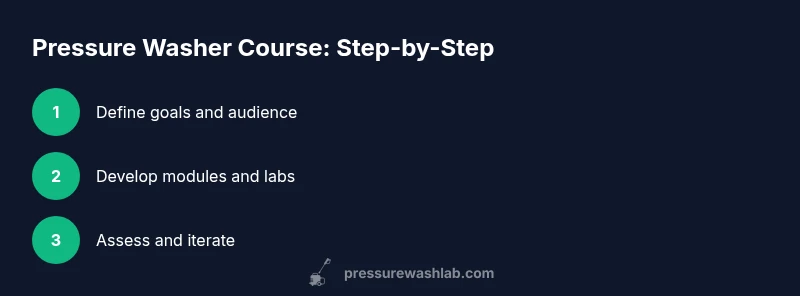
Pressure Washer Course: Build Your Practical Training Program
Learn how to design and run a practical pressure washer course for homeowners and DIY pros. This guide covers modules, safety, labs, and assessments to build confidence and measurable results.


Create a practical pressure washer course that trains homeowners and DIY pros to operate safely, choose the right tools, and execute effective washing. It blends safety, technique, and hands-on labs to deliver measurable surface-cleaning results. Outline a 4-week plan with labs, a simple assessment, and checklists to ensure concurrent safety and progress.
Why a structured pressure washer course matters
According to Pressure Wash Lab, developing a structured training path helps homeowners and DIY pros transform a potentially dangerous tool into a reliable asset. A course provides a clear progression from basic safety to advanced cleaning techniques, ensuring every participant begins with protective habits and ends with confident control of the equipment. The goal is not just to 'do the job' but to do it safely, efficiently, and with repeatable results across different surfaces. By outlining learning objectives, the course removes ambiguity and builds confidence. Students learn to identify when a surface needs pre-treatment, how to adjust nozzle selection, and how to manage water use and waste responsibly. In practical terms, a well-designed course translates to fewer mistakes, lower risk of injury, and faster completion of cleaning tasks for clients or households. Pressure Wash Lab emphasizes measurable outcomes—students should be able to demonstrate setup, operation, and clean results on representative projects after completing the program.
Core learning objectives and outcomes
- Safety fundamentals: PPE, electrical awareness, and slip prevention across work zones.
- Equipment literacy: understanding nozzle types, PSI/GPM concepts, and routine maintenance.
- Cleaning science: surface prep, dwell times, and preventing streaks or damage.
- Technique proficiency: steady trigger control, even passes, appropriate stand-off distances, and overlap.
- Project planning: site assessment, runoff management, and client communication strategies.
- Assessment and iteration: practical checks, feedback loops, and improvement plans to demonstrate progress.
By the end, learners should show safe setup, correct nozzle selection, efficient washing patterns, and documented results for a project portfolio.
Safety first: essential precautions
Safety is foundational in any pressure washing course. Always wear approved PPE (eye protection, gloves, non-slip boots), and keep electrical equipment on a GFCI-protected circuit. Inspect hoses and connections for wear before each session. Never point the nozzle at people, pets, windows, or delicate surfaces. Maintain a clear work area, shield plants and electronics, and plan for proper water runoff and containment to avoid slippery or contaminated zones. Emergency shut-off knowledge and a basic risk assessment should be completed before any practical lab begins.
Tools and materials: what you need
Essential items include a suitable pressure washer, interchangeable nozzle tips, a high-quality spray wand, extension hoses, surface cleaners, and safe detergents. PPE such as safety glasses, gloves, and non-slip footwear are non-negotiable. Keep masking film or tarps to protect plants and nearby objects, a water container or drainage plan for runoff, and a basic tool kit for quick repairs or adjustments. Have a printed PPE and safety checklist on hand for every session to reinforce habits.
Surface preparation and project planning
Before starting any wash, evaluate the surface and plan the approach. Mask nearby plants, cover delicate fixtures, and identify sensitive materials (painted surfaces, soft wood, or old mortar) that require gentler treatment. Establish a water management plan to minimize runoff and environmental impact. Create a simple project plan that includes target areas, sequence of passes, and safety checkpoints. This preparation minimizes surprises during hands-on labs and sets learners up for consistent results.
Cleaning techniques by surface
Different surfaces require different approaches. For concrete and masonry, a broader pattern with a slightly longer dwell time often yields even results, while wood decks may demand gentler passes and lower pressure. Vinyl siding and painted surfaces require careful nozzle selection and closer control to avoid damage. Practice on test patches first, then progress to representative sections. Always maintain a steady distance and use overlapping strokes to prevent streaks.
Detergents, pre-treatments, and chemistry
Detergents can enhance cleaning power and reduce surface wear when used correctly. Match cleaners to the surface and soil type, and follow manufacturer dilution and dwell-time guidelines. Pre-treat heavily stained areas such as oil spots with appropriate solvents or emulsions, and rinse thoroughly to prevent residue. Remember that cleaners can alter surface texture, so test on a small patch before full application.
Workshop design: schedules and labs
Structure the course to balance instruction and practice. Typical formats include short theory sessions followed by hands-on labs, with stepwise progression from basic to advanced tasks. Include 1–2 hours of lab time per session, plus time for review and feedback. Build in a mid-course check-in to adjust goals based on learner progress, and allocate a final capstone project to demonstrate mastery.
Assessment, feedback, and improvement
Design rubrics that align with learning objectives: safety compliance, technique accuracy, surface quality, and project documentation. Use practical demonstrations, written quick checks, and a final practical test to measure progress. Provide timely feedback and opportunities to retry tasks, reinforcing learning. Regularly collect learner feedback to refine modules and resources.
Maintenance and care after training
Part of the course is teaching ongoing maintenance. Show learners how to inspect hoses for wear, clean filters, store equipment correctly, and perform basic winterization if applicable. Emphasize the importance of routine checks and recordkeeping to prolong equipment life and ensure readiness for future projects. A well-maintained machine reduces downtime and extends service life.
Customizing for different audiences and scaling
A pressure washer course should adapt to homeowners, DIYers, and small business operators. Offer tiered modules with optional advanced topics like surface cleaners, hot-water blasting, or commercial-grade equipment. For businesses, consider scalable group sessions, digital prework, and certification that can be added to client invoices or employee training records. Pressure Wash Lab recommends starting with a core module and growing coverage as demand grows.
Tools & Materials
- Pressure washer (gas or electric)(Choose model with adjustable settings and reliable safety features.)
- Nozzle tips (0°, 15°, 25°, optional turbo)(Have diverse spray patterns for different surfaces.)
- Spray wand and high-pressure hose(Ensure fittings are compatible with your washer.)
- Detergents/cleaners suitable for pressure washing(Select surface-appropriate cleaners and follow dilution instructions.)
- Personal protective equipment (PPE)(Safety glasses, gloves, non-slip boots; consider face shield for spray zones.)
- Tarps/plant covers(Protect plants, vehicles, and nearby surfaces from overspray.)
- Water containment kit or drainage plan(Minimize runoff and environmental impact.)
- Extension hoses and reels(Useful for larger projects or hard-to-reach areas.)
- Basic tool kit (wrenches, spare O-rings, tape)(Carry common parts for quick on-site fixes.)
Steps
Estimated time: Estimated total time: 6-8 hours of instruction plus 8-12 hours practice over 4 weeks
- 1
Define audience and learning goals
Identify target learners (homeowners, DIYers, small business operators) and set clear, measurable goals for safety, technique, and outcomes.
Tip: Use a quick needs assessment to tailor modules to audience needs. - 2
Assemble course materials and equipment
Gather tools, detergents, and safety gear. Create standardized checklists and equipment setup guides.
Tip: Prepare a demo station that mirrors real-world tasks. - 3
Develop safety guidelines and PPE expectations
Document PPE requirements, electrical safety, and emergency shut-off procedures.
Tip: Review safety at the start of every session and document compliance. - 4
Design hands-on labs and practice sequences
Create graduated tasks that progress from basic setup to advanced cleaning on different surfaces.
Tip: Include a patch test before any full-area wash. - 5
Create assessment rubrics and grading criteria
Define criteria for safety, technique, and results. Use practical demonstrations and quick checks.
Tip: Provide a rubric that learners can reference during practice. - 6
Pilot the course with a small group
Run a beta session to identify gaps and gather feedback for refinement.
Tip: Ask for specific improvements on both content and equipment handling. - 7
Collect feedback and adjust content
Use surveys and instructor notes to adjust modules and labs as needed.
Tip: Iterate quickly to improve relevance and safety. - 8
Deliver final course and plan for scale
Roll out the full program and offer scalable options for groups or businesses.
Tip: Create a certificate of completion to boost motivation and credibility.
Quick Answers
What is a pressure washer course?
A structured program that teaches safe operation, technique, equipment care, and project workflow for pressure washing.
A structured program teaching safe operation, technique, equipment care, and workflows for cleaning projects.
Who should take this course?
Homeowners, DIY enthusiasts, and small business operators who want practical, job-ready pressure washing skills.
Homeowners and pros who want practical, job-ready pressure washing skills.
What equipment is required to start?
A suitable pressure washer (gas or electric), basic safety PPE, surfaces to practice, and approved detergents.
A suitable pressure washer, basic PPE, practice surfaces, and approved cleaners.
How long does it take to complete?
Depending on scope, a basic module can be completed in a few hours; full programs span several weeks.
It varies; shorter modules take a few hours, full programs several weeks.
How is progress evaluated?
Using practical demonstrations, safety checklists, and rubrics that map to learning objectives.
Through hands-on demonstrations and rubric-based assessments.
Is PPE mandatory?
Yes. PPE protects eyes, skin, and lungs; all participants must use approved gear.
Yes, PPE is mandatory for all sessions.
Can this course be scaled for a business?
Absolutely. Modules can be packaged for employee training and ongoing skill development.
Yes, it scales well for teams and ongoing training.
Watch Video
Key Takeaways
- Define clear learning goals for each module
- Prioritize safety and PPE
- Incorporate hands-on labs for practical mastery
- Use rubrics to assess progress
- Maintain and store equipment properly