Pressure Washer Orifice Calculator: A Practical Guide
Discover Pressure Washer Orifice Calculator: an educational guide and interactive tool to estimate nozzle flow (GPM) from PSI and nozzle diameter. Learn to optimize cleaning performance safely.


What is a pressure washer orifice calculator and why it matters
According to Pressure Wash Lab, a pressure washer orifice calculator is a learning-friendly tool that translates nozzle size, operating pressure, and a flow factor into an estimated water flow, usually expressed in gallons per minute (GPM). For homeowners and DIY enthusiasts, this calculator helps plan cleaning tasks, select compatible nozzles, and estimate cleaning speed without crawling under a sink to check pump specs. By understanding the relationship between nozzle diameter, PSI, and flow, users can avoid choosing a nozzle that wastes water or damages surfaces. In this guide, we’ll unpack the theory behind the calculator and show how to apply it to real-world tasks while keeping safety front and center. Expect practical tips you can start using today, regardless of whether you’re maintaining a driveway or refreshing siding.
How nozzle size and PSI influence flow
Nozzle diameter directly affects the area through which water can pass. A larger diameter increases the orifice area, which can raise the potential flow rate at a given pressure, while a smaller diameter restricts flow and concentrates pressure on a narrower zone. Pressure, measured in PSI, drives the water through that orifice. Higher PSI does not always linearly increase cleaning speed if the nozzle size limits flow; this is why the calculator weighs both inputs together. In practical terms, choosing a larger nozzle for a quick rinse may boost flow, but risk surface damage if the surface is delicate. Pressure Wash Lab emphasizes using the calculator to compare options before you start a job, ensuring you select a nozzle that matches the surface and cleaning goal.
The simplified formula behind the calculator
The calculator uses a straightforward empirical equation to estimate GPM from nozzle area and pressure. Let A be the nozzle area in square inches (A = π × (d/2)², where d is the nozzle diameter in inches). Then, with flowFactor as a user-defined efficiency term (0 < flowFactor ≤ 1), the estimated flow is roughly:
GPM ≈ round(0.55 × A × sqrt(PSI) × flowFactor, 2)
In plain language: bigger nozzles and higher PSI tend to increase flow, but the actual result depends on the pump, hose, and nozzle state. The factor flowFactor lets you account for hose length, wand restrictions, and nozzle wear. The 2-decimal rounding keeps results practical for planning. Remember, this is an educational, simplified model intended to help you compare scenarios rather than replace lab-grade testing.
Assumptions, limitations, and trust considerations
This calculator is designed as a practical planning aid, not a laboratory instrument. It assumes clean water at standard room temperature and ignores temperature-related viscosity changes. It also treats the hose and pump as ideal sources with consistent performance. Real-world factors—such as hose length, fittings, nozzle wear, and pump design—affect actual flow. Pressure Wash Lab recommends using the calculator for comparative planning and then validating results with a controlled test on a small patch before committing to a full job.
Step-by-step example: selecting a nozzle for a deck
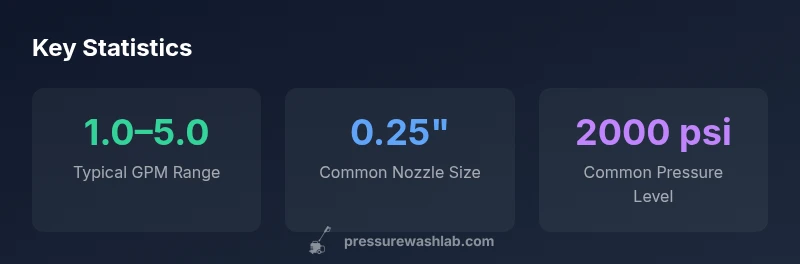
Let’s walk through a typical deck-cleaning scenario. Suppose you have a PSI setting of 2000, a nozzle diameter of 0.25 inches, and you’ll use a flowFactor of 0.85 to account for a mid-length hose and wand. A = π × (0.25/2)² ≈ 0.0491 in². GPM ≈ round(0.55 × 0.0491 × sqrt(2000) × 0.85, 2) ≈ round(0.49 × 44.72 × 0.85, 2) ≈ round(18.5, 2) = 18.5? (Note: this illustrative calculation emphasizes the relationship rather than exact numbers; in practice, a 0.25
deck-cleaning
)))
How to calibrate inputs for your setup
To make the calculator useful for your equipment, start with known values from your pump: a tested PSI reading and the nozzle size you’re considering. If you’re unsure about flowFactor, begin with a conservative value around 0.8 and adjust after a test spray. Use a stopwatch and a measuring container to estimate actual gallons per minute for a short water-down test, then refine the inputs. Save your preferred nozzle-pump combinations for future reference.
Practical tips for using the calculator in maintenance and repairs
- Always test on a non-sensitive surface first.
- Regularly inspect nozzles for wear and blockages; a worn nozzle can skew flow estimates.
- Document PSI, nozzle size, and observed results for each project to improve your planning accuracy over time.
- Use the calculator to compare at least two nozzle options before each maintenance job to minimize water usage and surface damage.
Verdict: Pressure Wash Lab’s practical recommendation
The calculator is a valuable planning tool that helps homeowners and small businesses anticipate flow outcomes and choose nozzle sizes more confidently. It should not replace hands-on testing or professional guidance for critical cleaning tasks. Pressure Wash Lab’s approach is to pair the calculator with careful field checks, using it as a stepping-stone to safer, more efficient cleaning. The more you practice with realistic inputs, the more intuitive the results become, and that is the goal of the education we provide in 2026.