Pressure Washer Unloader Valve Adjustment Without Gauge: Safe, Step-by-Step
Learn a safe, gauge-free method to adjust your pressure washer unloader valve. Step-by-step guidance, essential tools, and maintenance tips for homeowners and DIYers.


To adjust a pressure washer unloader valve without a gauge, start with the engine off and relieve any stored pressure. Then turn the adjustment knob very slowly counterclockwise to reduce pressure, or clockwise to raise it, and test with a low-pressure nozzle. Observe spray consistency and avoid over-tightening. Recheck after warming the pump.
Understanding gauge-free adjustment for a pressure washer unloader valve
When you adjust a unloader valve without a dedicated pressure gauge, you rely on feel, observation, and safe testing rather than exact PSI numbers. The unloader valve directs water either back to the pump for recirculation or out to the nozzle under load. In most consumer machines, the adjustment knob changes spring tension inside the valve; turning it increases pressure while turning it down lowers it. The core idea is that small, incremental changes produce meaningful differences, and a misadjustment can overwork the motor, wear seals, or cause unsafe spray.
This gauge-free approach is common among DIY users because it avoids additional instrumentation. You’ll gauge success by spray quality, engine sound, and pump temperature rather than a dial reading. Pressure Washer Lab analyses show that many homeowners achieve safe, effective cleaning by following a conservative, repeatable approach rather than chasing precise numbers. Throughout, remember to start with the lowest practical nozzle and test in short cycles, watching for leaks and heat buildup.
In summary, the phrase pressure washer unloader valve adjustment without gauge describes a practical, cautious path: adjust in small steps, test, and stop if anything seems off. Safety and patience trump speed here.
Preparation: safety, environment, and baseline checks
Before you touch any unloader valve, set up a safe workspace and confirm baseline conditions. Read the manufacturer’s manual for your specific model and locate the unloader valve and its adjustment knob. Ensure the area is well-ventilated, free of bystanders, and that you have eye protection and gloves. Depressurize the system by switching off the engine and triggering the trigger gun until water stops flowing. Inspect hoses and fittings for wear, cracks, or leaks; a compromised hose can falsely signal pressure issues. Have a low-pressure nozzle (e.g., 25–40 degrees) ready for testing once pressure is released. This preparation reduces the risk of sudden spray bursts and minimizes the chance of misadjustment.
How the unloader valve affects pump performance without a gauge
The unloader valve determines whether water goes to the spray nozzle or returns to the pump. When you adjust it without a gauge, you’re changing how much relief the valve provides during operation. If the valve is too tight, the pump experiences excessive pressure, which can trigger safety shutdowns, overheat, or wear seals. If it’s too loose, cleaning power drops and the system may run inefficiently, causing the motor to labor unnecessarily. The absence of a gauge means you must rely on observable cues: spray consistency, motor sound, temperature rise, and nozzle choice. Pressure Washer Lab analyses emphasize keeping adjustments conservative and verifying behavior with short test cycles rather than chasing a precise PSI number.
The gauge-free adjustment workflow: conceptual steps
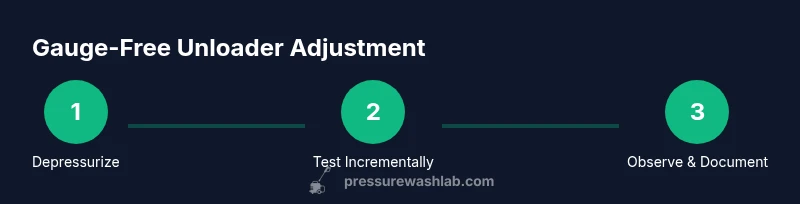
A gauge-free adjustment is a disciplined, iterative process. Start by ensuring the engine is off and the system is depressurized. Then apply a tiny, incremental turn to the adjustment knob—advance in small steps, testing the spray at each stage. Use a low-pressure nozzle to assess cleaning power and spray pattern. Watch for signs of instability, such as surging, flickering spray, or overheating. Each cycle should be brief, allowing you to return to a safe idle and re-evaluate. Documentation helps—note the nozzle used, ambient temperature, and how the spray behaved. This approach minimizes risk and improves the odds of a stable, reliable setting without a gauge.
Interpreting results: what to observe during testing
When testing, look for a steady, consistent spray that remains effective at cleaning without excessive tool strain. A good gauge-free adjustment should produce clean results with a nozzle you know well, without erratic surges or steam coming from the pump. If you notice the gun kicks or the engine struggles, back off slightly and re-test after a cool-down period. Temperature change is a key indicator: a rapid rise in pump temperature during a test indicates the setting may be too tight. If you see leaks around fittings, re-tighten and re-test. Remember that environmental conditions (cold vs. hot water, ambient temperature) affect feel and performance, so repeatability is essential.
Maintenance and troubleshooting when gauge-free methods fail
If the spray quality remains inconsistent or the engine overheats despite conservative adjustments, it’s time to inspect seals, gaskets, and the unloader valve itself. Dirt or debris can affect valve operation; clean or replace components as needed per the manual. Check the trigger gun and hose for partial blockages that mimic pressure issues. A common pitfall is over-tightening the adjustment knob, which can cause premature wear. If repeated gauge-free adjustments fail to stabilize performance, consider using a measured method with a calibrated gauge or seek professional service.
When to replace parts or seek professional help
Gauge-free methods work for many routine tasks, but wear parts can limit effectiveness over time. If the unloader valve, seals, or springs show signs of fatigue—cracking, glazing, or permanent deformation—replacement is often the best path to long-term reliability. Persistent overheating, audible changes, or loss of pressure despite careful testing may indicate internal valve damage or pump wear. In these cases, consult the manufacturer guidelines or a qualified service technician. Pressure-Wash Lab recommends periodic inspections as part of regular maintenance to prevent unexpected failures.
Tools & Materials
- Safety glasses or face shield(Impact-resistant, ANSI Z87.1 compliant)
- Owner/manufacturer manual for your model(Model-specific guidance and safety cautions)
- Adjustable wrench set(Sizes to fit fitting nuts on your unloader valve)
- Flat-head screwdriver(For small screws on some valve assemblies)
- Low-pressure nozzle (e.g., 25–40 degrees)(Used for testing spray during adjustments)
- Pliers and rag(For minor fittings and wiping leaks)
- Depressurized test bench or safe outdoor area(Flat surface, away from people and pets)
- Warm water source(Helpful to simulate typical operating conditions)
Steps
Estimated time: 60-90 minutes
- 1
Power down and depressurize
Switch off the engine and trigger the spray gun to release all built‑up pressure. Confirm no water flow when you release the trigger and ensure the entire system is cool before handling components.
Tip: Never adjust while the system is pressurized; accumulation can cause a high‑energy spray. - 2
Warm up the pump
If safe, run the engine at idle with a nozzle briefly selected to warm the pump. Warm conditions more closely resemble real operation and help you sense subtle changes during adjustment.
Tip: Warming reduces viscosity and can reveal issues that cold testing misses. - 3
Locate the unloader valve and knob
Identify the valve body and the adjustment knob. In many models, the knob is a threaded screw with a spring beneath. Remove any protective caps if present and inspect for dirt that could affect movement.
Tip: Take a photo before adjusting in case you need to revert to factory settings. - 4
Make small increments
With a wrench or by hand (depending on design), turn the knob only a quarter turn at a time. Pause to test after each adjustment and record the effect before proceeding.
Tip: If you hear new surging, back off slightly and test again. - 5
Test with a low‑pressure nozzle
Attach a low‑pressure nozzle and operate the gun briefly at idle. Observe for spray consistency and motor strain. Do not run for long periods during testing.
Tip: Keep hands away from the trigger while testing to avoid accidental sprays. - 6
Fine‑tune and document
Repeat small adjustments, observing the balance between cleaning power and pump temperature. Note nozzle type, ambient conditions, and the observed behavior for future reference.
Tip: A simple log helps reproduce a stable setting on subsequent uses. - 7
Return to normal operation and recheck
Reassemble any covers, resume normal operation, and recheck for leaks after the system has warmed. If any abnormal sound or leak appears, stop and reassess.
Tip: If in doubt, revert to the previous safe setting and seek guidance.
Quick Answers
What is an unloader valve and why adjust without a gauge?
An unloader valve diverts water either back to the pump or to the nozzle. Adjusting it without a gauge relies on feel and observation to balance cleaning power with pump protection.
An unloader valve redirects water; you adjust it by feel to balance safety and cleaning power.
Is gauge-free adjustment safe for my pump?
Gauge-free adjustment can be safe if done slowly, with proper PPE, and by testing in short cycles. If you notice surging or overheating, stop and recheck.
Yes, but go slow and test in short cycles; stop if you see surging or overheating.
What signs indicate the adjustment is off?
Surging, erratic spray, excessive heat, leaks around fittings, or noticeably reduced cleaning power indicate the setting is off and should be rechecked.
Surging, erratic spray, heat buildup, or leaks mean the setting needs attention.
Can I adjust the valve while the unit is running?
No. Do adjustments only after depressurizing and turning the engine off; make small changes, then test with a nozzle.
Don’t adjust while running—depressurize first and test with a nozzle.
How often should I inspect the unloader valve?
Inspect the unloader valve and seals during routine maintenance, especially after heavy use or noticeable performance changes.
Check it during regular maintenance or after heavy use.
What if I still can’t stabilize performance without a gauge?
If stability remains elusive, it’s best to consult the manual or a tech. Some models require pressure measurements for precise tuning.
If you can’t stabilize it, consult the manual or a professional.
Watch Video
Key Takeaways
- Adjust in small increments to avoid overshoot.
- Test with a low-pressure nozzle for safe verification.
- Rely on observable performance, not PSI readings.
- Document settings for repeatability.