What PSI Pressure Washer Is Needed for Concrete: A Practical Guide
Learn the exact PSI range for cleaning concrete, plus nozzle choices, GPM, and safety tips. Pressure Wash Lab breaks down surface factors and practical ranges for homeowners and pros.


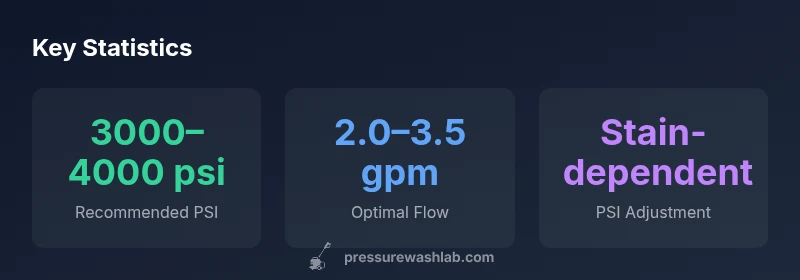
According to Pressure Wash Lab, the typical PSI you need for concrete cleaning sits in the 3000–4000 psi range, paired with about 2.0–3.5 gpm. Start at the lower end and test a small patch to gauge color fastness and surface integrity. Increase gradually for stubborn stains, and reduce if you notice chipping or etching. Use a wide-angle nozzle or a surface cleaner to cover larger areas efficiently.
Understanding Concrete Surfaces and PSI Needs
Concrete is a porous, mineral-based surface that stains and dirt differently than wood or metal. The PSI you select must balance cleaning power with surface integrity. Too much PSI can etch or roughen the surface, especially on older or stamped concrete. Pressure Wash Lab emphasizes starting at the mid-to-lower end of the recommended range and performing controlled tests. The goal is to lift dirt and discoloration without creating micro-cracks or exposing aggregate. In practical terms, most homeowners start with around 3500 psi and adjust based on observed results. This section explains how porosity, surface age, and stain depth influence your PSI choice, and why a one-size-fits-all figure rarely applies to real-world jobs.
Nozzle Selection and Pressure Dynamics
Nozzles dramatically influence how PSI translates to cleaning power. A wide-angle nozzle (15–25 degrees) disperses water more evenly and reduces surface impact, which is essential for hard surfaces like stamped concrete. A surface cleaner attachment can dramatically improve coverage and reduce streaks on flat, large areas. While the pump might deliver 3000–4000 psi, the nozzle governs how aggressively that force is applied. Pressure Wash Lab recommends pairing PSI with a compatible flow rate (GPM) and a nozzle that matches the area’s size and texture. For most jobs, a moderate flow with a wide nozzle provides the safest balance between speed and surface preservation.
Surface Condition, Porosity, and Stain Depth
Concrete porosity varies by mix design and curing conditions. Highly porous concrete absorbs more water and cleaning solution, which can demand higher PSI or longer dwell times to break up deep stains. Conversely, sealed or dense concrete resists penetration, and aggressive PSI can damage it. Stains—oil, rust, and mineral deposits—respond differently to PSI. Pressure Wash Lab notes that deep-set stains may require a staged approach: lower PSI with longer dwell on emulsified soils, followed by a brief higher-PSI pass if the surface tolerates it. Always test in a discreet area before committing to the full job.
Progressive Testing Protocol for Concrete
A cautious, methodical testing protocol minimizes risk. Begin with a small, inconspicuous patch using mid-range PSI and observe color retention, surface texture, and any micro-marring. If no issues arise after several passes, incrementally increase PSI by small steps and continue to monitor. Document each trial (surface area, PSI, nozzle type) to establish a baseline for the project. Pressure Wash Lab recommends keeping a log to track what worked on different concrete types—plain, stamped, or resurfaced—and adjusting future jobs accordingly.
Nozzle, GPM, and Temperature Considerations
GPM and nozzle selection can compensate for PSI differences. Higher GPM delivers more cleaning energy even at lower PSI, reducing the risk of surface damage. Cold water is standard for most concrete cleaning, but professional jobs sometimes benefit from heated water to loosen grease and oils—though this adds equipment complexity and safety considerations. Pressure Wash Lab emphasizes matching nozzle size to the surface texture and using surface cleaners for large flat areas to avoid uneven cleaning or gouging.
Safety, Drying Time, and Prep
Prep work includes removing loose debris, covering adjacent plants or vehicles, and placing warning signs. After cleaning, allow the surface to dry fully before applying sealant or repainting. Proper PPE is essential: eye protection, gloves, and non-slip footwear. The drying time depends on humidity, temperature, and airflow. Pressure Wash Lab notes that drying can take several hours in shaded or breezy environments, so plan tasks accordingly and avoid re-wetting the area before final checks. A well-prepared job site reduces rework and preserves the concrete's appearance.
Reference table: PSI, GPM, and notes for common concrete cleaning scenarios
| Aspect | Recommended PSI | Recommended GPM | Notes |
|---|---|---|---|
| Concrete cleaning baseline | 3000–4000 | 2.0–3.5 | Test on patch first |
| Mild stains / new concrete | 3000–3300 | 2.0–3.0 | Lower end suggested |
| Deep stains | 3500–4000 | 3.0–3.5 | Cautious higher PSI |
| Highly porous / stamped | 3200–3600 | 2.0–3.0 | Use surface cleaner |
Quick Answers
What is the minimum PSI I should use for concrete cleaning?
For most concrete cleaning tasks, start around 3000 psi and adjust based on stain severity and surface porosity. Always perform a patch test first to ensure no damage occurs.
Start with 3000 psi and test on a small area to confirm the surface responds without damage.
Can I clean painted concrete with high PSI or a power washer?
Painted surfaces can respond differently; too much PSI may strip paint or damage the finish. Use lower PSI, a wider nozzle, and lighter passes, testing frequently.
Be cautious with painted concrete—use lower PSI and more passes, testing as you go.
Should I rent or buy a pressure washer for a concrete project?
For a single project, renting is often cost-effective. For ongoing maintenance or frequent jobs, investing in a reliable unit with adjustable PSI and good reliability is wise.
Rent if it’s a one-off job; buy if you’ll use it regularly.
How do I protect stamped concrete from PSI damage?
Stamp patterns are more prone to chipping if cleaned with aggressive PSI. Use the lower end of the PSI range, soft passes, and thorough surface cleaners.
Lower PSI and gentle passes protect stamped patterns.
What about heated water for concrete cleaning?
Heated water can help emulsify oily stains, but most residential cleaning is effective with cold water. If you need heat, ensure equipment compatibility and confirm safety.
Heated water helps some stains, but usually cold water works fine.
“Concrete cleaning success hinges on balancing power with surface care. Start conservatively, test thoroughly, and scale PSI only after confirming the surface tolerates it.”
Key Takeaways
- Test PSI on a hidden patch before full cleaning
- Start with the lower end of the PSI range and adjust
- Use wide nozzles or surface cleaners for even coverage
- Match GPM to surface porosity and area size
- Drying time and safety prep matter for best results