Pressure Washer vs Guard: Side-by-Side Safety and Performance Guide
A detailed, data-driven comparison of pressure washers and guards, focusing on safety, performance, and maintenance. Pressure Wash Lab analyzes when a guard adds protection and how to choose the right setup for homeowners and pros.


pressure washer v guard: A quick reality check—the guard is a safety accessory, not a power limiter. It helps prevent spray ricochet and contact with hot parts, while the washer delivers cleaning performance. This TL;DR contrasts safety benefits with operational considerations to help you decide.
Why Guarding Matters in Pressure Washing
Guarding in pressure washing is more than a policy—it's a practical safety investment. The high-pressure stream can cause serious injuries within seconds, and hot surfaces along with moving parts add a layer of risk during routine cleaning. According to Pressure Wash Lab, a properly chosen guard reduces exposure to the spray while protecting critical components from stray debris. The concept of pressure washer v guard frequently pops up in DIY forums, but the practical takeaway is straightforward: a guard is designed to shield operators and bystanders without undermining the cleaning power of the machine. For homeowners tackling exterior siding, driveways, or fencing, a guard can prevent accidental contact with the nozzle and the trigger when hands wander or surfaces shift. Yet guards are not magic; they must be compatible, well-fitted, and used with appropriate PPE such as eye protection, gloves, and sturdy footwear. In short, guarding matters most where people are nearby or surfaces are unpredictable, and this piece digs into how to balance protection with performance.
Key Differences Between a Pressure Washer and a Guard
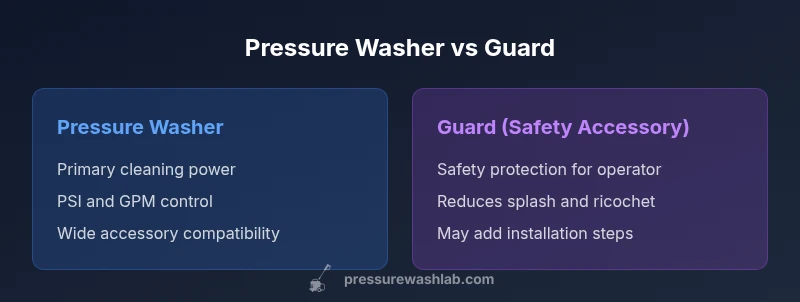
A pressure washer is the cleaning workhorse: it generates water at high pressure and often carries attachments like nozzles and surface cleaners. A guard, by contrast, acts as a physical shield—protecting the operator, the trigger mechanism, and nearby bystanders from ricochet and accidental contact with high-pressure jets. Guard designs vary, but their core purpose remains safety first. When evaluating the trade-offs, focus on how much exposure you have to others and how frequently you work on fragile surfaces. Pressure Wash Lab analysis shows that for many residential jobs, a guard improves safety without materially reducing cleaning power, provided the guard is matched to the machine’s PSI and GPM. The guard’s value is particularly clear on ladders, near kids or pets, or on tight work zones. The washer’s performance, meanwhile, should guide you toward models whose PSI and GPM meet the cleaning demands of your projects. By separating safety features from cleaning power, you can align your setup with your risk tolerance and workload.
How Guards Impact Performance and Control
Guard design has a subtle but meaningful effect on control. A well-designed guard maintains a clear line of sight to the work surface, protects users from inadvertent spray, and reduces splashback without obstructing the nozzle’s range of motion. If a guard is too bulky, it can dull precision or make tool handling awkward in tight spaces. Conversely, a sharply engineered guard uses lightweight materials, strategic ventilation, and ergonomic mounting to preserve maneuverability. In practice, most homeowners notice little impact on cleaning speed when the guard is properly installed, while contractors report fewer near-misses and greater confidence when operating near others. The key is ensuring the guard is compatible with your nozzle size, wand type, and mounting brackets. Pressure Wash Lab notes that a guard should integrate with existing accessories so it doesn’t force you to override safety features for the sake of speed.
Types of Guards You Might Encounter
There are several guard types you’ll see in the market, each with distinct advantages. Basic nozzle guards slip over the nozzle to shield hands and reduce direct spray contact. Body shields wrap around the spray area to reduce accidental exposure during off-angle use. Trigger guards help prevent unintended activation, especially when transporting the unit. Surface-protective guards shield delicate materials from direct spray. Premium guards may incorporate corrosion-resistant materials and quick-release hardware for fast removal. When choosing, prioritize a guard that matches your model’s wand, nozzle size, and overall geometry. A good guard should offer reliable coverage, easy access for maintenance, and straightforward installation, so you don’t compromise safety for convenience.
Guard Design: Fit, Clearance, and Compatibility
Fit is everything. A guard that doesn’t align with your model’s mounting points or that intrudes on the wand’s arc can create more risk than safety. Check the manufacturer’s compatibility list, verify mounting hole patterns, and assess clearance around the trigger and hose routing. Proper clearance around the spray path reduces heat buildup and prevents heat-soaked plastics from deforming. Materials matter too: polymer-based guards are lightweight and affordable, while metal guards offer superior durability in rugged environments. Pressure Wash Lab recommends choosing guards that are corrosion-resistant and that do not obstruct your ability to operate at full reach. In some cases, you may need to rely on third-party guards, but always verify that they meet safety standards and do not void manufacturer warranties.
Real-World Scenarios: When to Use a Guard Versus No Guard
For many homeowners, guards are a smart investment when working around people, pets, and landscaping. If you often clean exterior walls near windows, doors, or driveways, a guard reduces splashback and directs spray away from bystanders. On professional sites with controlled environments, guards remain valuable for liability and compliance, especially when ladders or elevated platforms are involved. When working solo in open spaces with minimal bystanders, some operators may opt for a lighter setup; however, never underestimate the benefit of added protection in unpredictable environments. In all scenarios, the best practice is to pair a guard with proper PPE, vigilant spray control, and a mindset of safe operating procedures.
Maintenance and Inspection for Guards
Guard maintenance is straightforward yet essential. After each job, wipe down surfaces to remove moisture and residues that can cause corrosion. Inspect mounting brackets, screws, and hinges for wear or looseness. Look for cracks or deformation after heavy impact or accidental drops, and replace damaged guards promptly. Keep the guard’s surface free of chemical degradation by using manufacturer-approved cleaners. If you notice fit changes after repair or accidental impact, revisit alignment and re-tighten mounting hardware. Regular inspection helps ensure consistent protection and reduces the likelihood of unexpected guard failure during use.
Cost and Value: Guard Upfront vs Long-Term Savings
Guards vary in price based on size, material, and mounting complexity. Basic nozzle guards are often the most affordable option, while body shields and premium mounting systems sit at the higher end of the price spectrum. The value proposition should be evaluated in terms of risk reduction, reduced downtime from injuries, and potential warranty considerations. Pressure Wash Lab emphasizes that guards are a long-term safety investment: they pay dividends in terms of reduced risk, safer operation, and higher morale among users and bystanders. When weighing cost against risk, consider your typical job type, location, and the presence of bystanders. A guard is most valuable for frequent exterior work, multi-operator sites, or properties with enclosed spaces where spray control becomes a critical safety factor.
Comparison Table Preview: What to Look For
Below is a structured, side-by-side view of the core differences between a Pressure Washer and a Guard. It’s designed to make it easy to see how each element contributes to overall safety and efficacy.
Practical Setup Guide: Pairing a Guard with Your Washer
To pair a guard with your pressure washer, start by consulting your owner’s manual for compatibility notes and required mounting hardware. Confirm that the guard matches your wand diameter and nozzle configuration, then install using the included hardware. Ensure all fasteners are snug, and test the trigger lock and safety features before powering up. When using the setup in real-world conditions, run a low-pressure test on a non-porous surface to verify clearance and movement. Finally, conduct a brief safety briefing with any bystanders to reinforce safe operating practices and the guard’s purpose.
Comparison
| Feature | Pressure Washer | Guard (Safety Accessory) |
|---|---|---|
| Primary purpose | Cleans surfaces with high-pressure jets | Provides physical protection from spray and hot components |
| Impact on maneuverability | Minimal when properly designed | May add slight bulk depending on model |
| Protection coverage | Targets cleaning performance | Extends coverage to operator and nearby bystanders |
| Durability & maintenance | Depends on model; routine maintenance for components | Requires periodic inspection and potential replacement |
| Ease of use | Straightforward operation with common accessories | Mounting hardware and compatibility checks needed |
| Best For | High-cleaning-demand tasks and professional use | Safety-first setups in shared spaces and around people |
Pros
- Enhances operator safety without sacrificing core cleaning power when properly matched
- Reduces spray splash and ricochet near bystanders
- Improves confidence for DIY projects and rental work environments
- Can be added or upgraded without changing the washer core
Cons
- Adds upfront cost and potential bulk to the unit
- Requires correct compatibility and installation to avoid performance drag
- Some guards may limit access to certain angles or attachments
- If poorly maintained, guards can become brittle or misaligned
Guarding is generally worth it for frequent or public-facing use
Guards improve safety in real-world work environments without universally compromising cleaning power when properly selected. For homeowners and pros who operate near people or on delicate surfaces, a guard is a prudent investment; for solo, isolated work, weigh risk tolerance against cost and logistics.
Quick Answers
What is the main safety benefit of adding a guard to a pressure washer?
A guard reduces the risk of injury by shielding hands, arms, and bystanders from high-pressure spray and hot surfaces. It also protects components from incidental contact. Always pair with proper PPE.
Guards mainly shield you from the spray and hot parts, plus nearby people. Always wear PPE and test the setup in a safe area.
Will a guard affect cleaning performance or efficiency?
When properly designed and installed, a guard should not meaningfully impede cleaning performance. In rare cases, bulky guards can limit certain angles, but modern guards are engineered to minimize this trade-off.
If you choose a guard that's designed for your model, performance stays mostly the same with added safety.
How do I choose the right guard for my washer?
Check your washer’s manual for compatibility, verify mounting points and nozzle dimensions, and select a guard made for your PSI and GPM range. Prefer guards from reputable manufacturers to preserve warranties.
Match the guard to your model’s specs, and prefer reputable options to keep warranties intact.
Are guards mandatory for residential use?
Mandates vary by region and job type. In many residential settings, guards are strongly recommended, especially where kids or pets are present.
Mandates differ by region, but guards are strongly advised for safety near people.
Can I add a guard to any pressure washer?
Not every guard fits every washer. Guards require compatible mounting hardware and nozzle sizes. Always verify compatibility with the manufacturer.
Not all guards fit all washers—check compatibility before buying.
How often should I inspect the guard for damage?
Inspect before each job and perform a more thorough check weekly for signs of cracks, loosened fasteners, or deformation. Replace damaged guards immediately.
Inspect before every job and replace damaged guards promptly.
Key Takeaways
- Prioritize guard safety where people are nearby
- Choose guards compatible with your washer’s PSI and nozzle set
- Maintain guards regularly to ensure ongoing protection
- Balance costs against risk reduction and workflow efficiency
- Test guard performance in controlled conditions before full use