PSI Needed to Clean Concrete: Practical Guide
Learn the PSI needed to clean concrete with practical ranges for light to deep cleaning, plus technique tips, safety notes, and real-world scenarios from Pressure Wash Lab.


PSI needed to clean concrete generally ranges from 2000 to 4000 psi, with light surface cleaning at the low end and heavy stain removal at the high end. For sealant removal or deep grout staining, professionals often push toward 3000–4000 psi while using a surface cleaner and a fan spray. Always start on a test patch to avoid damage.
Understanding PSI and Concrete Cleaning
According to Pressure Wash Lab, selecting the right PSI is a balance between cleaning power and surface safety. The PSI needed to clean concrete is not a single fixed number; it depends on the concrete's condition, the type of stain, the presence of sealers, and the equipment used. In practice, most residential projects fall within a broad range, with light cleaning on the low end and aggressive stain removal on the high end. The goal is to maximize contaminant removal while minimizing surface damage, etching, or color fading. This understanding matters because a misjudged PSI can leave behind streaks, fail to lift embedded oil, or strip a finish. For DIYers, starting near the lower end of the range and observing the surface response is a safer path than leaping to the top end immediately. Pressure Wash Lab’s team emphasizes patch testing and gradual adjustment as essential steps in any concrete cleaning plan.
Factors that influence your PSI choice
PSI is not the only variable. Surface texture, stain type, presence of sealers, age of the concrete, and outdoor conditions all influence the optimal pressure. The nozzle you choose, the distance from the surface, and the use of a surface cleaner can dramatically affect perceived power. A rough broom-finish concrete accepts higher PSI with less likelihood of etching than a smooth, dense slab. If you are cleaning an exterior driveway, plan for runoff and potential staining of adjacent surfaces. If the surface has a coating or sealer, you may need to adjust PSI downward and rely more on agitation and longer dwell times for stubborn stains. Finally, always consider water demand and the capabilities of your equipment—overworking a machine or undervaluing the surface can lead to unnecessary damage.
PSI ranges by concrete condition
Concrete cleaning is rarely one-size-fits-all. Here are practical ranges you’ll encounter:
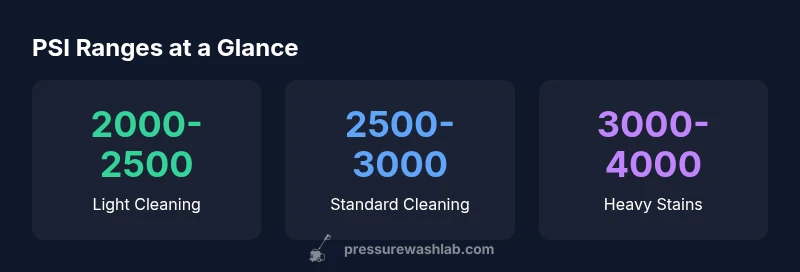
- Light cleaning: 2000-2500 psi – ideal for dust and light staining on rough surfaces.
- Standard cleaning: 2500-3000 psi – effective for general grime on patios and sidewalks when paired with a surface cleaner.
- Heavy staining: 3000-3500 psi – suitable for oil, mildew, and embedded dirt on porous concrete, with careful nozzle selection.
- Deep cleaning/coatings: 3500-4000 psi – used for coatings or sealers and deeply ingrained contaminants; often requires a slower pass and spot testing.
Equipment and technique that affect outcomes
The right tools amplify the PSI you can safely apply. A surface cleaner creates even cleaning and reduces streaks versus a wand. A 15° to 25° nozzle balances cleaning power and control; 0° is risky for most concrete and should be avoided on large surfaces unless you are highly skilled. Distance matters: keep the nozzle 8-12 inches from the surface for aggressive cleaning, or increase distance for delicate areas. For very tough stains, consider a brief chemical pretreatment in a well-ventilated area, followed by mechanical agitation with wash techniques. Always monitor the surface as you work; what starts as “okay” can quickly become etched if PSI is excessive.
Safety considerations and surface protection
Wear protective eyewear, gloves, and hearing protection when operating high-PSI equipment. Protect nearby plants and coatings by using shields or barriers, and avoid spray on windows or delicate landscaping. Keep pets and children away from the work zone. Some surfaces, especially old or unsealed concrete, are more prone to damage from high PSI. If you notice any powdering, color loss, or raised edges, reduce PSI immediately and re-evaluate technique. After cleaning, consider applying a sealant or repaving to extend the surface’s life and resistance to future staining.
PSI ranges by cleaning scenario
| Scenario | Recommended PSI | Notes |
|---|---|---|
| Light cleaning (minor stains) | 2000-2500 | Use 25° nozzle or surface cleaner; patch test |
| Standard cleaning (walkways, patios) | 2500-3000 | Opt for surface cleaner to reduce streaks |
| Heavy staining (oil, mildew) | 3000-3500 | Mind etching risk; monitor surface appearance |
| Deep stains / coatings | 3500-4000 | Consult pro; may require chemical pretreatment |
Quick Answers
What is the ideal PSI range for cleaning concrete?
The ideal range varies by surface condition and stain, but practical residential tasks typically fall between 2000 and 4000 psi. Begin at the low end and adjust upward after patch testing.
Start with a patch test and increase pressure gradually to avoid damage.
Can high PSI damage concrete?
Yes. Excessively high PSI can etch or erode concrete, especially on aged or unsealed surfaces. Use appropriate nozzles, keep some distance, and test first.
Yes—high pressure can harm concrete; test and proceed cautiously.
Should I use a surface cleaner for even results?
Yes. A surface cleaner helps produce flat, uniform cleaning and reduces streaking. Pair it with PSI within the recommended range for your surface.
Absolutely—surface cleaners give best results for even cleaning.
What nozzle angle is best for concrete?
A 15° to 25° nozzle is typically recommended for concrete cleaning. Avoid 0° on large areas unless you’re trained, and always patch-test first.
Start with a 15° or 25° nozzle and test.
Is there a safe PSI for sealed concrete?
Sealed concrete can resist cleaning better but still requires caution. Begin at the low end and test; sealing can alter surface hardness and cleaning efficiency.
Yes—test patches and go slowly with sealed surfaces.
“Choosing the right PSI is less about a single number and more about testing, observing surface response, and adjusting to the stain and texture.”
Key Takeaways
- Start with the lowest effective PSI and adjust upward
- Use a surface cleaner for even results
- Test on a small patch before treating the entire surface
- Consider stain severity, surface texture, and sealer status
- Follow safety guidelines to avoid surface damage