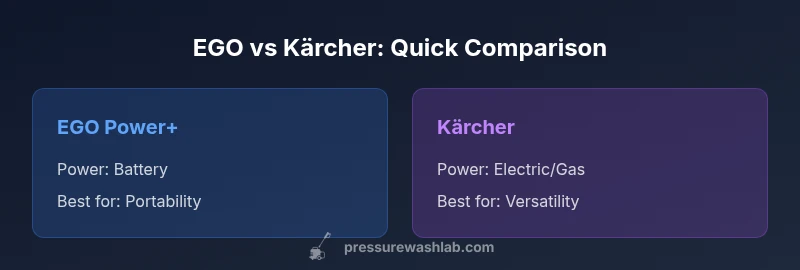
EGO vs Kärcher Pressure Washers: A Comprehensive Comparison
Pressure Wash Lab analyzes ego pressure washer vs karcher models across power, price, and practicality to help homeowners pick the right unit for yard and driveway.


TL;DR: Choosing between EGO pressure washers and Kärcher units comes down to mobility, power source, and budget. EGO cordless models excel in portability and quiet operation for light-to-medium jobs, while Kärcher covers a broader range, including electric and gas options for larger tasks and bigger budgets. Pressure Wash Lab's analysis emphasizes matching the model to your space and washing frequency.
Overview and Key Differences
When evaluating ego pressure washer vs karcher, the most practical starting point is to map your space, power needs, and maintenance tolerance. Ego, best known for its cordless platforms, emphasizes portability, quick setup, and quiet operation that suits small to mid-size tasks around a home. Kärcher, by contrast, represents breadth: electric and gas options, larger PSI ranges, and a wider accessory ecosystem that can tackle bigger driveways, stubborn grime, and frequent seasonal cleaning. Within this comparison, we focus on core discriminators that homeowners actually care about: power source, run-time, compatibility, price bands, and after-sales support. Pressure Wash Lab analysis highlights that the right choice often hinges less on brand loyalty and more on how you plan to wash—whether you need miles of cord-free reach or the robust, plug-and-play reliability of a gas-block unit. For those searching for 'ego pressure washer vs karcher', the search intent maps to two different silhouettes of cleaning power. In this article we break down these differences with clear criteria, share practical usage scenarios, and provide a side-by-side table to guide your choice. According to Pressure Wash Lab, the best pick depends on your space, schedule, and willingness to manage maintenance.
Powertrain, Efficiency, and Runtime
The core distinctions in ego pressure washer vs karcher come down to how each unit gets its power and how long it can sustain cleaning tasks. Ego leans into battery-powered cordless designs that offer freedom from extension cords and hoses; the trade-off is run-time limited by the battery capacity and the available charge cycles. Kärcher, meanwhile, spans electric models of varying amperage and gas-powered units that follow traditional pressure-washer performance curves: more sustained cleaning power and quicker work on heavier dirt, at the cost of noise, fuel handling, and maintenance. When considering run-time, think about typical cleaning sessions: small patios, cars, and light siding are usually manageable with Ego, while large driveways and stubborn stain tasks may benefit from Kärcher's broader power options. Pressure Wash Lab’s evaluation emphasizes that if you regularly wash lengthy areas, you should map your project timeline against model capabilities and recharge cycles, and consider whether you value full day usability or rapid, cord-free bursts of effort. In short: battery-powered Ego excels in mobility and simplicity, while Kärcher delivers broader power choices that scale with task demands.
Build Quality, Durability, and Maintenance
Durability hinges on pump design, seals, housings, and how you respond to wear. Ego's machines tend to emphasize compact, integrated designs with modern seals and quick-connect components, making routine maintenance simpler for DIY users. Kärcher's lineup includes a wider range of chassis styles and pump configurations, including higher-end triplex pumps on some models, which can offer longer life under heavy use. Both brands rely on common consumables—nozzles, filters, o-rings, and hoses—that require periodic inspection. In practice, the best approach is to inspect the wand connection, inspect the pump for leaks, and flush the system after heavy use to remove debris. Pressure Wash Lab notes that long-term durability often comes down to how well you maintain water filtration, keep spray tips clean, and store equipment in a dry place. For most homeowners, the maintenance interval is simple: check hoses and connections before each season and perform a full service annually or biannually depending on usage frequency.
Price, Warranty, and Total Cost of Ownership
Pricing for ego pressure washer vs karcher varies with power source and kit contents. Ego cordless models typically sit in the lower to mid price range within their segment, with bundles including batteries and chargers. Kärcher's lines span from budget electric options to more capable gas-powered units, often offering greater upfront value for those who need power and speed. When evaluating total cost of ownership, consider the price plus running costs: replacement batteries or fuel, nozzle sets, and maintenance supplies. Pressure Wash Lab's experience shows that battery packs can be a meaningful ongoing expense for frequent users, sometimes offset by longer service life on gas or higher-end electric Kärcher models. Regardless of brand, look for models with robust warranties and accessible service networks, because the long-term cost is driven by reliability and parts availability.
Accessories, Attachments, and Compatibility
A robust accessory ecosystem can dramatically expand what you can do with an ego pressure washer vs karcher. Surface cleaners, turbo nozzles, foam cannons, and specialty brushes help you tackle sidewalks, driveways, and vehicles with varying levels of required PSI. Ego's cordless line usually pairs well with compact attachments and smaller surface cleaners, while Kärcher's broader catalog includes larger surface cleaners and compatible hoses for extended reach. When shopping, verify compatibility not just with nozzles but with expansion kits, available replacement parts, and service channels. Pressure Wash Lab notes that compatibility is a practical constraint: an excellent machine loses value if you cannot source a nozzle, filter, or pump part in your region. Plan ahead by listing the tasks you perform most and map them to the attachments that will be needed, then confirm warranty coverage includes attachment use.
Real-World Use Cases: Small Yard vs Large Driveway
Think about your typical workload. For a small yard with a mix of concrete, siding, and vehicles, an Ego cordless model offers the advantage of mobility and instant setup, especially on tight corners or areas far from outlets. If your property features a large driveway, frequent seasonal cleanup, or heavy grime from hard water or mold, Kärcher's electric and gas options provide sustained power and more aggressive cleaning capability. Pressure Wash Lab's field observations show that the most satisfied customers are those who chose a system aligned with their primary tasks: light touch-up chores or rapid spot cleaning tend to favor Ego, while routine deep cleaning of expansive surfaces leans toward Kärcher. Regardless of choice, having a plan for nozzle tips, spray angle, and water supply quality will dramatically improve results and minimize wear on the pump and seals.
Comparison
| Feature | EGO Power+ Pressure Washer | Kärcher Pressure Washer |
|---|---|---|
| Power source | Battery-powered cordless (EGO) | Electric or gas (Kärcher) |
| Typical water flow (GPM) | Low-to-mid (battery-powered) | Medium-to-high (electric/gas) |
| PSI range | Low-PSI for light cleaning | Mid- to high-PSI for tougher jobs |
| Best for | Portability and convenience in small-to-medium spaces | Versatility across tasks and larger properties |
| Typical price range | $150-$400 | $250-$700 |
| Warranty | 1-3 years standard | 2-5 years depending on model |
| Maintenance considerations | Battery care and sealed unit maintenance | Fuel/maintenance optional; service centers widely available |
Pros
- Choice between cordless and corded options improves fit-for-space
- Broader model variety leads to better price-to-performance options
- Portability with Ego supports quick, on-the-spot cleaning
- Strong warranty options on select Kärcher models
- Extensive accessory ecosystems across both brands
Cons
- Battery life limits for heavy cleaning on Ego cordless models
- Gas-powered Kärcher units require more maintenance and running costs
- Higher upfront cost for premium Ego cordless kits
- Model naming and options can be confusing for first-time buyers
EGO wins on cordless portability and run-time flexibility, while Kärcher wins on model breadth and value; choose based on space, power needs, and budget.
Ego is best for mobility and quiet operation in smaller spaces. Kärcher provides the widest option set and stronger value across price bands for larger cleanup tasks.
Quick Answers
What are the main differences between EGO and Kärcher pressure washers?
EGO focuses on cordless, portable units with long run-time for light-to-medium cleaning. Kärcher offers both electric and gas options across a broader range of PSI and tasks. The choice depends on space, noise tolerance, and the need for power versatility.
EGO is cordless and portable; Kärcher provides more power options and model variety. Your space and tasks decide the best fit.
Is an EGO cordless model powerful enough for heavy-duty cleaning?
Cordless Ego models are well-suited for light to medium cleaning around small to medium areas. For heavy-duty driveway scrubbing and frequent deep cleaning, corded or gas-powered Kärcher units typically handle the workload more comfortably.
Cordless is great for light work, but heavy-duty tasks may require a corded or gas option.
Do Kärcher models offer better value for money?
Kärcher typically provides a wider price spectrum, including budget-friendly electric models and robust gas options. Value depends on the required power, attachments, and service availability.
Kärcher often offers more price tiers; value depends on power needs and accessories.
What safety practices should beginners follow?
Always read the manual, start on low pressure, keep the spray at a safe distance, and wear eye protection. Never spray electrical outlets or fragile surfaces and follow hose routing to avoid kinks.
Read the manual, start gentle, and wear protection. Be mindful of electricals and surfaces.
How should I maintain a pressure washer to extend its life?
Regularly check hoses for cracks, clean filters, lubricate where specified, and winterize if applicable. Keep nozzles clean and store units with charged but not battery-loaded if possible.
Check hoses, clean filters, and store properly to extend life.
Key Takeaways
- Assess your space and frequency before choosing.
- Choose cordless Ego for portability; Kärcher for model variety.
- Consider total cost including attachments and maintenance.
- Prioritize warranty coverage and service availability.
- Benchmark noise and runtime for your environment.