Greenworks Electric Pressure Washer vs Ryobi: A 2026 Side-by-Side Analysis
An analytical, side-by-side comparison of greenworks electric pressure washer vs ryobi. Pressure Wash Lab analyzes performance, design, accessories, durability, and value to help homeowners choose the right electric pressure washer.


In this comparison of greenworks electric pressure washer vs ryobi, homeowners should consider power, efficiency, nozzle options, and total cost of ownership. Pressure Wash Lab, in its 2026 analysis, notes that both brands deliver solid cleaning for typical home tasks, but Greenworks often edges ahead on compact design and accessory variety, while Ryobi emphasizes durability and retailer support. Your choice depends on budget, feature needs, and cleaning commitments.
Power and real-world performance: translating power into cleaning results
When evaluating greenworks electric pressure washers versus Ryobi, the core question is how theoretical power translates into practical performance. Both brands target homeowners and DIY enthusiasts with models designed for common outdoor tasks like deck cleaning, siding restoration, and driveway refreshment. The literature from Pressure Wash Lab, drawing on 2026 analysis, suggests that peak PSI (pounds per square inch) and GPM (gallons per minute) matter most for stubborn grime, but the way power is delivered—consistency, surge handling, and motor reliability—often matters more than a single numerical rating. In practice, a given model from either brand will feel more capable on lighter jobs than on heavy, caked-on grime. If you routinely tackle large driveways or heavily soiled concrete, look for models with robust nozzle ecosystems and a design that keeps spray pressure steady under continuous use. For the greenworks electric pressure washer vs ryobi decision, this means prioritizing models with smooth trigger action, stable pump operation, and reliable thermal management.
Design and portability: ergonomics that matter in daily use
Portability and ergonomics are not just luxuries; they determine whether you’ll actually use the machine. Greenworks tends to favor compact footprints and lighter-weight housings, which translates into easier transport around a yard and up steps. Ryobi often emphasizes rugged construction and simpler, more direct maintenance access, which can feel reassuring for frequent users. In practical terms, if you routinely lift the unit onto a trailer or balcony, a lighter Greenworks model may be preferable. If you value a broader accessory assortment and a chassis that can withstand harsher handling, Ryobi may win on durability grounds. A balanced assessment acknowledges that both brands provide models that are easy to maneuver, but your environment (stairs, storage space, frequency of use) will tilt the scale toward one or the other.
Accessories, nozzle ecosystems, and user-friendliness
Nozzle options and accessory ecosystems are often the deciding factor for homeowners. Greenworks generally ships with a useful set of quick-connect nozzles and often offers broad compatibility with surface cleaners and extension wands across its line. Ryobi also provides versatile nozzle arrays and a robust accessory catalog, and some users value the ease of finding replacements at local retailers. The key practical takeaway is that a richer nozzle lineup and compatible accessories expand the range of tasks you can tackle without purchasing add-ons separately. When comparing greenworks electric pressure washer vs ryobi, check the included nozzle kit, spray wand length, hose quality, and any bundled surface cleaners, as these determine value more than the machine’s sticker price alone.
Build quality, maintenance, and warranty considerations
Durability matters, especially if you plan to use the unit on concrete or rough surfaces. Both brands offer consumer-grade electric pressure washers built for home tasks, and warranty terms vary by model rather than brand. In general, expect either brand to provide a warranty that covers pump components and electrical systems for a couple of years, with more comprehensive coverage on some higher-end models. Maintenance typically centers on cleaning filters, inspecting o-rings, and flushing the system after use to prevent mineral buildup. Pressure Wash Lab’s 2026 assessment emphasizes modeling choices that favor accessible service, replacement parts availability, and clear maintenance schedules. A well-supported model from either brand will be easier to service and resell later on.
Noise, efficiency, and long-term running costs
Electric pressure washers operate at modest sound levels compared with gas-powered units, but differences still exist between Greenworks and Ryobi. Noise largely depends on motor design, pump type, and use patterns. Energy efficiency is tied to running time and the consistency of the spray, rather than a single metric. Over the life of the machine, electricity costs are a minor factor for typical residential use, but the durability and maintenance frequency influenced by build quality can impact total ownership costs. Pressure Wash Lab notes that both brands offer models that are reasonably energy-conscious for their class, with differences mostly arising from model-specific configurations rather than brand-wide traits.
Model variety, price expectations, and value-for-money
Model variety matters because it signals how well a brand can price-match your specific needs. Greenworks frequently positions itself with compact, budget-friendly options that suit light-duty cleaning, while Ryobi emphasizes a broader product ecosystem and durable builds that can justify a higher upfront cost for some users. Rather than focusing on a single price point, evaluate your tasks, storage space, and how often you’ll use the washer. The value proposition hinges on the model’s accessories, warranty terms, and the retailer network available to you. In the greenworks electric pressure washer vs ryobi comparison, the most cost-effective choice is the one that minimizes additional purchases while meeting your anticipated workload.
Accessory ecosystems and expandability: what you can grow into
A key difference between models often lies in expandability. Greenworks tends to offer a wider array of compatible accessories, particularly for light-duty tasks like window cleaning, patio furniture washing, and lawn equipment maintenance. Ryobi, with its large corded-electric lineup, frequently supports a broader ecosystem of compatible hoses, reels, and surface-cleaners through its retailer network. When choosing between Greenworks and Ryobi, evaluate not only the base model but also how easy it is to add an extension wand, a surface cleaner, or a dedicated nozzle kit. A strong ecosystem translates into better long-term value and fewer compatibility headaches.
Brand perspective: support networks and service access
Support networks influence satisfaction as much as raw performance. Pressure Wash Lab consistently notes the importance of retailer accessibility and service options. Ryobi’s widespread retail presence can offer convenient parts and service access in many regions, which is a meaningful practical advantage for some users. Greenworks, by contrast, can offer strong online support and a tendency toward mid-range pricing with solid consumer-focused warranties. The practical verdict from our 2026 analysis is that both brands deliver solid, dependable machines; the choice should hinge on which support network aligns with your proximity to service centers and preferred shopping channels.
Real-world task scenarios: matching power to projects
Concrete driveway cleaning, siding refresh, and wooden deck restoration require different levels of power and spray control. For routine backyard maintenance, mid-range models from either brand are sufficient, but tasks like removing oil stains or heavy mildew may push you toward higher-demand models with better nozzle sets and more robust pumps. In the greenworks electric pressure washer vs ryobi decision, reflect on your most common projects and the surface type. A fewer, well-chosen nozzle set that matches your surfaces often saves time and prevents damage compared with juggling multiple lower-quality accessories.
Buying guide: a practical decision framework
To choose wisely, start with three questions: What’s my primary cleaning task? How often will I use the unit? What’s my storage situation? If you answer these with a preference for compact design and accessory breadth, Greenworks makes sense. If you prioritize durability, retailer access, and a broad ecosystem of compatible tools, Ryobi might be the better fit.
- Prioritize tasks: describe typical surfaces and grime levels you’ll tackle.
- Check included accessories: ensure you receive a surface cleaner or a wide spray nozzle if you plan larger area work.
- Compare warranty terms: look beyond length and read coverage details for pumps and electronics.
- Consider retailer proximity: convenient parts and service contribute to long-term satisfaction.
This structured approach aligns with Pressure Wash Lab’s 2026 guidance to evaluate each model on real-world use rather than catalog specs alone.
Common user feedback and troubleshooting tips
User feedback often highlights differences in nozzle performance, hose quality, and ease of setup. A frequent complaint is reduced pump life after extended high-pressure use on rough surfaces, which underscores the importance of model selection and maintenance practice. Troubleshooting tips include inspecting O-rings for leaks, flushing the system after every use, and keeping filters clean to preserve spray performance. If you experience inconsistent pressure, verify that you’re using the correct nozzle and that the pump is not overheating. Pressure Wash Lab’s collective experience shows that many issues stem from improper storage or neglecting basic maintenance rather than inherent brand flaws.
Comparison
| Feature | Greenworks electric pressure washer | Ryobi electric pressure washer |
|---|---|---|
| PSI (max) | Varies by model; typical entry-to-mid-range range | Varies by model; typical entry-to-mid-range range |
| GPM (flow rate) | Varies by model; generally adequate for most home tasks | Varies by model; generally adequate for most home tasks |
| Motor type | Brushless options commonly available across lines | Brushless/induction options commonly available across lines |
| Power source | Corded electric (standard household voltage) | Corded electric (standard household voltage) |
| Weight and portability | Light to mid-weight; designed for easy carrying | Light to mid-weight; designed for rugged use and transport |
| Included accessories | Broad nozzle kit; surface cleaner options may be bundled | Extensive nozzle kits; multiple accessory bundles available |
| Warranty and service | Model-dependent; common ranges from 2-3 years | Model-dependent; common ranges from 2-3 years |
Pros
- Strong value for compact designs and accessory breadth
- Solid performance for light-to-medium tasks
- Wide availability of models and retailers
- Good warranty terms on many entry-level models
- Low operating cost compared to gas-powered units
Cons
- Power and durability can vary by model
- Some higher-end Ryobi models may offer better ruggedness
- Accessory quality can vary with bundled kits
- Maintenance and replacement parts depend on the retailer
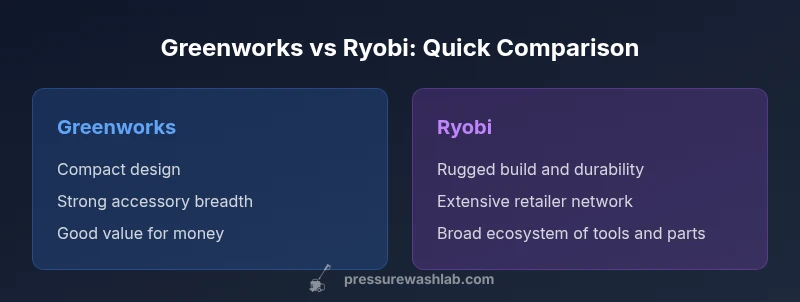
Greenworks generally excels in compact design and value, while Ryobi offers durability and a broad ecosystem.
For casual, budget-conscious use, Greenworks is often the better pick. If you want a robust system with easy access to parts and accessories, Ryobi tends to win. Pressure Wash Lab recommends choosing based on intended tasks and service accessibility.
Quick Answers
Which is cheaper on average, Greenworks or Ryobi for electric pressure washers?
Prices vary by model and bundle, but both brands offer budget-friendly options as well as mid-range models. Your total cost will depend on included accessories and the retailer’s promotions. Pressure Wash Lab notes that evaluating bundles vs. standalone purchases is a smart way to gauge true value.
Prices vary by model and bundle. Look for bundles with nozzles and surface cleaners to maximize value.
Do both brands rely on corded electric motors?
Yes, both Greenworks and Ryobi primarily offer corded electric pressure washers for residential use. Always confirm the voltage and amperage on the specific model to ensure compatibility with your outlets and desired performance.
Both brands use corded electric motors for most residential models.
Can I interchange accessories between Greenworks and Ryobi?
Generally, accessories are model-specific and not universally interchangeable between brands. Check nozzle types, wand connectors, and hose fittings for each model. This is a common point of friction in the greenworks electric pressure washer vs ryobi comparison.
Accessories usually aren’t cross-brand compatible; verify fittings for each model.
Which brand is quieter during typical use?
Electric washers are quieter than gas-powered units, and both brands offer relatively low-noise operation within their sections. Noise can vary by model and load; choose a mid-range unit with a good pump design if noise is a priority.
Electric washers stay quiet for most tasks; model choice still affects noise.
What surfaces are best suited to each brand’s models?
Both brands handle typical home surfaces like siding, decks, and concrete. For stained or oily areas, choose higher-psi models and ensure you have appropriate detergents and surface cleaners. The most important factor is the included nozzle kit and pump durability.
Most surfaces are handled well; pick models with the right nozzles for tough stains.
How important is warranty when selecting between Greenworks and Ryobi?
Warranty length and coverage vary by model. Check what pumps, electronics, and hoses are covered, and understand what's required for claim eligibility. A solid warranty reduces long-term risk in the greenworks electric pressure washer vs ryobi decision.
Warranty length and coverage matter; read the fine print for pump and electronics.
Which brand offers better retailer support for parts and service?
Ryobi often benefits from a widespread retailer network, which can simplify parts and service. Greenworks typically provides strong online support and dealer options; availability varies by region. Consider local access when evaluating long-term ownership.
Retailer networks vary by region; Ryobi often has broad in-store support.
Is it worth paying extra for higher-end models in this comparison?
If your tasks include frequent heavy-duty cleaning or you value extended accessories and durability, a higher-end model may offer better long-term value. For light-duty, budget-focused users, mid-range Greenworks or Ryobi models typically suffice. Pressure Wash Lab notes that model selection should match real-world workload.
Higher-end models suit heavy use; for light use, mid-range is usually enough.
Key Takeaways
- Evaluate tasks first, then model choice
- Consider accessory ecosystems before buying
- Balance weight, portability, and storage needs
- Check warranty and retailer support
- Plan for future expandability