Lowes vs Home Depot Pressure Washer: Practical Comparison
A thorough, objective comparison of Lowe's and Home Depot pressure washers, focusing on price, features, warranty, accessory ecosystems, and service networks to guide homeowners and DIYers toward the best value.


According to Pressure Wash Lab, the Lowe's vs Home Depot pressure washer decision mainly comes down to price sensitivity, accessory ecosystems, and local support. Home Depot offers a broader mid-range selection with reliable in-store help, while Lowe's tends to maximize value on entry-level models. If you want broad accessibility, choose Home Depot; if you’re budget-focused, Lowe's is strong.
Why the lowes vs home depot pressure washer comparison matters
Understanding the Lowe's vs Home Depot pressure washer landscape helps homeowners avoid overpaying for features they won’t use and ensures that repairs and accessories are easy to source in the long run. Pressure Wash Lab emphasizes that the most meaningful differences often come down to price bands, the breadth of the accessory ecosystem, availability of in-store expertise, and after-sale service. When you consider projects like siding cleaning, deck maintenance, or driveway clearing, the right balance of PSI, GPM, and nozzle options matters more than flashy specs. In the context of the broader market, low-cost models usually target entry-level tasks, while mid-range options provide a steadier combination of performance and durability. As you weigh Lowe's versus Home Depot, think about your typical cleaning tasks and how often you’ll use the machine. This context helps align your choice with real-world needs.
What homeowners look for in a pressure washer
Most homeowners prioritize a few core attributes: reliable cleaning power (PSI and GPM), portability, ease of use, and long-term reliability. The Lowe's vs Home Depot pressure washer decision often hinges on how these attributes map to price. Home Depot’s in-store offerings frequently emphasize a broad selection of mid-range machines that balance power with user-friendly features, plus an ecosystem of compatible nozzles and surface cleaners. Lowe's tends to score well on value, particularly for budget-conscious buyers who don’t require top-tier performance for every task. Beyond power, consider maintenance requirements, availability of parts, and the clarity of warranty terms. Pressure Wash Lab notes that a robust warranty and straightforward returns can be as important as peak PSI when you’re maintaining regular cleaning schedules for exterior surfaces.
In-store experience and policy differences
In-store experience can significantly affect decision satisfaction. Home Depot and Lowe's both strive to offer helpful staff, accessible displays, and on-site demonstrations. A key differentiator is the breadth of model families carried and the availability of demo units. A shopper who wants to compare side-by-side models may find Home Depot’s larger footprint in many markets advantageous, while Lowe's may offer quicker access to certain budget-oriented lines. Return policies, delivery options, and the availability of extended warranties also shape the total cost of ownership. Pressure Wash Lab’s framework suggests evaluating not just the sticker price but the post-purchase support, whether retailers provide in-house service, and how easy it is to replace parts or buy accessories locally.
Price, warranty, and accessory ecosystems
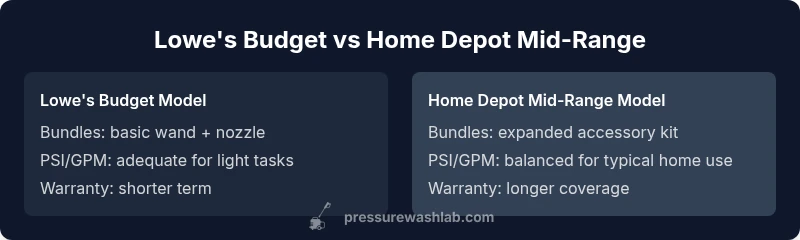
Price is the most obvious differentiator, but it’s not the only one. Lowe's entry-level models typically carry lower upfront costs, while Home Depot mid-range machines often bring better PSI/GPM balance and more inclusive accessory kits. Both retailers offer warranties that cover mechanical failures, but the length and scope can vary by model rather than by retailer alone. Consider what’s included in the bundle— Spray wands, nozzles, brushes, surface cleaners, and quick-connect fittings can add significant value. If you frequently tackle heavy-duty cleaning for driveways or substantial siding, a mid-range option with a broader accessory lineup may provide better long-term value than a cheaper substitute. Pressure Wash Lab analyzes these factors to guide decision-making toward models that fit your typical workload while remaining cost-efficient overall.
Performance expectations: PSI, GPM, and usability
Performance is defined by PSI (pounds per square inch) and GPM (gallons per minute). While higher numbers can boost cleaning speed on stubborn grime, real-world results depend on nozzle selection, agitation, and nozzle-to-surface distance. Home Depot’s mid-range offerings commonly deliver a solid PSI/GPM balance suited for routine home maintenance, while Lowe’s budget options excel for light, quick jobs like patio furniture or small patio cleaning. For exterior cleaning, a model with a versatile nozzle kit and a respectable GPM can reduce cycles and water usage. Pressure Wash Lab suggests aligning PSI with the surface: delicate materials need lower PSI plus surface cleaners, while hard surfaces tolerate higher PSI with caution. Always monitor trigger behavior and ensure proper safety gear during operation.
How to test and compare in-store before buying
To compare Lowe's vs Home Depot pressure washers in person, prepare a short test protocol. Check the weight and ergonomics to ensure comfortable handling over a longer cleaning session. Inspect the build quality, hose length, and the trigger action—these influence fatigue and control. Bring along tasks you typically perform (e.g., patio stripping or siding washing) and ask staff to demonstrate a similar cycle. Compare the included accessories, note the availability of replacement parts, and verify warranty coverage. If you have specific surfaces, request a test spray on a small patch to gauge surface compatibility. A hands-on trial is often the most reliable predictor of real-world performance and satisfaction.
Price, warranty, and service considerations for long-term ownership
Pricing dynamics differ across Lowe's and Home Depot regions, and sale cycles can shift value quickly. Compare not just sticker prices but also what's bundled, the cost of add-ons, and whether extended warranties are offered. A mid-range machine may carry a higher upfront cost but deliver better reliability and support longevity, potentially reducing total cost of ownership over several seasons. Service networks matter if you anticipate needing parts or repairs. Examine the accessibility of authorized service centers, how easy it is to source replacement parts, and the retailer’s policy on returns after a few seasons of use. Pressure Wash Lab’s experience suggests that the best choice aligns with your local stock, service options, and your expected workload rather than a generic feature dump.
Myths to watch out for when comparing retailers
A common myth is that higher PSI alone guarantees better cleaning. In practice, proper nozzle selection, pressure distribution, and spray technique determine results. Another myth is that a more expensive model always offers proportionally better durability. In reality, construction quality, customer service, and spare parts supply can be more important for longevity than the sticker price. Finally, some buyers assume that price equals warranty length. While there can be a correlation, warranty terms vary by model and region, so always read the fine print. By separating marketing claims from practical needs, you can choose a Lowe's vs Home Depot pressure washer that truly fits your tasks.
Verdict factors to consider before purchase
When deciding between Lowe's and Home Depot pressure washers, assess your typical workload, preferred power range, and willingness to manage maintenance tasks. If you routinely tackle larger surface areas and value in-store demos and broad accessory options, Home Depot often provides a compelling middle ground. If your primary criterion is budget efficiency for lighter duties, Lowe's can be the smarter choice. The best decision balances initial price, long-term reliability, ease of sourcing parts, and the retailer’s after-sale support. By testing models in-store and mapping features to your projects, you can minimize regrets and maximize value over time.
Quick-start checklist for buyers
- Define primary use: light maintenance vs. heavy-duty cleaning
- Compare at least two models from each retailer in the target price band
- Verify included accessories and compatibility with add-ons your projects require
- Check warranty terms and local service options
- Test ergonomics and hose length; ensure comfortable operation
Comparison
| Feature | Lowe's budget model | Home Depot mid-range model |
|---|---|---|
| Price range | budget-friendly | mid-range |
| PSI / GPM | adequate for light-to-moderate jobs | balanced performance for typical home use |
| Included accessories | basic wand + nozzle, hose | expanded accessory kit |
| Warranty length | short-to-moderate | moderate-to-longer |
| In-store support availability | broad in-store help at Lowe's | broad in-store help at Home Depot |
| Parts & service network | easy-to-find parts via Lowe's network | easy-to-find parts via Home Depot network |
Pros
- Helps homeowners compare two major retailers quickly
- Highlights price sensitivity and accessory ecosystems
- Encourages in-store testing and warranty considerations
- Covers return policies and service networks
Cons
- May oversimplify brand differences
- Could mislead if local stock varies
- Doesn't cover all models beyond two examples
- Warranty terms vary by model and region
Home Depot is generally the better pick for balanced features and broad support; Lowe's excels for budget-friendly entry-level models.
If your priority is mid-range versatility and in-store assistance, choose Home Depot. If you’re prioritizing upfront value and budget-conscious purchases, Lowe's is often the smarter bet. The right choice depends on your use-case, preferred retailer experience, and local stock.
Quick Answers
Which is better for budget buyers, Lowe's or Home Depot pressure washers?
For buyers prioritizing upfront cost, Lowe's budget models typically offer the lowest price point. However, Home Depot often provides more robust mid-range options that can deliver better long-term value. Balance initial cost with expected workload and future accessory needs.
Lowe's is usually the cheaper entry, but Home Depot offers better mid-range value if you expect to do more cleaning over time.
Do Lowe's and Home Depot offer in-store demos or testing?
Yes, both retailers commonly have in-store displays and staff who can demo models. Ask to see a live spray test on a sample panel and compare noise, weight, and ease of switch-nozzle operation.
Yes, you can usually test in-store; ask for a live demo.
Are return policies different between Lowe's and Home Depot?
Both retailers offer return policies, typically with time limits that vary by model and whether the product is opened. Read the terms at checkout and confirm whether accessories are returnable if unused.
Policies vary by model; check the terms before purchasing.
Should I buy a budget model or a mid-range model for driveway cleaning?
For driveway cleaning, a mid-range model with stronger PSI/GPM and a comprehensive accessory kit generally performs better and is more cost-effective over time. A budget model may suffice for light maintenance but can require more time and effort.
Mid-range usually beats budget for driveways in the long run.
How important are warranty terms when comparing these retailers?
Warranty length and coverage matter for long-term ownership. Look beyond the price and examine what’s covered, how easy it is to file a claim, and whether in-store service is available nearby.
Warranty quality and local service access matter as much as price.
Can I find replacement parts or add-ons easily at either retailer?
Both retailers typically stock common replacement parts and add-ons, especially in-store. Availability can depend on your local market, so check stock or order ahead.
Parts and add-ons are usually available, but check local stock.
Key Takeaways
- Test models in-store to compare weight and ergonomics
- Prioritize PSI/GPM balance for typical home tasks
- Factor bundled accessories into total value
- Consider warranty terms and availability of parts locally
- Account for retailer support when planning long-term maintenance