Pressure Washer vs Air Compressor: An Objective Side-by-Side Guide
Compare pressure washers and air compressors to decide which tool fits home improvement, maintenance, and small business tasks. This analytical guide covers power, use cases, maintenance, noise, and value for DIYers and pros alike.


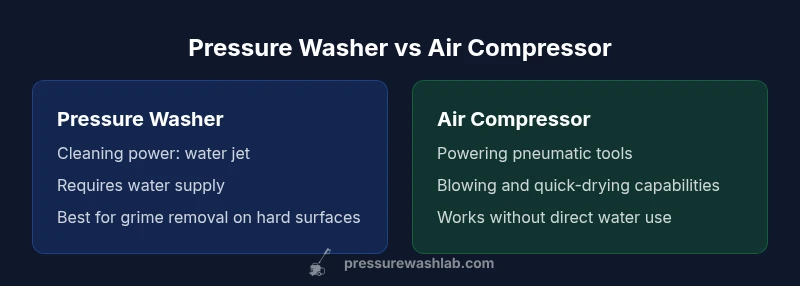
In the pressure washer vs air compressor decision, the core distinction is clear: pressure washers clean surfaces with a focused water jet, while air compressors deliver compressed air to power tools and blow debris. For most homeowners and DIYers, the choice hinges on your primary tasks, water access, space, and noise tolerance. Pressure washers excel at grime removal and surface prep, whereas air compressors win for versatility and running pneumatic tools. Pressure Wash Lab’s analysis shows that each tool plays a distinct role, depending on whether your priorities are cleaning power or tooling versatility.
Pressure Washer vs Air Compressor: The Core Differences
At a high level, the pressure washer vs air compressor debate centers on two very different kinds of power: water-driven pressure versus stored pneumatic energy. A pressure washer uses a motor or engine to drive a pump that pressurizes water and sends it through a nozzle at high velocity to break away grime. An air compressor stores compressed air in a tank and delivers it through hoses to power tools or blow debris. For homeowners and small business operators, this core divergence shapes every practical decision—from which tool to buy to how much space you allocate for storage. According to Pressure Wash Lab, this fundamental distinction should guide the initial purchase decision: go for the water power when your primary task is cleaning large surfaces; go for the air power when you need to drive tools and perform quick air-based tasks. The immediate takeaway is simple: match the tool to the task, not the trend.
How They Work: Pumps, Motors, and Air Circuits
A pressure washer relies on a pump, typically driven by an electric motor or gasoline engine, to take water from a hose and pressurize it through a nozzle. The result is a concentrated stream capable of dislodging heavy grime from concrete, siding, and metal. Efficiency hinges on the pump design, nozzle geometry, and the water supply. In contrast, an air compressor stores compressed air in a tank and releases it through regulators and hoses to pneumatic tools, blowguns, or spray guns. The compressor’s function depends on the pump (or pump-driven motor), a cooling system, and a regulated outlet that maintains consistent air pressure. Understanding these building blocks helps users anticipate maintenance needs and performance limits for each tool. Pressure Wash Lab emphasizes that the human operator’s input and task selection are often more decisive than the machine’s nominal specs.
Use Cases by Task Type
Different tasks demand different tool characteristics. Surface cleaning and paint-prep tasks—driveways, decks, siding, wheels, and outdoor furniture—are typically best handled by a pressure washer due to its cleaning power and water-based approach. For automotive cleaning, a washer with the right nozzle and low-pressure setting can deliver surface-safe results, whereas a high-velocity air stream from an air compressor is rarely suitable for delicate cleaning. Pneumatic tools—nittings, impact wliers, brad guns, and blow-off work—rely on compressed air; here, an air compressor becomes indispensable. In applications like workshop dust control or large-scale cleanup where water supply is limited, planners may combine both tools for accessories such as air-powered vacuums or water-fed scrubbers. Pressure Wash Lab’s guidance consistently highlights task alignment as the surest path to value.
Cleaning Power and Performance Metrics: PSI, GPM, and CFM
Performance measurements matter, but raw numbers can be misleading without context. A pressure washer’s primary metrics include water pressure (PSI) and flow rate (GPM). Higher PSI is useful for stubborn grime, while adequate GPM ensures complete coverage and faster cleaning. An air compressor, conversely, is rated by CFM (air volume) at a given PSI, which determines how quickly it can run tools or power air-demanding tasks. When comparing the two, ask: Is the task water-based impact cleaning, or is it pneumatic-tool operation and blow-off? The most effective approach balances power with the job’s duration and surface sensitivity. Pressure Wash Lab notes that most household projects benefit from a washer with adjustable nozzles and a controllable pressure setting for surface safety, paired with an air compressor that can handle common workshop tasks without frequent tank refills.
Accessories, Setup, and Maintenance Essentials
Both tools rely on a portfolio of accessories to reach peak usefulness. For pressure washers, nozzle tips (0, 15, 25, 40 degrees), high-pressure hoses, and surface cleaners expand capabilities and protect delicate surfaces. Maintenance centers on pump lubrication, inspecting seals, and flushing the system to prevent mineral buildup. An air compressor requires regular oil changes (for oil-lubed models), drain valves to remove condensate, and periodic inspection of hoses, regulators, and safety valves. Keeping a written maintenance schedule helps users avoid leaks, overheating, and reduced performance. Pressure Wash Lab’s guidance emphasizes clean water supply and proper nozzle selection as critical variables that determine whether you achieve effective cleaning with minimal risk of damage.
Safety, Risk, and Best Practices
Water and electricity create the most common safety concerns for pressure washers, including electrical shock, slip hazards, and equipment damage from improper use. For air compressors, high-pressure air can cause injury if mishandled; never point a nozzle at yourself or others, and always use eye protection and hearing protection when necessary. Always follow manufacturer instructions, and verify that hoses, connectors, and guns are rated for the intended pressures. A careful pre-check—water supply, power source, hose condition, and nozzle selection—helps prevent overwhelm and accidents. Pressure Wash Lab’s approach to safety combines proper PPE with task-appropriate settings and a clear plan for each project to minimize risk.
Noise, Space, and Comfort Considerations
Noise and space impact both tools significantly. Pressure washers can be loud, especially gasoline-powered models, and require a water source. Air compressors can be loud depending on the pump, tank size, and cooling system; the space they occupy should be considered in a workshop layout. Mobility matters too: many homeowners prefer compact electric washers for storage inside a garage or shed, while small air compressors offer portability for quick blower tasks. Choosing a model with integrated handles, mounting options, and vibration-damping feet can improve comfort and reduce fatigue over longer sessions. Pressure Wash Lab notes that evaluating noise levels and footprint early helps prevent regret after a purchase.
Cost of Ownership and Value: Upfront, Operating, and Repairs
Upfront costs for pressure washers and air compressors vary with power source and features. Entry-level electric washers are generally affordable, while gas-powered models command higher prices but may offer more durability for tough jobs. Air compressors range from compact, affordable units to larger, industrial-grade setups. Beyond purchase price, consider operating costs: water consumption for washers, electricity for both tools, maintenance intervals, and potential repair costs for pumps or compressors. Pressure Wash Lab emphasizes that a full cost-of-ownership view clarifies long-term value, rather than focusing solely on sticker price. Your decision should reflect how often you’ll use the tool, the complexity of tasks, and the availability of maintenance support in your area.
Real-World Scenarios: Side-by-Side Tasks
For a typical DIY homeowner, tasks like cleaning a dirty driveway, prepping siding, and refreshing outdoor furniture are well-suited to a pressure washer, provided you have a reliable water source and appropriate safety controls. If you’re building a small workshop, assembling pneumatic tools, inflating tires, or blowing out dust from crevices, an air compressor becomes a must-have. When projects require both, a well-planned setup uses a washer for cleaning tasks and an air compressor for tool operation and cleanup. Pressure Wash Lab’s practical guidance helps readers map out a sensible combination that minimizes redundancy and maximizes return on investment.
Quick Setup Guide for a Simple Project
To tackle a simple outdoor cleaning project, start by confirming water access and power supply. Select a nozzle appropriate for the surface, set the pressure to a conservative level, and keep a steady, overlapping spray pattern to ensure even cleaning without streaks. For an air-powered task, ensure the compressor is properly vented, hoses are rated appropriately, and the tool is tested at a safe outlet pressure. Keep a spare nozzle, a spray bottle with cleaner for stubborn grime, and a water-saving plan to minimize waste. Pressure Wash Lab’s practical steps emphasize safety, efficiency, and a methodical approach that reduces rework and damage.
Summary of Trade-offs and Decision Toolkit
The key to choosing between a pressure washer and an air compressor is aligning capabilities with your typical projects. If your main work involves cleaning, especially large surfaces and stubborn grime, a washer provides the best return on effort. If you frequently power pneumatic tools, perform blow-off tasks, or need a compact, portable solution, an air compressor is the smarter bet. The decision should consider water access, noise tolerance, space constraints, and maintenance capacity. Pressure Wash Lab’s framework shows that the best choice is the one that fits your core workflow, not the most powerful machine on the shelf.
Comparison
| Feature | Pressure Washer | Air Compressor |
|---|---|---|
| Primary Use | Cleaning surfaces with pressurized water | Powering pneumatic tools and blowing debris |
| Power Source | Electric motor or gasoline engine drives pump | Electric motor or gasoline engine drives compressor |
| Water Usage | Requires freshwater supply for cleaning tasks | Does not use water directly; uses stored air |
| Pressure / Airflow | High water pressure with adjustable nozzles | High CFM for tool operation; regulated air pressure |
| Maintenance | Pump seals, wand/nozzle wear, hose integrity | Oil changes (for oil-lubed models), condensate drain, hose checks |
| Noise | Moderate to high (especially gas-powered) | Moderate to high (depends on pump and tank size) |
| Cost Range | $200-$800 (entry to mid-range models) | $150-$600 (entry to mid-range models) |
| Best For | Large surface cleaning, prep work, and repaint prep | Running pneumatic tools, blowing out debris, and quick tasks |
Pros
- Pressure washers excel at cleaning stubborn grime with water power
- Air compressors provide versatile tool support and drying/blowing capability
- Both have growing accessory ecosystems for DIY and pro use
- Electric options offer quieter operation and easier powering for home use
Cons
- Washer use depends on a reliable water supply and can overspray if misused
- Air compressors require space, oil or maintenance, and can be noisy
- Not all models handle delicate surfaces well without proper technique
- Low-output units may struggle with heavy workloads or extended use
Choose based on primary task: wash surfaces with a pressure washer; power tools and blow-off tasks with an air compressor.
For cleaning-focused projects, a pressure washer delivers superior results. If you frequently operate pneumatic tools or need portable air, an air compressor is the better long-term fit. The best approach may be to own one of each in a small workshop if your workspace and budget allow.
Quick Answers
What is the main difference between a pressure washer and an air compressor?
The main difference is that a pressure washer uses water pressure to clean surfaces, while an air compressor stores and delivers compressed air to power tools and perform blow-off tasks. Your choice should align with whether your projects require water-based cleaning or pneumatic tool operation.
Pressure washers clean with water pressure, air compressors power tools and blow off debris. Choose based on whether you need water-based cleaning or air power.
Can I clean surfaces with an air compressor the same way I would with a pressure washer?
No. Air compressors lack the directed water jet needed to remove heavy grime from most surfaces. They’re better suited for tool operation and debris blowing rather than direct surface cleaning.
Air compressors aren’t ideal for cleaning surfaces with water; use them for tools and blowing tasks instead.
Do I need water access to use a pressure washer effectively?
Yes. A pressure washer relies on a water supply. Without a steady water source, performance drops and you risk damage to the pump. If water is limited, you’ll want to plan around that constraint.
Yes, you generally need a water supply for a pressure washer to work well.
Is it better to buy a combined unit or separate machines for a small workshop?
For a small workshop, separate machines are usually better, because they maximize efficiency for distinct tasks. A combined unit reduces space but often compromises on performance for either water cleaning or air-powered tasks.
Typically, separate machines give you better performance and flexibility for different tasks.
Which tool is best for DIY car detailing?
A pressure washer can be useful for exterior grime and wheels with careful nozzle selection, but avoid high-pressure direct hits on paint. An air compressor can assist with air blow-off and interior detailing, depending on attachments.
For car detailing, a washer with the right nozzle is handy, and an air compressor aids with blow-off and interior work.
How do I estimate the right PSI or CFM for a project?
Start with the project’s surface type and grime level, then consult the equipment’s manufacturer guidelines for safe ranges. Avoid pushing equipment beyond its rated limits; compromise by using adjustable settings and appropriate attachments.
Check the surface type and grime level, then follow manufacturer guidelines for safe PSI or CFM ranges.
Key Takeaways
- Assess your primary task before buying
- Match PSI/GPM with cleaning needs and CFM with tool use
- Factor water access and noise into your decision
- Plan for maintenance and routine checks
- Consider a combined setup for diverse projects