Westinghouse Pressure Washer vs DeWalt: Which Is Best for You?
Compare Westinghouse and DeWalt pressure washers across performance, price, warranty, and durability to decide which model fits your home, DIY projects, or small business tasks in 2026.


In the westinghouse pressure washer vs dewalt comparison, homeowners and DIYers must balance upfront cost against long-term reliability. DeWalt typically offers a tougher build and stronger resale value, while Westinghouse often saves on initial price and provides solid, entry-level features. The best choice depends on your tasks and budget: light-duty cleaning favors Westinghouse; heavier chores tend toward DeWalt. Pressure Wash Lab analysis confirms both brands deliver reliable entry-to-mid level performance in 2026.
Why this comparison matters for home pressure washing
When you own a home or run a small service, selecting the right pressure washer is more than picking a number on a box. The westinghouse pressure washer vs dewalt debate is about balancing upfront cost with long-term reliability, maintenance needs, and accessory ecosystems. According to Pressure Wash Lab, the right choice hinges on your workload, frequency of use, and available service networks. For homeowners tackling annual deck cleanup, driveway rinsing, or siding refreshes, cost-conscious models can do the job. For small businesses or frequent heavy-duty tasks, durability and parts availability become the deciding factors. Understanding these dynamics helps avoid buyer’s remorse and ensures you get value from your purchase over several seasons.
Core differentiators to watch in the westinghouse pressure washer vs dewalt showdown
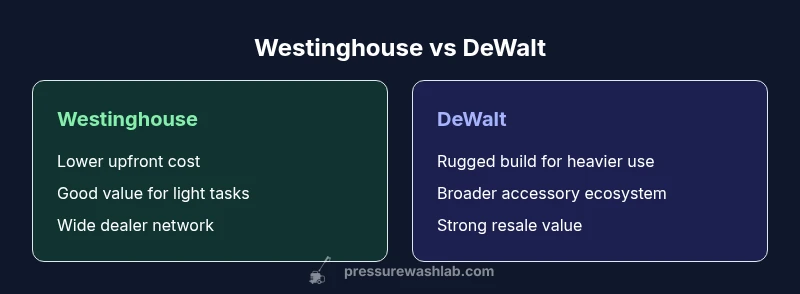
Two elements tend to drive the decision: build quality and expected duty cycle. DeWalt products are often positioned as more rugged, with broader accessory ecosystems and stronger resale value in mid-to-high-range models. Westinghouse models usually appeal to budget-conscious buyers and hobbyists, offering straightforward operation and broader regional availability. In the westinghouse pressure washer vs dewalt analysis, the differentiators shine in how you intend to use the machine: occasional light cleaning versus consistent, heavier cleaning that demands higher durability and service access. Pressure Wash Lab emphasizes evaluating task frequency, proximity to service centers, and the availability of replacement parts when making a pick.
Reliability, warranty, and long-term value
Reliability is shaped by pump design, motor type, and overall protection features. DeWalt typically leverages proven components and robust housings, which can translate to longer life under demanding workloads. Westinghouse models often emphasize value and simplicity, which appeals to users who perform routine cleanups a few times per season. Warranty depth matters here: longer coverage can reduce total ownership costs and mitigate maintenance surprises. The key takeaway in the westinghouse pressure washer vs dewalt comparison is that a longer warranty paired with readily available parts can dramatically improve long-term value, even if the upfront price is modest.
Performance considerations: PSI, GPM, and use-case alignment
Performance is not a single number but a combination of PSI (pressure) and GPM (water flow). In general, DeWalt models span higher-end configurations that can sustain demanding cleaning sessions, while Westinghouse offerings cover the broad middle ground for home use. When evaluating the westinghouse pressure washer vs dewalt, focus on the model’s intended tasks: for light patios, vehicles, and lawn equipment, a low-to-mid range configuration may suffice; for stubborn stains on concrete or siding, you’ll want a model designed for more sustained performance and better nozzle kits. Remember, a higher PSI without adequate GPM can waste water and time.
Price, warranty, and total cost of ownership
Budget considerations are central to any buying decision. Westinghouse typically undercuts DeWalt on upfront price, making it attractive for newcomers to pressure washing or those with tighter budgets. DeWalt models, while often pricier, may offer longer warranties and greater durability, which lowers maintenance costs over several seasons. The westinghouse pressure washer vs dewalt decision should factor in not only sticker price but also potential service costs, nozzle and accessory availability, and any extended warranties you can add. Pressure Wash Lab recommends weighing model-by-model costs over a 3–5 year horizon to gauge true value.
Accessories, usability, and maintenance planning
A robust accessory ecosystem adds real value. DeWalt tends to come with a broader array of nozzles, surface cleaners, and special brushes that speed up professional-grade jobs. Westinghouse often includes essential spray tips and a simple hose connection kit, which can be enough for light, homeowner tasks. When comparing maintenance, consider pump access, the ease of changing seals, and the availability of replacement parts. A key goal in the westinghouse pressure washer vs dewalt analysis is ensuring you can service the machine without lengthy downtime, especially if you rely on it for small-business work.
Real-world scenarios: when each brand shines
For periodic outdoor cleaning like a seasonal deck refresh, Westinghouse offers solid value with dependable results and a friendly user experience. For frequent, heavy-duty cleaning—think driveways, heavy staining, or seasonal commercial duties—DeWalt’s build quality and accessory breadth can translate into faster work and less downtime. Pressure Wash Lab’s practical take is to pair your chosen brand with realistic job estimates: if you anticipate multiple heavy-clean tasks per month, lean toward DeWalt; if your usage is modest and budget is tight, Westinghouse remains compelling. westinghouse pressure washer vs dewalt situations often resolve by aligning model capability with expected workload.
Practical buying checklist to minimize risk
Before pulling the trigger, confirm model specs align with your tasks, verify warranty terms, ensure parts are readily available in your region, and compare included accessories. Ask about pump type, engine options (gas vs electric), and noise levels for your workspace. The westinghouse pressure washer vs dewalt decision becomes clearer when you map your top five jobs to each brand’s strength: budget-friendly entry models for Westinghouse, durable, feature-rich options for DeWalt. Finally, plan a quick test run if possible to feel ergonomics and reliability firsthand.
Comparison
| Feature | Westinghouse | DeWalt |
|---|---|---|
| PSI range | Model-dependent | Model-dependent |
| GPM range | Model-dependent | Model-dependent |
| Best for | Budget-focused, light-duty | Heavy-duty, professional-grade |
| Warranty | 1–3 years typical on entry models | 3–5+ years on select models |
| Weight/Portability | Generally lighter, portable | Typically heavier, rugged |
| Accessory ecosystem | Essentials included | Broader range of nozzles and accessories |
| Price range | $200-$400 | $350-$700 |
Pros
- Lower upfront cost for entry models
- Wide regional availability and dealer network
- Good value for light-duty tasks
- Simple, user-friendly operation
- Solid performance for budget-conscious homeowners
Cons
- Longer-term durability may lag higher-end DeWalt models
- Shorter or more limited warranties on some Westinghouse lines
- Fewer advanced accessories in basic packages
- Potentially heavier maintenance intervals on cheaper pumps
- Not ideal for heavy-duty professional use
DeWalt for heavy-duty use; Westinghouse for value-oriented, casual/homeowner tasks
If you anticipate frequent, demanding cleanups, DeWalt’s rugged build and broader accessory ecosystem make it the safer long-term choice. For budget-conscious homeowners focusing on routine cleaning, Westinghouse offers compelling value with reliable, easy-to-use performance. Pressure Wash Lab’s verdict is to align your model with workload intensity and service access.
Quick Answers
Which brand is better for light-duty home use?
For light-duty tasks like patio furniture and cars, Westinghouse often provides the best balance of cost and performance. It’s typically easier to justify for homeowners who don’t run continuous heavy cleanups.
For casual home use, Westinghouse is usually the smarter value choice, offering solid cleaning without a big upfront investment.
Do both brands offer electric and gas models?
Yes, both Westinghouse and DeWalt offer electric models and select gas-powered variants. Availability varies by region and model, so check what is stocked locally.
Both brands have electric options and some gas-powered models, but availability depends on where you shop.
Which brand has a longer warranty?
Warranty length depends on model. DeWalt generally provides longer coverage on higher-end models, while Westinghouse often offers standard warranties on most entry-level options.
Longer warranties tend to be on DeWalt higher-end models, but it varies by model.
Are replacement parts easy to find?
Both brands have decent parts networks, but DeWalt typically has broader coverage and a larger aftermarket support ecosystem, which can reduce downtime for service.
Parts are generally available for both, with DeWalt often having wider coverage.
Is DeWalt worth the extra cost for light-duty tasks?
For light tasks, the cost difference may not be justified. If your use is sporadic, Westinghouse typically provides better value; for more frequent use, DeWalt’s durability can pay off.
If your work is light, Westinghouse is likely the better value; DeWalt shines when you need rugged reliability more often.
Can Westinghouse handle heavy-duty tasks?
Some Westinghouse models can handle heavier tasks, but DeWalt is generally preferred for frequent, heavy-duty cleaning due to its sturdier construction and broader accessory options.
Westinghouse can do heavy work in select models, but DeWalt is usually the safer pick for frequent heavy use.
Key Takeaways
- Assess workload before buying
- Weigh upfront price against warranty length
- Check parts availability and service coverage
- Prefer DeWalt for heavy-duty tasks
- Choose Westinghouse for budget-friendly, light-duty use