Difference Between Pressure Washer Tips: An In-Depth Comparison
Explore the difference between pressure washer tips and learn how to select the right nozzle for concrete, wood, siding, and more. Practical, safety-focused guidance for homeowners seeking effective, surface-friendly results.


Comprehensively, the difference between pressure washer tips comes down to spray angle, pattern, and intended surface. Using the right tip improves cleaning efficiency while protecting surfaces. This comparison covers common tip types, how to select them by task, and best practices for safe operation. Pressure Wash Lab analyzes how each tip changes cleaning results and surface impact for homeowners and pros.
What nozzle tips are and why they matter
In pressure washing, nozzle tips are small, replaceable components that shape the spray exiting the wand. Understanding the difference between pressure washer tips is essential for achieving the right balance between cleaning power and surface safety. For homeowners, selecting the correct nozzle can mean faster results with less risk of damage. The Pressure Wash Lab team notes that the right tip can transform a difficult cleaning task into a quick, predictable process. By changing angles and spray patterns, you control the impact force and how much water is delivered to the surface. This first section defines common tip categories and sets up the rest of the comparison.
Tips come in a few broad families: fixed-angle tips (0°, 15°, 25°, 40°), rotary nozzles, and detergent/soap tips. Each family has unique advantages and risks, which is why the right choice often hinges on the surface being treated, the level of dirt, and the desired speed of cleaning. Pressure Wash Lab emphasizes that no single tip fits every job; rather, a thoughtful combination yields the best results.
When used correctly, tips help you maximize cleaning power while limiting surface wear. The goal is to match the tip’s impact to the surface’s tolerance. A light touch on soft materials, paired with a broad spray angle, often achieves deep cleaning without scouring. In contrast, stubborn stains on hard surfaces may benefit from a narrower angle with careful technique. The practical takeaway is simple: know your surfaces, know your tips, and test on a small area first.
Understanding spray angles and patterns
Spray angle defines how wide or narrow the jet exits the tip. Narrow angles, such as 0° and 15°, concentrate water into a tighter column with higher impact. Wide angles, like 40°, distribute water over a larger area with lower per-square-inch force. The spray pattern also matters: some tips produce a tight, pin-point stream, others create fan-shaped patterns. These characteristics determine how aggressively you clean and how much risk you introduce to delicate materials. Pressure Wash Lab notes that angle selection is the most practical lever to scale cleaning power up or down without changing your equipment dramatically.
Practical rule of thumb:
- Narrow angles are effective for heavy grime on hard surfaces but require careful handling near edges and delicate finishes.
- Wide angles are safer for larger areas and fragile surfaces, but may require multiple passes for deep staining.
Always start with a wider angle when evaluating a new surface, then narrow only if you need more focused action.
How nozzle tips affect cleaning efficiency and surface safety
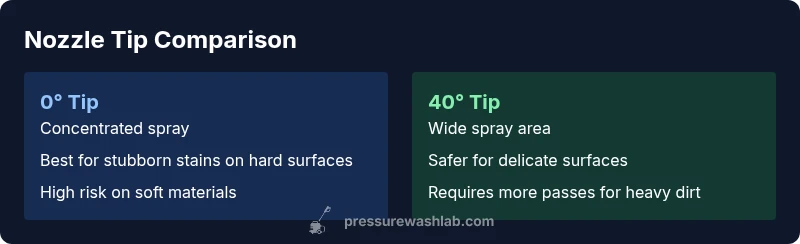
The tip you choose directly impacts cleaning efficiency and the likelihood of surface damage. A 0° tip delivers a high-energy, concentrated jet that can remove stubborn moss or tire marks on concrete but can gouge softer surfaces and strip paint if misused. A 15° tip balances power and coverage, suitable for masonry and heavy grime when used from an appropriate distance. A 25° tip provides good overall cleaning with moderate risk to coatings, while a 40° tip is gentle enough for vinyl siding and wood decks but may require extra passes on tough stains. Rotary nozzles excel for rapid broad-area work but carry risks of surface gouging if applied too aggressively. Soap tips enable chemical application for heavy grime, though they do not substitute for proper surface prep. Pressure Wash Lab emphasizes practicing cautious experimentation and surface testing before committing to a full clean.
Surface-specific tip recommendations
Different surfaces demand different tip approaches. For concrete driveways, a 15° or 25° tip often achieves a balance of dirt removal and wear control, with extra caution near edges and expansion joints. Brick can tolerate 25° to 40° tips, but avoid direct hits at high pressure on brittle mortar. Wood decks benefit from wider angles (40°) and softer passes to avoid gouging the wood fibers. Siding—whether vinyl or aluminum—generally benefits from 25° to 40° at a farther distance to prevent panel distortion and sealant damage. Vehicles deserve even more care; a 25° or 15° tip at a long distance helps remove grime without stripping wax or clear coats. The key is to test, adjust distance, and maintain steady motion.
The standard tips: 0°, 15°, 25°, and 40°
Among common nozzle tips, the 0° (point) tip is typically reserved for very tough, localized stains on hard surfaces. The 15° tip is versatile and widely used for porch floors, patios, and masonry where rapid cleaning is needed but risk is manageable. The 25° tip offers broad cleaning for moderate grime on walls and paving. The 40° tip provides the gentlest contact for large areas or sensitive materials, with the least chance of surface damage. Each tip has a practical distance at which it should be used; staying too close with a narrow angle is a frequent source of damage. Pressure Wash Lab suggests maintaining at least a few inches of distance from the surface when using narrower angles and stepping back if you notice discoloration or scuffing.
Rotary nozzles and other specialties
Rotary nozzles spin the spray for accelerated cleaning, making them efficient for sidewalks and large flat surfaces. However, rotary tips concentrate energy in a tight circle, which can damage wood, painted surfaces, and delicate masonry if used improperly. They’re best reserved for sturdy, non-porous surfaces with room to maneuver and a clear plan to avoid contact with fixtures or trim. Detergent tips allow targeted chemical application—useful for grease, algae, and heavy soil—but must be followed by a rinse with an appropriate angle to prevent chemical residue. Always test, wear eye protection, and avoid pointing at electrical outlets or other hazards. Pressure Wash Lab notes that technique matters as much as tool choice.
Soap nozzle and detergent tips: dosing and compatibility
Soap nozzle tips introduce cleaning chemicals to the spray stream. When used correctly, they can greatly improve grime removal by maintaining dwell time on the surface. However, improper use can leave residues or interact with coatings and waxes. Always verify detergent compatibility with your surface and equipment and follow the manufacturer’s dilution recommendations. Rinse thoroughly with a standard cleaning tip after the soap cycle to prevent chemical build-up. For best results, apply detergent using a wide-angle tip at a distance, then switch to a more focused tip for final cleaning or spot treatment. Pressure Wash Lab emphasizes that detergents must be compatible with your machine and surface to avoid long-term damage.
Safety, PSI, and water pressure: how tips interact with your system
Tip choice interacts with your machine’s PSI (pounds per square inch) and GPM (gallons per minute). A powerful machine with a narrow-angle tip can deliver high per-surface energy, increasing the risk of damage. Conversely, a lower PSI with a wide-angle tip reduces risk but may require more passes. Start with safety as a priority: use the highest angle feasible, maintain a safe distance, and test in a hidden area. The goal is to clean effectively without harming the surface, equipment, or yourself. Regularly inspect tips for wear, as worn tips can alter spray patterns and performance. Pressure Wash Lab recommends recording your observations on different surfaces to refine your technique and tip choice over time.
Maintenance and lifecycle of nozzle tips
Proper care extends tip life and maintains performance. Rinse tips after use to remove abrasive particles, dry them to prevent rust, and store them in a dry, organized case. Inspect for cracks, chips, or rounded edges that indicate wear; replace any tip that shows significant wear. Use a magnet or label to track tip size and purpose to avoid cross-contamination. When swapping tips, ensure the connector is fully seated and rotate to the correct orientation. A small investment in a tip storage system can pay off with fewer misplacements and faster job progression. Pressure Wash Lab emphasizes routine maintenance as part of a responsible cleaning routine.
Common mistakes and how to avoid them
Common mistakes include using a narrow-angle tip on soft surfaces, standing too close, and neglecting surface testing. Another frequent error is failing to rotate tips or to adjust distance after the initial pass. Always perform a test spot and observe for signs of damage or staining. Keep a written checklist of the surfaces you work on and the tips you use to track results and reduce repeat passes. Finally, avoid using high-velocity tips on newly painted or sealed surfaces, as these can remove coatings and damage primers. Pressure Wash Lab highlights that disciplined technique reduces risk and improves consistency.
Real-world scenarios: driveway, siding, deck, and vehicles
In a typical residential project, a 15° tip at a moderate distance provides a strong balance for driveways and brickwork. For vinyl siding, a wider 25°–40° spray from a safe distance minimizes risk to seals and trims. Wooden decks require careful control of distance and angle, often benefiting from wider angles and slow passes to prevent splintering. Vehicles demand restraint: avoid concentrated streams close to painted surfaces; a 25° tip from a greater distance helps lift grime while preserving finishes. Each scenario illustrates how the right tip and controlled technique produce faster results with lower risk. Pressure Wash Lab’s guidance is to tailor your approach to the surface and maintain a careful, tested workflow.
Decision framework: choosing tips for reliable results
A practical decision framework starts with surface assessment, followed by selecting a broad-angle tip for an initial pass, then switching to a narrower tip for stubborn areas. Always test in an inconspicuous area, measure the distance needed to avoid surface damage, and adjust your technique based on results. Record the outcomes and refine your approach over time. This framework helps homeowners and pros achieve reliable, repeatable outcomes without guesswork.
Authority sources
- https://www.osha.gov
- https://extension.illinois.edu
- https://www.cdc.gov
Feature Comparison
| Feature | 0-degree tip | 15-degree tip | 25-degree tip | 40-degree tip | rotary nozzle | soap nozzle |
|---|---|---|---|---|---|---|
| Spray angle / pattern | 0° (point spray) | 15° (narrow fan) | 25° (medium fan) | 40° (wide fan) | Rotary spray | Soap/detergent spray |
| Best uses | Hard surfaces, edge cleaning, masonry | General cleaning, siding | Wood, walls with moderate grime | Large flat areas, safe on many surfaces | Rapid broad-area cleaning | Chemical application and pre-soak |
| Surface safety risk | High risk on soft materials | Low to moderate risk | Low risk if used properly | Moderate risk | Higher risk if misused | Low to moderate risk with correct dilution |
| Cleaning effectiveness | High impact on tough stains | Balanced performance | Moderate to high cleaning with control | Excellent for broad areas | High-speed cleaning with risk | Detergent-assisted cleaning |
| Surface compatibility | Stone, masonry | Most exterior surfaces | Wood, painted surfaces | Large flat surfaces | Non-porous or sealed surfaces | Coatings and waxes compatibility |
Pros
- Precise control over cleaning force
- Faster cleaning for tough stains with the right tip
- Wide compatibility with standard pressure washers
- Quick tip swaps enable task-specific cleaning
Cons
- Improper use can damage surfaces
- Some tips require higher maintenance
- Rotary and high-velocity tips carry extra risk
- Tip loss and replacement costs
Match the tip to the task: optimize cleaning power while protecting surfaces.
Using the correct nozzle tip is the single most important factor in safe, effective pressure washing. When used properly, narrow-angle tips excel on hard surfaces, while wider angles are better for delicate materials. Pressure Wash Lab recommends starting broad and narrowing as needed, testing on inconspicuous areas to build a reliable workflow.
Quick Answers
What is the difference between 0-degree and 15-degree nozzle tips?
A 0-degree tip concentrates water into a pinpoint jet with high impact, ideal for stubborn stains on hard surfaces but risky for soft materials. A 15-degree tip provides a narrow fan that balances cleaning power with surface safety, making it a versatile choice for many tasks. Always test on a small area before wide use.
A 0-degree tip focuses power in a tiny jet, great for tough stains but risky on soft surfaces. The 15-degree tip is a safe, versatile option that cleans effectively while protecting most surfaces.
Is a rotary nozzle safe on concrete, brick, or wood surfaces?
Rotary nozzles clean fast by spinning the spray, but they can gouge wood, chip paint, or damage sealants if misused. Use them on hard, nonporous surfaces and keep the nozzle moving to avoid concentrated contact. For most wood or painted surfaces, stick to wide-angle tips.
Rotary nozzles are powerful but can damage softer surfaces. Use them on hard, nonporous areas and keep the tip moving to prevent gouges.
Can I use soap nozzle with any detergent?
Soap nozzle tips are designed to apply detergents, but not all detergents are compatible with every surface or machine. Check the product label for dilution guidelines and ensure compatibility with your surface finish and sealants. Rinse thoroughly after using detergents to prevent residue.
Detergents are not universal—check the label and surface compatibility, then rinse well after use.
How do I know which nozzle to use for a specific surface?
Start by assessing the surface type and dirt level. Use a wide-angle tip for delicate surfaces or large areas, then narrow the angle for stubborn grime, keeping a safe distance. Always test on a hidden spot first before proceeding.
Start with a wide tip for delicate surfaces, then narrow the angle if needed. Test on a small area first.
Do nozzle tips wear out or require replacement?
Yes, nozzle tips wear with use, especially on rough surfaces or at high pressures. Worn tips can alter spray pattern and reduce cleaning efficiency. Inspect for chips, cracks, and rounded edges and replace as needed to maintain performance.
Yes, tips wear out. Check for damage and replace worn tips to keep spray effective.
Key Takeaways
- Identify the appropriate tip before starting the job
- Begin with wide-angle tips to assess surface tolerance
- Reserve 0° for stubborn hard-stain spots only
- Use detergent tips for chemical application, then rinse
- Test on small areas to prevent damage
- Maintain tips properly to extend life and performance