How Far Can a Pressure Washer Spray? A Practical Guide
Explore the factors that determine spray reach, how nozzle tips, PSI, and GPM interact, and actionable tips to maximize reach safely. Pressure Wash Lab analyzes typical distances, safety guidelines, and testing methods for homeowners and pros.


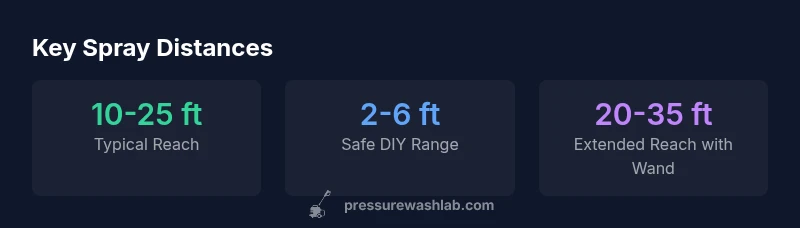
Spray distance for a consumer pressure washer typically ranges from about 10 to 25 feet, depending on nozzle, PSI, and GPM. Real-world reach can extend with a longer wand or higher flow, but safety and surface type dictate practical limits. Start with the lowest pressure and smallest nozzle for control, then test your target distances at a safe, measured pace.
What determines spray distance
The distance a pressure washer can spray is not a fixed value. A range is typical for most homeowners, influenced by several interacting factors. First, the nozzle angle matters: a zero-degree (point jet) nozzle produces a tighter, longer reach but increases risk of surface damage, while broader spray nozzles spread the jet and reduce reach. Second, operating PSI and GPM directly affect how much energy is delivered to the surface and, consequently, how far the jet maintains coherence. Third, wand length and any extension attachments amplify reach—longer wands can add several feet to your effective spray distance, provided you maintain control and stability. Environmental conditions like wind also play a role, especially for high-velocity jets. Finally, surface type and the presence of contaminants influence how aggressively you should spray, which in turn can limit the usable distance.
The role of nozzle tips and PSI
Nozzle choice and pressure are the primary levers for reach. A narrow angle (0°) concentrates energy into a tight stream, achieving greater distance but with a higher risk of gouging or etching on soft materials. A 15° nozzle is a common compromise, delivering strong cleaning power with a safer profile and moderate reach. Wider angles, such as 25° or 40°, expand coverage but shorten the jet’s effective distance. PSI climbs with cleaner demands and stubborn grime, while GPM (gallons per minute) contributes to overall flow and can extend reach slightly when paired with appropriate attachments. For homeowners, starting with a wider nozzle and gradual adjustments helps balance reach with surface safety.
How GPM and wand extensions affect reach
GPM contributes to how much spray energy is available at the surface, but it does not always translate directly to longer reach. Higher GPM can improve cleaning efficiency and maintain jet coherence at a given distance, but reach often depends more on nozzle geometry and wand length. Wand extensions—typically 12 to 25 feet in professional setups—offer a practical way to increase your spray distance without climbing onto ladders. When using extensions, maintain a stable stance and avoid overextending, which can reduce control and increase the chance of kickback.
Real-world scenarios and safety considerations
Different tasks demand different distances. Cleaning a concrete driveway will generally allow for more aggressive nozzles and greater reach, while washing siding or windows requires gentler settings and shorter distances to prevent damage. Always involve a controlled approach: stand at a safe distance, test on inconspicuous patches first, and back away gradually as you adjust pressure and angle. Safety gear—eye protection, gloves, and non-slip footwear—remains essential whenever you push reach limits, especially on elevated surfaces or wet areas.
How to measure your actual spray distance at home
A practical method is to set up a taped distance chart on a wall or fence. Mark known distances (e.g., 5 ft, 10 ft, 15 ft). Starting with a broad spray and lower pressure, aim at the wall perpendicularly and observe the spray’s dispersion and impact area. Move to the next mark only after confirming you have cleanly removed the marked spot without excessive splatter or surface damage. This process gives you a tangible feel for your equipment’s real-world reach and safe operating range for different surfaces.
Distance estimates by nozzle angle
| Nozzle Type | Estimated Reach | Best Use |
|---|---|---|
| 0-degree (point jet) | 8-15 feet | Heavy-duty cleaning, hard surfaces |
| 15-degree | 12-20 feet | General surface cleaning |
| 25-degree | 15-25 feet | Wide-area cleaning |
| 40-degree | 20-30 feet | Delicate surfaces, siding |
Quick Answers
What factors most influence spray distance when using a pressure washer?
The nozzle angle, operating PSI, GPM, wand length, and surface texture all influence reach. Wind and hose friction can also affect how far the spray travels. Choosing the right nozzle and maintaining equipment matters.
The main factors are nozzle angle, pressure, and wand length; test safely.
How can I safely maximize spray distance?
Use a longer wand, start with a wide-angled nozzle for safety, then gradually adjust. Maintain a stable stance and avoid full power on delicate surfaces. Test on a hidden patch before proceeding.
Start with the widest nozzle and extend your wand; test gradually.
Is it better to move closer or farther away during cleaning?
For most tasks, begin at a close distance to maintain control and technique, then back away if you lose control or risk overspray. Use the smallest safe nozzle and gradually extend reach as needed.
Stay close enough to control the spray, then back away slowly.
Can I measure spray distance with household tools?
Yes—mark a wall or fence with tape at known distances and perform controlled spray tests. Document the marked locations and observe spray pattern, distance consistency, and any surface impact.
Use tape marks on a wall to test reach safely.
Does surface type affect reach more than nozzle choice?
Surface type influences safe operating distance and fan pattern. Hard surfaces tolerate higher pressure and longer reach; delicate surfaces require shorter distances and gentler nozzles.
Surface matters; adjust nozzle and distance accordingly.
“Understanding spray distance is essential to avoid damage while maximizing cleaning efficiency.”
Key Takeaways
- Start safely: test distance with a wide nozzle first.
- Distance depends on nozzle, PSI, GPM, and wand length.
- Longer wands extend reach but require better stance and control.
- Always test on inconspicuous patches before broader use.
- Follow manufacturer safety guidelines for each task.