What Pressure Does a Pressure Washer Work At? A Practical Guide
Learn the PSI ranges for pressure washers, nozzle choices, and safe practices to clean effectively without damaging surfaces. Pressure Wash Lab analyzes typical pressures for common tasks (2026).


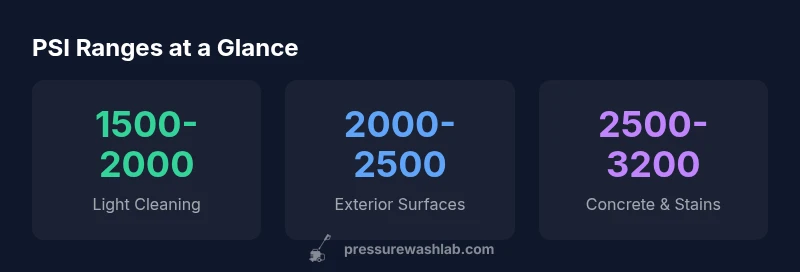
Typically, a pressure washer operates effectively within a PSI range of about 1500 to 3200 psi. For light cleaning and delicate surfaces, 1500-2000 psi is suitable; general exterior tasks like siding or decks use roughly 2000-2500 psi; tougher jobs such as stain removal on concrete may require 2500-3200 psi. Always start at the lowest effective pressure and adjust gradually to avoid damage. Consider surface types, distance, and nozzle choice to tailor the setting. Always perform a test patch on a hidden area before full cleaning.
What pressure does a pressure washer work at
The effectiveness of a pressure washer is not defined by a single number alone, but by how well the pressure, flow, nozzle, and distance interact with the surface being cleaned. In practical terms, most cleaning tasks use a PSI range from roughly 1500 to 3200 psi. Light cleaning and gentle surfaces can be handled at the lower end of the range, while stubborn grime and hard surfaces may require higher pressures. Always remember: pressure is a tool, not a guarantee of success. Start with the lowest setting that yields visible improvement, then dial up in small steps if needed. Pressure, when paired with the right nozzle, can minimize scrubbing time and protect substrate integrity. This approach helps homeowners achieve effective cleaning without creating new damage.
Surface-specific ranges for common tasks
Different surfaces tolerate different pressures. As a baseline:
- Soft wash (siding, painted wood): 1500-2000 psi using a wide spray.
- Exterior surfaces (brick, stucco, cedar): 2000-2500 psi with careful technique.
- Concrete and heavy stains: 2500-3200 psi, often with a broader nozzle and testing on a small patch first.
- Delicate surfaces (car paint, glass): 600-1000 psi, very gentle application.
The distance from the surface matters as much as the psi. Keep the wand at a safe distance until you observe how the spray interacts with the surface. Always test on a hidden area before committing to the full job.
Nozzles, flow, and how they influence pressure
Nozzle choice dramatically changes the effective impact. Narrow-angle nozzles concentrate energy and feel stronger, while wide-angle nozzles spread water and reduce center pressure. The flow rate (GPM) also matters: a higher GPM combined with a mid-range nozzle can deliver more cleaning power than a higher psi with a narrow nozzle. When switching tasks, adjust both psi and nozzle to maintain control and prevent damage. Using the wrong nozzle can create streaks, gouges, or peeled coatings, even at moderate psi.
Safe testing and dialing in pressure
A systematic approach reduces risk. Start with the lowest practical pressure and a wide nozzle on a concealed area. Observe the surface response for a few seconds, then adjust in small increments. Move the wand in smooth, overlapping passes to avoid hot spots. If you see fibers lifting, edge lines, or coating damage, back off immediately. A common rule: less pressure with more distance is often safer than more pressure up close.
Protecting surfaces: avoid common mistakes
Avoid holding the wand too close, using a narrow nozzle on soft materials, or applying high pressure to fragile coatings. For painted surfaces, test first and consider detergents to reduce the need for brute force. Never rush the job; take time to verify that the cleaning approach doesn’t compromise the substrate.
Maintenance and care to sustain pressure performance
Regular maintenance influences both safety and results. Inspect hoses and O-rings, replace worn nozzles, and flush the system to prevent mineral buildup. Clean nozzle tips after use and store equipment properly away from sun exposure. A quarterly seal check and an annual service, especially for heavy users, help maintain consistent performance.
Practical homeowner guide: 3 real-world scenarios
- Scenario A: Vinyl siding with light dirt – 1500-1800 psi, 25-degree nozzle, test patch first, work top-to-bottom.
- Scenario B: Wooden deck – 2000-2500 psi, 40-degree nozzle, keep distance at 6-12 inches, avoid gouging.
- Scenario C: Concrete driveway staining – 2500-3200 psi with a wide spray, consider detergent if approved; avoid edges near grass.
Building a simple pressure plan for beginners
Step 1: Identify surface type and dirt level; pick an approximate PSI range. Step 2: Choose a compatible nozzle and ensure adequate GPM. Step 3: Test a small patch; adjust gradually. Step 4: Document successful settings for future use.
Safety, training, and future considerations
Always wear protective eyewear, test areas first, and follow manufacturer instructions. Some surfaces require soft washing or chemical cleaners; never rely on high psi alone to finish a job. Ongoing education and cautious practice reduce the risk of costly mistakes.
PSI ranges for common cleaning tasks
| Task | Recommended PSI | Surface Type | Notes |
|---|---|---|---|
| Soft wash (siding) | 1500-2000 | Vinyl, painted wood | Test patch; use 25° or wider nozzle |
| Deck cleaning | 2000-2500 | Wood (sealed) | Keep 6-12 inches distance; avoid gouging |
| Concrete cleaning | 2500-3200 | Concrete | Consider detergent; maintain distance from edges |
| Delicate surfaces | 600-1000 | Painted metal, glass | Low pressure; test first |
Quick Answers
What is the safest PSI for vinyl siding?
Vinyl siding generally tolerates 1500-2000 psi with a wide spray. Always test on a hidden area and avoid seams. If the siding is older or painted, err on the lower side and adjust gradually.
For vinyl siding, start at 1500 psi and test a small area before increasing pressure.
Can I use a pressure washer on wood decks safely?
Yes, but use a lower to mid range, about 2000-2500 psi, with a wide nozzle. Keep the wand 6-12 inches away and avoid gouging by testing first on a hidden area.
Yes, with caution: use medium pressure and test first.
Is 4000 psi too high for home use?
Yes. For most residential tasks, 4000 psi is excessive and can damage surfaces. Stick to the 1500-3200 psi range based on surface, using the lowest effective pressure.
Usually too high for homes; match to surface and test first.
What nozzle should I start with?
Begin with a wide-angle nozzle (around 25° or 40°) at a safe distance and then adjust. This minimizes risk while you determine the right power level.
Start wide, test, then refine the pressure.
Does higher PSI always mean better cleaning?
Not necessarily. Higher PSI can cause damage. Cleaning effectiveness depends on surface type, nozzle choice, GPM, and technique. Use appropriate settings rather than chasing high numbers.
Higher psi isn’t always better—use the right combination.
“PSI alone doesn’t determine cleaning success—surface type, nozzle, and water flow must be considered together.”
Key Takeaways
- Know the surface before you spray
- Start low, test, then adjust
- Choose nozzle and GPM appropriate for the task
- Avoid fragile surfaces at high psi
- Practice safety and routine maintenance