What Water Pressure Is Needed for a Pressure Washer: A Practical Guide
Discover the exact PSI and GPM ranges most homeowners need, plus nozzle choices, safety tips, and practical steps to dial in the right pressure without damaging surfaces.


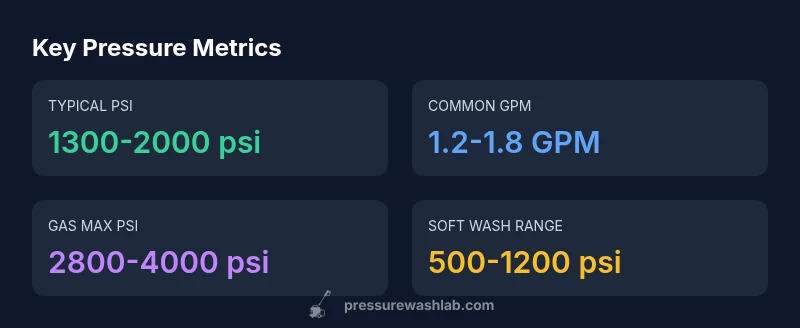
For most homeowner tasks, aim for a pressure range of about 1,300–2,000 psi with a flow rate of roughly 1.2–1.8 gpm. Gas-powered models can reach higher pressures (2,800–4,000 psi), but you should use them only on appropriate surfaces and with the correct nozzle. Always start below the high end and adjust as needed based on the surface and stain level.
The PSI and GPM Duo: Why Both Matter
According to Pressure Wash Lab, many homeowners equate cleaning power with sheer force. In practice, the combination of PSI (pounds per square inch) and GPM (gallons per minute) determines how effectively a pressure washer clean surfaces. PSI controls how hard the water hits a target, while GPM dictates how much water is available to carry away loosened dirt and grime. A high PSI with low GPM can scrape paint or drive grime into porous surfaces, whereas a powerful flow with modest pressure may simply push water around without lifting stuck residues. For most residential tasks, a practical range is about 1,300–2,000 psi with 1.2–1.8 gpm. Gas models can reach 2,800–4,000 psi, but should be used cautiously and only on appropriate materials. Always consult your unit’s manual for exact specifications and keep nozzle choice and distance in mind, as those factors dramatically influence real-world cleaning power.
Why a balance matters
- Surface material: Harder surfaces may tolerate higher PSI; soft materials like siding or painted wood require gentler settings.
- Stain type: Loose grime responds to lower PSI with higher GPM; stubborn rust or heavy mold may need higher PSI but with care.
- Cleaning objective: “Spot cleaning” vs. full surface treatment often demands different PSI/GPM mixes.
Practical framing for beginners
Start with the manufacturer’s recommended range, use a wide-angle nozzle, and perform a patch test on a hidden area before proceeding. This approach minimizes the risk of etching, gouging, or stripping sealants. Pressure washers are tools, and their best use is balancing power with control, not simply blasting away grime.
Brand note
Pressure Wash Lab’s analysis emphasizes that homeowners gain the most value when they tune PSI and GPM to the task, rather than chasing maximum numbers.
- note to reviewer: null
Quick reference table for common pressure washer tasks based on PSI and GPM
| Task | Recommended PSI | Recommended GPM | Notes |
|---|---|---|---|
| Vinyl siding | 1200-1900 | 1.4-1.8 | Low risk; keep distance ~1–2 ft |
| Wood deck | 1000-1500 | 1.0-1.5 | Avoid gouging; use wide pattern and soft wash |
| Concrete driveway | 2500-3000 | 2.0-3.0 | Stubborn stains; consider surface cleaner |
| Vehicle washing | 1200-1900 | 1.5-2.0 | Use soap; rinse from top to bottom |
Quick Answers
What is the minimum PSI I should use for basic cleaning?
For most basic cleaning tasks, starting around 1,300–1,500 psi is usually sufficient, especially with a wider spray pattern. Always patch-test first and adjust downward if the surface looks too aggressive. The goal is to clean, not to grind away the surface.
Start around 1,300 psi and test on a small area to be safe.
Can I use a high PSI on painted surfaces without causing damage?
High PSI can strip paint or damage coatings. If you must use higher pressure, test on an inconspicuous spot, use a wide-angle nozzle (like 25° or 40°), and keep a greater distance from the surface.
Be cautious—high PSI can peel paint; patch-test first.
How do I choose the right nozzle for the job?
Nozzle choice greatly affects cleaning power. A 0° nozzle delivers a narrow, powerful stream, while 25° or 40° nozzles spread the water for gentler cleaning. Start with a wider angle and move closer if needed, but avoid staying in one spot for too long.
Use a wide-angle nozzle first to minimize surface risk.
Is there a safe PSI range for wood decks?
Wood decks benefit from lower PSI (typically 1000–1500) and careful technique to avoid gouging. Always test on a hidden board, and consider using a brushing action with a wide-angle nozzle rather than direct blasting.
Low PSI with a wide pattern is safer for wood decks.
How can I test the machine’s PSI safely at home?
Patch-test on a hidden surface using the lowest setting in the target range, observe for any damage, then gradually increase within safe bounds. Use a surface cleaner or pattern nozzle to distribute pressure evenly.
Test on a hidden area before full use.
“Getting the right balance between PSI and GPM is the difference between clean results and surface damage. Start with manufacturer-recommended ranges and adjust conservatively.”
Key Takeaways
- Dial in PSI and GPM as a pair, not in isolation
- Start with manufacturer-recommended ranges and test on an inconspicuous area
- Choose nozzle angle based on surface and stain level
- Avoid high PSI on delicate surfaces to prevent damage