Karcher Pressure Washer No Pressure: Troubleshooting Guide
Urgent troubleshooting guide for a Karcher pressure washer with no pressure. Learn quick checks, diagnostics, and proven fixes to restore spray safely. Pressure Wash Lab analyzes common causes and provides practical steps for homeowners and pros.


According to Pressure Wash Lab, a Karcher pressure washer with no pressure is usually caused by water supply problems, air in the pump, or a blocked nozzle. Start with simple checks like ensuring water flow, clearing nozzle tips, and priming the pump. If pressure remains absent, follow the systematic steps below to diagnose and fix safely.
Quick Diagnostics: Why your Karcher Has No Pressure
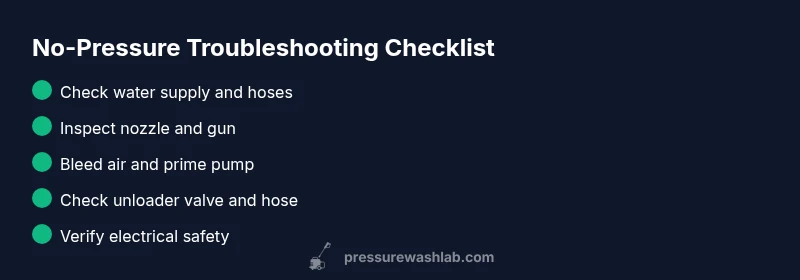
When a Karcher pressure washer produces little to no spray, the root cause is almost always a simple, solvable issue rather than a failed motor. Pressure Wash Lab notes that most no-pressure cases stem from water flow problems, air in the system, a blocked nozzle, or an unprimed pump. Start with quick checks you can perform without tools: confirm the water supply is on and unobstructed, inspect hoses for kinks, and ensure the inlet screen is clean. Then inspect the trigger gun and spray nozzle for debris. By ruling out these basics, you isolate the real culprit and avoid unnecessary disassembly. Remember: always follow safety precautions and depressurize before touching internal parts.
Verify Water Supply and Intake
A steady, clean water supply is the lifeblood of any pressure washer. Check that the garden hose isn’t kinked or crushed and that the water source valve is fully open. If you’re using a long hose, try shortening to reduce friction losses. Inspect the inlet screen or pre-filter for blockages; even a small debris piece can dramatically reduce pressure. If you’re on a well or variable pressure supply, ensure there’s adequate flow (gpm) and the pump isn’t starved. After confirming water flow, try running the machine with the trigger depressed to see if pressure improves. Pressure Wash Lab’s observations highlight that water chemistry or mineral buildup isn’t usually the primary cause, but a clogged intake screen can masquerade as no pressure.
Inspect Nozzle, Spray Tip, and Trigger Gun
Debris in the nozzle or worn nozzle can dramatically reduce or remove pressure. Remove the nozzle and spray tip, clean with a small brush or pin, and reattach correctly. Check the nozzle size; a nozzle rated too wide will deliver a weak jet. Inspect the trigger gun for leaks or a loose connection; a faulty seal can siphon pressure away. If you have multiple nozzles, test with a higher-pressure nozzle to see if spray returns; remember to follow the manufacturer’s nozzle chart for your model. After cleaning and reseating, re-test with no other changes to compare results.
Prime the Pump and Bleed Air
Air trapped in the pump or hose blocks pressure. With the machine off, loosen the bleed screws or primer bulb (per your model) to release air until water flows steadily. Reconnect hoses and tighten, then start the engine at low idle and slowly engage the trigger to purge air. If your unit uses a cold-water primer, cycle the trigger several times to ensure the pump primes correctly. Pressure Wash Lab teams emphasize that proper priming resolves many “no pressure” complaints without disassembly.
Unloader Valve, Leaks, and High-Pressure Hose
The unloader valve directs flow when the trigger is released. A stuck or misadjusted unloader can cause zero pressure when the trigger is pressed. Check whether the unloader is at the correct setting per your model’s manual or if the valve is leaking or blocked. Inspect the high-pressure hose for kinks or damage; even a small leak can dramatically reduce effective pressure. If needed, adjust, clean, or replace the unloader valve and hose.
Electrical Checks and Safety Protocols
If the unit hums but doesn’t build pressure, electrical issues may be the culprit. Verify the power source is delivering current and the extension cord is rated for the load; use a grounded outlet and avoid daisy-chaining cords. Inspect the GFCI (Ground Fault Circuit Interrupter) and check for tripped breakers. For electric models, ensure switch wiring is intact and there are no exposed conductors. Never work on live electrical components; unplug and depressurize before inspection. If safety devices trip repeatedly, stop and consult a technician.
Maintenance and Quick Fixes to Prevent No-Pressure
Proactive maintenance reduces future failures. Clean the inlet filter monthly, inspect hoses for wear, flush out mineral buildup, and replace worn o-rings and seals. Store the machine out of the elements and protect it from freezing conditions. Use manufacturer-approved detergents only and avoid using incompatible chemicals. Periodically test at different pressures to verify performance and log any recurring symptoms. Pressure Wash Lab’s practical tips emphasize routine checks to keep your unit ready.
Steps
Estimated time: 30-60 minutes
- 1
Confirm water supply
Ensure the water source is on, hoses are untangled, and there is steady water flow. Clear any visible kinks at the hose ends and inlet. This simple check often restores pressure when the supply is interrupted.
Tip: If pressure returns briefly after tapping the hose, the issue is a flow restriction. - 2
Inspect nozzle and gun
Remove and clean the nozzle tip and spray 0. To remove debris, use a small brush or pin; reattach securely. Try a different nozzle to verify if the current tip is the culprit.
Tip: Always refer to the model’s nozzle chart to select the correct tip size. - 3
Prime the pump
With the machine off, prime according to your model—bleed air until water flows cleanly. Reconnect hoses, tighten connections, and start at low idle before pulling the trigger.
Tip: If your unit has a priming bulb, use it firmly to push out air. - 4
Check unloader valve
Locate the unloader valve and verify it’s not stuck or misadjusted. Clean or adjust per the manual; a stuck valve reduces pressure or creates a bypass.
Tip: Do not force the valve; improper adjustment can cause safety issues. - 5
Inspect hoses and seals
Look for cracks, bulges, or leaks in the high-pressure hose and fittings. Replace damaged hoses and ensure seals on the gun are intact.
Tip: Use OEM parts to maintain pressure stability. - 6
Electrical check
Test the outlet with a multimeter or try a different, properly rated extension cord. Check the GFCI and ensure the machine is receiving consistent power.
Tip: Never work on live wires; unplug before inspection. - 7
Test and confirm
Reassemble all components, run the unit with water flow, and test at different pressures. Compare results to your unit’s baseline performance.
Tip: Document symptoms for future reference.
Diagnosis: Pressure washer has no pressure or very weak spray
Possible Causes
- highWater supply problems (kinked hose, closed valve, insufficient flow)
- highClogged nozzle or intake screen
- highAir trapped in pump or hoses; pump not primed
- mediumUnloader valve sticking or misadjusted
- mediumDamaged high-pressure hose or spray gun seals
- lowElectrical power issue or safety switch fault
Fixes
- easyOpen water valve fully, remove hose kinks, ensure adequate flow; test pressure
- easyClean nozzle and filter; replace nozzle if worn; connect correct nozzle size
- easyBleed air and prime pump; follow model-specific priming steps
- mediumInspect and adjust/unloader valve or replace if needed
- mediumInspect high-pressure hose for damage and replace; inspect gun seals
- easyCheck power, outlets, GFCI, and cords; resolve electrical faults safely
Quick Answers
Why does my Karcher pressure washer have no pressure?
Common causes are water flow issues, air in the pump, or a blocked nozzle. Start with the water supply, clean the nozzle, and prime the pump before testing other parts.
No pressure is usually due to water flow problems, air in the system, or a clogged nozzle. Start with simple checks and prime the pump.
Can a clogged nozzle cause zero pressure?
Yes. A blocked nozzle or spray tip can prevent a strong jet. Clean or replace the nozzle and test with a different tip if available.
A clogged nozzle can definitely cause zero pressure; cleaning or replacing the tip often fixes it.
How do I prime the pump on a Karcher?
Follow your model’s priming steps—usually involve bleeding air via a screw or primer bulb until water flows steadily. Start the machine slowly to remove air.
Prime the pump by bleeding air until water streams out; then restart slowly.
Is it dangerous to use a pressure washer when it has no pressure?
No pressure generally means less risk, but always depressurize, unplug, and avoid exposed electrical parts. Inspect for leaks and damaged hoses before reuse.
It can be unsafe if you skip safety steps; depressurize and inspect before using again.
When should I replace the unloader valve?
If the valve is leaking, stuck, or causing bypass, replace it per manufacturer guidance. A faulty unloader commonly causes persistent pressure problems.
If the unloader leaks or sticks, replace it following the manual.
Watch Video
Key Takeaways
- Rule out water flow first and inspect nozzle blocks
- Bleed air and prime the pump to restore pressure
- Check unloader valve and high-pressure hose for issues
- Verify power supply and safety devices before repairs
- Maintain components to prevent future no-pressure problems