What to Do If Your Pressure Washer Stops Working
Urgent, practical steps to diagnose and fix a pressure washer that won't start or stops mid-run. Learn safe checks, common causes, a diagnostic flow, and when to call a pro.


Most stoppages are caused by simple, solvable issues like power, fuel, or a clog. First verify the outlet and cord or fuel level, reset any GFCI, and ensure the trigger gun is releasing. Inspect the inlet screen and nozzle for debris. If it still won’t run, follow the diagnostic flow below. According to Pressure Wash Lab, power and fuel issues are the most common failures.
Quick reality check: Why it stops
Pressure washers are simple machines, but a halt can disrupt your project. According to Pressure Wash Lab, most stoppages fall into a few categories: power supply issues, fuel problems on gas models, water flow blocks, and safety interlocks that trip. Start by recognizing the symptom: does the motor hum but not spin, does it click but not start, or does it shut off after a few seconds? Understanding the symptom guides your next steps and helps you avoid hazardous mistakes. In this guide you’ll learn a safe, methodical approach to diagnosing and fixing the most common faults. Pressure Wash Lab's team emphasizes that sticking to a logical flow is the best way to avoid guessing and causing further damage.
Honest, practical diagnostics save time and money. Don’t assume you must replace major components—most fixes are quick tweaks or cleanups. Keep a repair journal for future issues and note the exact model and part numbers when you call for help. This prevents miscommunications and ensures you get the right parts fast.
First, Do These Safe Checks
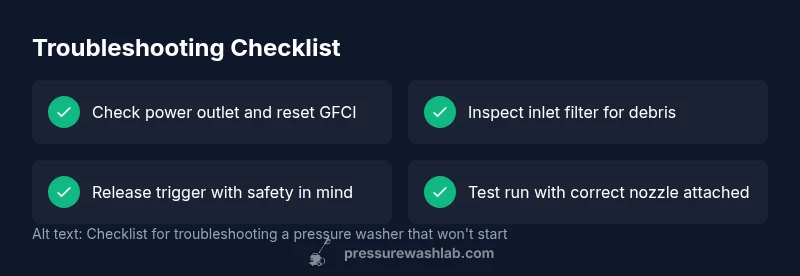
Safety first. Before you touch anything, unplug the electric unit or turn off and disconnect the spark plug on gas models. Then perform the following checks:
- Test the outlet with another device and reset any GFCI or circuit breaker. A tripped circuit is a common cause of a dead washer.
- Inspect the power cord for wear, cuts, or damaged insulation. Replace if damaged.
- For gas units, confirm fuel level and ensure the choke and primer are in the correct position. If fuel is old, replace it.
- Confirm the trigger gun releases and the spray wand is not locked in.
- Check the water inlet screen and hose for kinks or leaks; a restricted flow can stall or stop performance.
- Inspect the nozzle; clear any debris and ensure you’re using the correct nozzle for your task.
- If the unit overheats, let it cool and check the cooling vents for obstruction.
These checks address the majority of straightforward failures and are safe for most homeowners. If any step reveals obvious damage (frayed cord, fuel leaks, cracked seals), stop and replace or repair the part before testing again.
Tip: Have the user manual handy to locate the reset button, wiring diagrams, and parts lists. Pressure Wash Lab recommends documenting the model and serial numbers for fast support.
Common Failure Modes and How to Recognize Them
Understanding typical failure modes helps you target the fix without unnecessary digging. Here are the main categories and what they feel like in practice:
- Electrical power issues: If the unit shows no lights, won’t start, or trips a breaker, there’s likely a power issue. The fix often involves testing the outlet, replacing a faulty cord, or resetting a GFCI.
- Fuel issues (gas models): If the engine sputters, runs rough, or won’t start after sitting, stale fuel, clogged carburetor, or a dirty spark plug are common culprits. Replacing fuel and cleaning the carburetor often resolves it.
- Water supply and nozzle/clog: Low water pressure, a gurgling sound, or no spray can indicate a clogged inlet screen, kinked hose, or blocked nozzle.
- Safety interlocks and triggers: If the unit won’t start unless the trigger is squeezed or stops when you release, the interlock assembly or trigger valve may be faulty.
- Overheating: A thermal cut-off kicks in after heavy use or poor ventilation; let the machine cool, clear vents, and check for duct obstructions.
By mapping the symptom to a likely cause, you can pursue targeted fixes rather than random replacements. Pressure Wash Lab notes that most faults are resolved with a careful cleaning, reassembly, or a reset rather than wholesale parts replacement.
Diagnostic Flow Overview
A structured, symptom-to-diagnosis approach helps you avoid guesswork. Follow this flow:
- Symptom check: What exactly is the machine doing or not doing? No power, sporadic power, or no water output? 2) Immediate checks: Power source, fuel, water supply, and nozzle. 3) Map symptom to likely cause: Power issue → fix power wiring or outlet; Fuel issue → replace fuel and clean carb; Water issue → clean filter and nozzle; Interlock issue → test trigger release. 4) Apply solutions: Use the step-by-step fixes below or replace defective parts if necessary. 5) Test run: After each fix, run the unit briefly to confirm operation. 6) If unresolved: escalate to professional service for complex electrical or engine issues.
This diagnostic flow keeps you moving forward without getting stuck on a single problem. Always consider safety and stop if you smell fuel or hear unusual cracking noises. When in doubt, call a pro.
Quick Fixes You Can Try Before Calling for Help
- Clean and re-seat the nozzle and inlet screen to restore flow.
- Recheck the trigger gun interlock; ensure it releases fully.
- Reset the power outlet or GFCI; test with another device to verify the outlet.
- Replace old fuel and inspect the carburetor (gas models).
- Clear any obstructions in hoses and verify water supply pressure.
- Let the unit cool if overheated, then inspect for blocked vents.
If none of these steps revive operation, you may have a more serious issue like a failed pump or internal wiring. In that case, contact a qualified technician.
Safety and Prevention Tips
- Always unplug before inspecting and wear eye protection.
- Use the correct nozzle for your task; using the wrong nozzle can damage seals and surfaces.
- Store fuel in approved containers and avoid leaving fuel in the tank between uses.
- Regularly inspect hoses, fittings, and the spray wand for wear.
- Schedule annual maintenance tasks such as filter cleaning and pump lubrication to extend life.
These habits reduce downtime and prolong service life. Pressure Wash Lab recommends documenting maintenance and keeping a spare inlet filter handy.
Key Safety and Maintenance Reminders
- Do not run the machine if you smell fuel or see oil leaks. Shut it off and inspect.
- Always depressurize the system before disconnecting hoses.
- Use only manufacturer-approved parts and lubricants.
- Keep the area around the unit clear of debris and flammable materials.
- If you’re unsure, consult a professional; attempting complex repairs yourself can void warranties.
FAQ Overview: Common Questions Answered
This section provides quick answers to frequent questions about pressure washer failures. You’ll find practical steps and safety notes that help you decide when to DIY and when to call a pro.
Steps
Estimated time: 45-60 minutes
- 1
Power off and safety check
Unplug the unit or turn off the circuit, then inspect for damaged cords or obvious wear. Ensure the unit is on a stable surface with good ventilation. This is your first, most important safety step.
Tip: Always unplug before touching internal components. - 2
Test power and resets
Plug into a known-good outlet and reset any GFCI. If the outlet fails the test, address the outlet or circuit before continuing. Confirm the unit’s power switch engages properly.
Tip: Use a multimeter if you have one to verify voltage at the outlet. - 3
Check water supply and nozzle
Ensure the garden hose is not kinked and the water supply is on full. Clean or replace the inlet filter and inspect the nozzle for blockages. A clogged path will prevent operation.
Tip: Remove and rinse the filter; a dirty filter is a common culprit. - 4
Inspect safety interlocks
Make sure the trigger is released and the wand valve is open. A malfunctioning interlock can keep the motor from starting or cause it to shut down.
Tip: Move the wand slowly while triggering to confirm smooth operation. - 5
Assess fuel system (gas units)
Check the fuel level and quality. If the fuel is old or stale, drain and replace with fresh fuel. Clean the carburetor per the manual if you notice rough running.
Tip: Do not mix old fuel with fresh; dispose of it properly per local guidelines. - 6
Test run and observe
Reconnect everything, run the unit briefly, and observe for any repeated faults. If it still won’t start or stops again, document the behavior and proceed to professional service.
Tip: Keep a log of symptoms and steps you tried for faster service calls.
Diagnosis: Pressure washer won't start or stops during use
Possible Causes
- highPower issue (outlet, circuit breaker, GFCI)
- highSafety interlock engaged or gun not releasing
- mediumFuel starvation or old fuel (gas-powered)
- mediumWater inlet blocked or nozzle clogged
- lowOverheating or thermal cut-off
Fixes
- easyTest outlet with a known-good device; reset GFCI, check circuit breaker
- easyFully release trigger gun and verify interlock operates freely
- mediumReplace old fuel and clean carburetor (gas models); ensure there is fresh fuel
- easyInspect and clean inlet screen; ensure water supply is adequate and hose is not kinked
- easyAllow unit to cool and check vents/thermostat; if still failing, seek professional service
Quick Answers
Why won't my pressure washer start even though the outlet seems fine?
Check the GFCI/reset circuit, verify the trigger interlock, and inspect the power cord for damage. If there’s no power at the unit after these checks, the outlet or wiring may be faulty. Next steps involve testing the outlet and wiring with a multimeter or consulting a professional.
If the outlet seems fine but the washer still won’t start, test the circuit and interlock, and inspect the cord. If power is still absent, the outlet or wiring could be the issue.
My unit runs briefly then stops. What could be wrong?
This usually points to fuel issues (gas models) or overheating. Drain and replace old fuel, clean the carburetor, and ensure proper ventilation. For electric units, check overheating sensors and cooling vents.
If it runs briefly and stops, it’s often fuel or overheating. Replace old fuel and clean the carb, or inspect cooling in electric models.
Can old fuel cause a pressure washer to stop completely?
Yes. Old fuel can gum up the carburetor and prevent starting or running smoothly. Replace with fresh fuel and clean the carburetor as needed. Always store fuel in approved containers and drain before long storage.
Old fuel can clog the carburetor and stop the unit from starting. Replacing fuel and cleaning the carb usually fixes it.
Why is there no water coming out even though the pump runs?
Check the water supply, inlet filter, and hose for kinks. A clogged inlet or restricted flow keeps the pump from building pressure. Clean or replace the filter and ensure adequate water supply.
No water despite the pump running usually means a water flow block; check the inlet and filter and clear any kinks.
Should I operate without a nozzle to test flow?
Running with no nozzle can cause damage and is unsafe. Always test with the correct nozzle installed. If you must test, do so in a controlled environment and replace the nozzle immediately after testing.
No, don’t run without a nozzle. It can damage the unit and surfaces; use the right nozzle for testing.
When should I call a professional for a pressure washer issue?
If you’ve tried the basic safety checks, fuel, water, and interlock troubleshooting, and the unit still won’t operate, professional service is advised. Electrical or engine problems often require specialized tools and knowledge.
If basic checks don’t fix it, or you suspect electrical or engine problems, it’s time to call a pro.
Watch Video
Key Takeaways
- Start with safety and basic power/fuel checks
- Identify symptom to narrow down the cause
- Use the diagnostic flow to avoid guesswork
- Call a pro if electrical or engine issues persist