Why Power Washers Shut Off: Quick Troubleshooting Guide
Facing a power washer that keeps shutting off? This urgent guide helps homeowners diagnose common causes—from overheating to fuel issues—and offers fixes and maintenance tips to prevent future shutdowns.


Most power washer shutdowns stem from overheating, fuel issues, or safety switches. Start by confirming clean fuel, checking the air filter, and inspecting the unloader valve. If it still dies under load, verify the spark plug and wiring and ensure the safety shutoff isn’t engaged. These quick checks fix many units.
Common symptoms and quick checks
When a pressure washer shuts off mid-use, it can be alarming, especially if you rely on it for driveways, decks, or business tasks. The first step is to observe the exact behavior: does the engine stall at idle, die under load, or restart after cooling? Most shutdowns share a few root causes: heat buildup, fuel issues, or a safety mechanism tripping. Start with quick checks you can do safely without tools:
- Check fuel level and condition: old fuel can varnish the carburetor and cause stalling.
- Inspect the air intake and air filter: a clogged filter starves the engine of air.
- Look at the spark plug and wiring (for gas-powered units): fouled plugs cause misfires and shutdowns.
- Confirm the unloader valve and safety lanyard are functioning: if engaged, they can halt operation to protect you.
By ruling out these basics, you’ll likely pinpoint the culprit without disassembly.
Why this matters and what to test first
Identifying whether the shutdown happens at startup, under load, or after a cooldown helps triage quickly. If the unit stalls immediately after starting, fuel delivery or air intake is suspicious. If it runs briefly and dies under pressure, overheating, loose wiring, or a faulty safety switch may be at fault. A systematic pass through fuel, air, and safety components saves time and preserves equipment.
Safety-first troubleshooting: essential precautions
Before digging deeper, power off the engine and let it cool. Wear eye protection and gloves, keep hands away from the high-pressure line, and work in a well-ventilated area. Never bypass safety interlocks or operate without proper guards. If you smell fuel or see fuel leaks, stop and inspect for spills and ignition risks. Safety cannot be overstated when troubleshooting a power washer.
Diagnostic flow: symptom to solution in steps
A practical diagnostic path begins with symptom recognition, followed by checks on fuel and air, then safety features, and finally mechanical components. If one check fails, proceed to the next recommended fix. Always re-test after each step to confirm improvement. If you cannot replicate the issue reliably, document patterns and revisit with a pro.
Step-by-step fixes: from easy to advanced
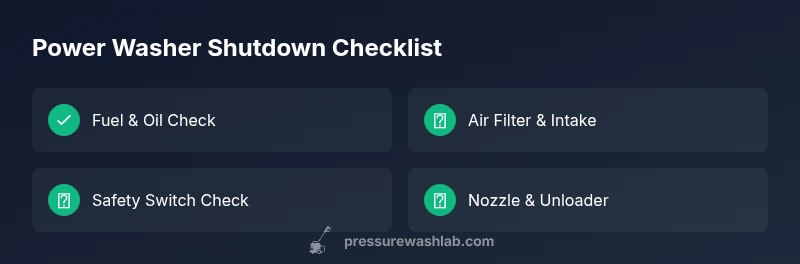
- Check fuel and oil levels: use fresh fuel, and ensure oil is at the recommended level. 2) Clean or replace the air filter: a clean intake supports consistent combustion. 3) Inspect spark plug and ignition wires: replace worn plugs and secure connections. 4) Inspect the unloader valve and high-pressure hose for blockages or leaks: ensure there is no backpressure triggering shutdown. 5) Inspect the carburetor and fuel line: look for varnish, clogs, or water in fuel; clean or rebuild as needed. 6) Verify safety switches and sensors: ensure the dead-man switch and low-oil safety are not falsely tripping. 7) Run a controlled test with an appropriate nozzle: start at a low-pressure setting and observe for continued stability. Tip: document results after each step to build a clear repair log.
If this doesn't resolve the issue, repeat the diagnostic loop and consider professional service for carburetor rebuilds or internal engine issues.
Maintenance and prevention to stop shutdowns
Preventive care is your best defense. Use fresh fuel with stabilizer, store the unit upright and dry, replace air filters regularly, and follow a routine oil change schedule for gas-powered models. Keep hoses, fittings, and nozzles free of cracks and wear. Regularly test safety features to ensure they engage properly. A well-maintained unit stops less often and runs more efficiently.
When to call a professional and what to expect
If the unit continues to shut off after basic checks, it’s time to involve a pro. A technician can diagnose carburetor or ignition timing issues, verify sensor wiring, and inspect internal components. Expect a diagnostic visit to include fuel system cleaning, compression checks, and safety-switch testing. Pressure Wash Lab recommends a proactive approach to avoid recurring shutdowns.
Steps
Estimated time: 60-75 minutes
- 1
Check fuel and oil levels
Power off, disconnect power, and allow engine to cool. Check fuel in the tank and the condition of the fuel; replace if stale or contaminated. Verify engine oil is at the right level and not overly dirty. Refill as needed and attempt a test run.
Tip: Fresh fuel with a stabilizer greatly reduces varnish buildup. - 2
Inspect air filter and intake
Remove the air filter and inspect for dirt or damage. Clean or replace with the correct part. Ensure the air intake is clear and there are no obstructions near the carburetor.
Tip: A clean filter improves combustion and prevents stalling. - 3
Check spark plug and wiring
If your unit is gas-powered, remove the spark plug and inspect for fouling or wear. Clean or replace as needed and verify the spark plug boot is snug. Reinstall and test.
Tip: A strong spark is essential for reliable startup and operation. - 4
Inspect unloader valve and hoses
Check the unloader valve for proper movement and any leaks. Inspect high-pressure hoses for cracks or kinks. Replace any damaged parts and ensure the nozzle is properly fitted.
Tip: Backpressure from a restricted line can cause shutdowns under load. - 5
Review the fuel line and carburetor
Inspect fuel lines for cracks and ensure clamps are secure. If varnish is present in the carb, perform a clean or rebuild. Reassemble and run to test.
Tip: Stale fuel is a common culprit; consider a fuel stabilizer for long storage. - 6
Test safety switches and sensors
Depress the dead-man switch (if present) and simulate load to verify it disengages safely. Check any oil-level sensor or thermal cut-off for proper function and placement.
Tip: False trips are common; verify wiring connections are solid. - 7
Controlled test run with correct nozzle
Reattach the nozzle, set to the lowest safe pressure, and run the unit for several minutes. Gradually increase pressure while monitoring for stability and shutdowns.
Tip: Document each setting and outcome for future reference.
Diagnosis: Power washer shuts off during operation
Possible Causes
- highOverheating due to restricted air or high pressure
- highFuel starvation or bad fuel
- mediumFaulty safety switch or thermal cut-off
- mediumClogged air filter or carburetor varnish
Fixes
- easyEnsure clean fuel and proper oil level; replace fuel if old or contaminated
- easyClean/replace air filter; inspect intake for blockages
- easyInspect spark plug and ignition wiring; replace if worn
- easyCheck unloader valve and hoses for leaks or blockages; ensure correct nozzle setting
- easyInspect safety switches and sensors; test with engine off to ensure no false trips
Quick Answers
What is the most common reason a power washer shuts off?
The most common causes are overheating and fuel issues. If the unit dies under load, check for restricted air, stale fuel, or a faulty safety switch. Fixing these often restores operation without professional help.
Most shutdowns come from overheating or fuel problems. Check air, fuel, and safety switches first.
Can a dirty air filter cause shutdowns?
Yes. A clogged air filter reduces airflow, causing the engine to stall or overheat. Clean or replace the filter and re-test the unit.
A clogged air filter can make the unit stall—clean or replace it and test again.
Should I run the washer without a nozzle to diagnose?
No. Operating without a proper nozzle can cause backpressure and dangerous spray. Use the correct nozzle and observe behavior safely.
Never run it without a nozzle; use the correct nozzle to test safely.
When should I call a professional?
If the shutdown persists after basic checks, or if you suspect carburetor, ignition, or sensor issues, a professional evaluation is recommended.
If it still shuts off after checking basics, call a pro.
What can I do to prevent shutdowns in the future?
Perform regular maintenance: use fresh fuel, replace filters, inspect hoses, and store units properly. Routine checks reduce the likelihood of future shutdowns.
Regular maintenance prevents most shutdowns; keep fuel fresh and parts clean.
Watch Video
Key Takeaways
- Start with fuel and air checks to diagnose.
- Inspect safety switches and overheating protection.
- Clean or replace clogged filters and hoses.
- Maintain a regular maintenance schedule to prevent shutdowns.