Gas vs Electric Pressure Washer for Detailing: A Practical Guide
Compare gas and electric pressure washers for detailing. Pressure Wash Lab analyzes power, portability, and maintenance to help DIY detailers choose the right tool.


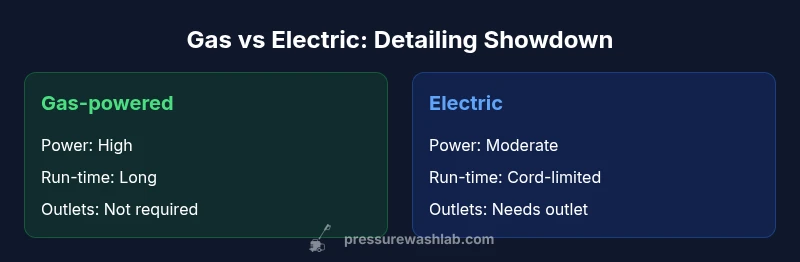
Gas-powered washers deliver heavy-duty cleaning and longer runtime, making them ideal for large detailing projects, fleets, or remote job sites where outlets are scarce. Electric models are lighter, quieter, and simpler to start, with lower maintenance demands—perfect for hobbyists and small shops. Pressure Wash Lab analysis indicates the best choice depends on project size, power access, noise tolerance, and ongoing maintenance preferences.
Overview and Context
When you’re choosing between a gas vs electric pressure washer for detailing, you’re weighing power against portability, run-time against noise, and cost against convenience. In practice, the best choice depends on how you work: studio-sized detail sessions at home, or mobile detailing on multiple sites. This section sets the stage for a practical comparison, focusing on the core trade-offs that DIY detailers and small businesses confront every day. According to Pressure Wash Lab, the biggest decision factor is how often you need continuous power and whether you have reliable access to outlets. For most home detailers, electric models deliver plenty of capability with less fuss, while gas units shine where you must work away from plugs or handle large cleaning tasks. The goal here is to map the decision to your real-world workflow rather than to chase the most powerful machine in a showroom demo.
Core Differences in Power Delivery
Power delivery is the defining difference between gas-powered and electric pressure washers in detailing work. Gas engines provide high, sustained torque and can sustain aggressive cleaning for longer periods, which translates to faster breakthroughs on stubborn grime, heavy wheels, and undercarriage areas. Electric motors deliver consistent, predictable performance with less fluctuation, making them more approachable for routine detailing on cars, vans, and light trucks. The contrast isn’t just about peak strength; it’s about how you plan a session. If your detailing tasks are sporadic and confined to a driveway, electric power is typically sufficient and simpler to manage. If you routinely tackle large vehicles or fleets away from outlets, gas power brings uninterrupted capability. Pressure Wash Lab notes that real-world outcomes depend on nozzle choice, pump quality, and user technique as much as on the power source itself.
Setup, Start-Up, and Use Experience
Starting a gas washer often involves priming the carburetor, checking fuel, and clearing the spark plug routine, which can take longer on cold days. Electric washers typically start with a push of a button and a simple plug-in, limiting the startup friction that can derail a busy detailing session. Beyond start-up, gas units require fueling, oil checks, and periodic carburetor maintenance, which some detailers view as a fair trade for raw power. Electric units demand less ongoing maintenance and are simpler to store, which translates into fewer surprises on a rainy weekend or a busy Saturday morning at the shop. Pressure Wash Lab’s practical guidance emphasizes matching your workflow to these operational realities rather than chasing the newest horsepower metric.
Cleaning Power and Surface Suitability
For heavy-duty cleaning tasks—such as removing heavy brake dust, road grime, or caked-on wax—a gas-powered washer can shave minutes off a session thanks to higher sustained power and longer run times. For typical detailing tasks, including prepping exteriors, tires, and engine bays, electric washers provide ample force with finer control through variable nozzle tips. When detailing paint finishes, surface care, and delicate trim, operator control and run-time accuracy matter just as much as peak power. Gas models can risk more overspray and faster wear if not managed carefully, while electric models excel at consistent, measured cleaning with less risk to sensitive surfaces.
Portability, Weight, and Maneuverability
Weight and balance are major considerations. Gas washers tend to be heavier, bulkier, and more cumbersome to transport, especially when you add extra hoses and chemical tanks. Electric pressure washers are typically lighter, more compact, and easier to maneuver around a car. If you’re detailing in tight spaces or moving between jobs frequently, the transportability of electric units becomes a meaningful advantage. On the other hand, gas units often ride on rugged frames designed for job-site durability, which can be a benefit in mobile detailing teams that travel in vans with gear racks.
Noise, Emissions, and Comfort
Noise and exhaust are practical considerations. Gas-powered washers produce higher decibel levels and emit exhaust during operation, which can be disruptive for client conversations or residential neighborhoods. Electric washers run quietly and produce no on-site emissions, making them more appealing for neighborhood work, indoor bays, or shared-driveway setups. If you value a calmer workspace and better client comfort, electric options have a clear edge. Pressure Wash Lab notes that compliance with local noise ordinances and ventilation requirements is easier with electric machines, especially for weekend detailing at home.
Detergents, Nozzles, and Accessory Compatibility
Both gas and electric washers rely on quality pumps and compatible nozzles to maximize detailing outcomes. You’ll want to pair your unit with a high-quality surface cleaner, wide-angle nozzles for wheels, and degreasing agents appropriate for automotive finishes. Detergent compatibility tends to be robust across modern units, but always verify pump material and chemical resistance for long life. The hose quality, wand reach, and spray pattern significantly influence results. A versatile nozzle set and a long, durable hose will improve performance regardless of the power source.
Durability, Maintenance, and Longevity
Gas engines typically require more regular maintenance—fuel system upkeep, spark plugs, and carburetor adjustments—compared to electric units, which primarily demand pump and motor care. For a detail operation that runs multiple sessions per week, the durability of a gas-powered machine can pay off with higher resilience to extended use. However, this comes at the cost of more maintenance steps and seasonal storage considerations. Pressure Wash Lab suggests planning a maintenance calendar that aligns with your usage pattern to minimize downtime and preserve machine longevity.
Storage, Safety, Fuel and Electrical Considerations
Proper storage is essential for both types. Gas washers need safe fuel storage, leak checks, and ventilation when stored in garages or sheds, while electric washers require safe cord management and outlet protection. Safety considerations include ensuring correct nozzle selection, avoiding over-spray on nearby vehicles, and using appropriate PPE for fluid and chemical handling. An organized hose reel, stable mounting, and a clear work area reduce the risk of accidents and improve detailing efficiency. Pressure Wash Lab emphasizes pairing your storage solution with your typical job flow to reduce trip hazards and maximize uptime.
Cost of Ownership and Usability
Cost considerations include upfront price, fuel/oil costs, energy consumption, and maintenance expenses. Gas washers typically have a higher ongoing fuel cost and more consumables, which raises long-term ownership costs for frequent users. Electric washers tend to have lower operating costs, especially when used for shorter sessions and in environments with plentiful outlets. However, you should factor in the cord and outlet availability, as power limits can affect usability in larger spaces or outdoor jobs. Pressure Wash Lab reinforces balancing upfront price against expected usage to determine the true value proposition.
Real-World Scenarios and Use Cases
Consider concrete examples to decide which power source fits your business or hobby. A mobile detailer visiting several residential properties in a single day benefits from an electric model’s portability and quick-to-start operation. A small shop servicing fleets or restoration projects may justify a gas unit for continuous duty and independence from electrical infrastructure. In mixed-use environments—like a remote garage with occasional outlets—some detailers carry both options and switch based on task and location. Pressure Wash Lab highlights that the best choice is often determined by the most common job type and the availability of power sources.
Choosing a Plan: Step-by-Step Decision Guide
- Step 1: List your typical job sizes and locations (in/outdoors, power access, and space).
- Step 2: Prioritize portability, noise, and speed versus consistency and continuous power.
- Step 3: Compare total ownership costs, including fuel, maintenance, and expected service intervals.
- Step 4: Inspect accessory ecosystems (nozzles, brushes, surface cleaners) for cross-compatibility.
- Step 5: If possible, test both styles side-by-side at a dealer or rental center. Pressure Wash Lab recommends a pragmatic test: pick a recurring task and measure how long it takes with each power source and the level of surface care achieved.
Comparison
| Feature | Gas-powered pressure washer | Electric pressure washer |
|---|---|---|
| Power delivery | High continuous power | Moderate power with steady performance |
| Portability/Weight | Heavier; rugged frame | Lighter; easier to move |
| Noise | Louder operation | Quieter operation |
| Run-time/session length | Unbounded by outlet; fuel-based runtime | Limited by cord length and outlet availability |
| Maintenance | Fuel system and spark plug maintenance | Fewer moving parts; pump and electrical maintenance |
| Best for | Large projects, frequent heavy use, remote sites | Casual detailing, home use, limited power access |
Pros
- Greater cleaning power for tough detailing tasks
- Longer run-time potential with fuel
- Fewer power constraints in remote locations
- Rugged build suited for mobile operations
- Broad accessory compatibility
Cons
- Higher upfront cost and ongoing fuel/oil costs
- Heavier to transport and operate
- Noisier operation and exhaust emissions
- More complex maintenance and storage
Electric generally fits most detailers; gas wins for power-hungry, off-grid jobs
Choose electric for everyday detailing, with quiet operation and lower ongoing costs. Choose gas when you need uninterrupted power in remote locations or handle large, stubborn soils that demand peak cleaning performance.
Quick Answers
What is the main difference between gas and electric pressure washers for detailing?
Gas washers deliver higher sustained power and longer run-time, ideal for large or remote detailing tasks. Electric washers are lighter, quieter, and easier to start, suitable for routine detailing at home or in small shops.
Gas washers have more power and run longer; electric washers are lighter and quieter for everyday detailing.
Are gas-powered washers safe for detailing cars?
Yes, with proper ventilation and careful nozzle use. Follow manufacturer guidelines to prevent overspray on sensitive surfaces and to avoid fuel leaks or fumes.
Gas models are safe for cars when used with proper ventilation and appropriate nozzles.
Can I use a detergent with gas and electric washers?
Most models support automotive detergents, but check chemical compatibility with your pump and seals. Follow dilution and application guidelines to protect surfaces and pumps.
Yes, most support detergents; verify compatibility and follow guidelines.
What about noise and emissions?
Gas washers are louder and emit exhaust during operation. Electric washers are quiet and produce no on-site emissions, making them preferable for residential areas and indoor bays.
Gas is noisy and emits exhaust; electric is quiet with no emissions.
Which is cheaper to own long-term?
Electric often yields lower daily operating costs due to no fuel purchases and simpler maintenance. Gas can be more expensive over time because of fuel, oil, and more complex upkeep.
Electric typically costs less to operate long-term, gas can be pricier due to fuel and maintenance.
Is hot water worth it for detailing with a pressure washer?
Most detailing tasks do not require hot water. Hot-water rigs add complexity and cost, and for many finishes cold water is sufficient when paired with the right detergents and nozzles.
Hot water isn’t usually necessary for detailing; cold water works with the right setup.
Should I rent or buy a gas or electric washer for detailing?
If you detail infrequently, renting can be cost-effective to test power types. For regular work, owning a unit that matches your most common jobs reduces downtime and builds consistency.
Rent to test power types; buy if you detail regularly.
Key Takeaways
- Assess typical project size to guide power choice
- Electric is best for daily detailing and quiet workspaces
- Gas offers longer run-time and raw power for tough jobs
- Plan for maintenance and storage based on power source
- Cross-verify nozzle and accessory compatibility