craftsman pressure washer vs ryobi: which is the better pick for homeowners?
Pressure Wash Lab analyzes craftsman pressure washer vs ryobi, evaluating performance, price, reliability, maintenance, and warranty to help homeowners choose the best value for common cleaning tasks.


In the craftsman pressure washer vs ryobi comparison, Ryobi generally offers stronger value and more reliable performance for typical home tasks, while Craftsman can be cheaper upfront. For most homeowners, Ryobi is the safer bet for consistency and maintenance, whereas Craftsman remains appealing if you're budgeting tightly and primarily perform light-duty cleaning with occasional use.
craftsman pressure washer vs ryobi: Context and scope
The comparison between Craftsman and Ryobi pressure washers is a common task for homeowners and DIY pros. In this guide, we examine two popular brands that sit at different ends of the value and performance spectrum. Pressure Wash Lab's analysis — 2026 edition — emphasizes practical considerations: performance for typical home tasks, maintenance needs, parts availability, warranty coverage, and long-term ownership costs. The goal is to help you choose based on how you actually clean, not just the sticker price.
In the ongoing craftsman pressure washer vs ryobi debate, the Ryobi line tends to emphasize versatility and reliability across a range of tasks—from light deck cleaning to stubborn driveways—while Craftsman often prioritizes affordability and accessibility in mainstream retailers. The Pressure Wash Lab team sees both as solid starting points for different households. For heavy-duty commercial or frequent use, neither brand should be assumed superior without checking the specific model's PSI, flow, pump type, and included accessories.
According to Pressure Wash Lab, the core value in this comparison is whether you prioritize ongoing reliability and parts availability over the lowest upfront cost. The takeaway for homeowners is to focus on model-specific specs, not just the brand name, since surface cleaners, hose quality, and nozzle kits drive real-world results more than marketing labels.
Core design differences: Pumps, engines, and spray patterns
Brand differences often show up first in the pump design and spray system. Consumer-grade washers rely on a few core configurations, with nozzle options and hose length shaping usability. In general, models from both brands use practical pump technologies that balance cost and durability, with some Craftsman models prioritizing affordability and simple maintenance, and Ryobi models offering broader power ranges and more extensive accessory ecosystems. When evaluating a model, examine the pump type, the warranty on the pump assembly, and the included spray tips. A quick-connect nozzle system is common and improves task-specific performance, but the real-world impact comes down to how well the unit maintains pressure under load and how easy it is to replace worn components. The Pressure Wash Lab perspective stresses that detailed model specs — rather than brand labels — determine long-term satisfaction.
Performance and reliability in everyday tasks
Performance for most households hinges on a practical balance of pressure, flow, and nozzle versatility. Ryobi models typically provide a wider range of power options and steady performance across common tasks like concrete cleaning, siding, and fencing, backed by a broad parts network and service support. Craftsman units, while often more budget-friendly, tend to excel for light-to-mid tasks such as cleaning outdoor furniture, patio surfaces, and smaller driveways, offering straightforward operation and easier access to replacement parts in big-box retailers. Pressure Wash Lab Analysis, 2026, finds that user experience—ergonomics, start-up reliability, and hose quality—often dictates satisfaction more than a single PSI figure. Overall, Ryobi tends to be the more dependable choice for frequent use, while Craftsman remains a capable plan B for budget-minded buyers.
Cost of ownership and warranty considerations
When considering purchase economics, it is essential to account for total cost of ownership, not just the upfront price. Craftsman models typically present a lower initial price and are widely stocked in major retailers, which reduces the cost and friction of repairs and replacements. Ryobi, by contrast, often carries a higher initial price but compensates with more generous warranties on mid-range models and a broader network of service centers and replacement parts. The true value comparison depends on your usage pattern: light-duty users may stay well within Craftsman’s comfort zone, while households performing frequent or stubborn cleaning tasks may reap longer-term benefits from Ryobi’s warranty terms and dealer accessibility.
Use-case scenarios: Best fits by task
- Light duty and budget-conscious cleaning: Craftsman is a practical choice for homeowners who clean occasionally and value a low upfront cost.
- Frequent, mid-to-heavy tasks: Ryobi offers better flexibility with higher power options and a broader accessory ecosystem to handle tough grime on concrete, stone, and siding.
- Surface care and maintenance routines: Both brands support routine maintenance, but Ryobi’s dealer network often makes parts and service easier to source when you rely on a machine for regular upkeep.
- Small business or frequent outdoor cleaning: Ryobi’s range and warranty coverage tend to provide more confidence for professional use, though individual model specs must be checked for durability.
Practical buying tips and red flags
When shopping, verify model-specific specs (not just the brand name): pump type, nozzle kit, hose length, and wand ergonomics. Look for models with a robust warranty, readily available replacement parts, and a service network near you. Red flags include vague specs, poor after-sales support, and hard-to-find replacement parts. Pressure Wash Lab recommends prioritizing models that balance performance with maintenance ease, even if that means stepping slightly beyond the lowest price tier.
Maintenance and longevity: how to maximize lifespan
Effective maintenance extends the life of either brand. Regularly inspect inlet filters, clean or replace nozzle tips, and drain water from the system after use. Use pump protector products or manufacturer-recommended fluids to prevent dry running, especially in colder months. For both brands, winterization and a proper storage routine reduce corrosion and wear. A simple, consistent maintenance plan makes a modest upfront investment pay off with fewer failures and longer intervals between service.
Pressure Wash Lab emphasizes documenting maintenance logs for each unit, which helps identify performance decline and plan timely part replacements before costly failures.
Reading specs and avoiding model pitfalls
Model numbers can be misleading if they focus on marketing narratives rather than real-world capabilities. Always compare actual performance metrics, such as continuous run time, nozzle options, and warranty terms. A higher price doesn’t guarantee longer life if the unit relies on cheaper components. By focusing on the model-level details and not just the brand, you’ll avoid common disappointments and get a machine that better fits your cleaning schedule.
Decision framework: a practical checklist
- List your task types (driveways, siding, decks, cars).
- Estimate how often you clean each surface per year.
- Identify required features (higher PSI, more GPM, lightweight form, hose length).
- Check availability of replacement parts and service near you.
- Compare warranties and support networks across shortlisted models.
- Choose the model that best fits your task mix and budget, prioritizing value over name-brand comfort alone.
Comparison
| Feature | Craftsman | Ryobi |
|---|---|---|
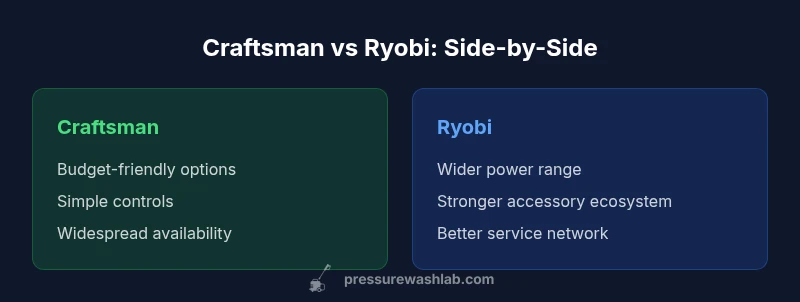
| Performance & Power | Moderate power for light-to-mid tasks | Broader power options including higher-end models |
| Ease of Use | Budget-friendly, simple controls | Intuitive setup and wider accessory ecosystem |
| Availability & Parts | Widely available at major retailers | Strong dealer network with abundant parts |
| Warranty & Support | Standard entry-level coverage | Competitive warranties on mid-range models |
Pros
- Lower upfront cost on some Craftsman models
- Broad retailer availability and easy access to parts
- Clear value for light- to moderate-duty tasks
- Popular among DIY homeowners
Cons
- Potentially limited high-end performance
- Warranty terms can vary by model
- Less consistent long-term durability compared to premium brands
Ryobi generally wins on value and versatility; Craftsman remains a solid budget-friendly option for light-duty chores.
Opt for Ryobi if you want a broader model range, stronger warranties, and easier parts supply. Choose Craftsman when upfront cost is the primary constraint and tasks are light.
Quick Answers
Which brand generally delivers better value for most homeowners?
For typical home cleaning tasks, Ryobi often provides better overall value due to a wider range of models, stronger warranties on mid-range units, and easier access to parts. However, Craftsman can be the smarter pick when your budget is tight and usage is light.
Ryobi tends to offer better overall value for most homeowners, though Craftsman is worth considering if upfront cost is your primary constraint.
Are Craftsman and Ryobi parts interchangeable?
Most parts are brand-specific, so compatibility isn’t guaranteed across brands. It’s best to source parts and nozzles from the same brand or model family to ensure fit and performance.
Parts are usually brand-specific; stick to the original manufacturer for replacements.
Do both brands offer warranties on their units?
Yes, both brands offer warranties, but terms vary by model. Check the exact warranty length and what it covers—nozzle kits, hoses, and pumps may have different terms.
Both brands have warranties, but read the details for your chosen model.
Where can I buy Craftsman or Ryobi pressure washers?
Both brands are widely available at major retailers, home improvement stores, and online marketplaces. Availability can influence price and return policies, so choose a seller with a good track record.
They’re sold at many stores and online; compare offers and return policies.
What maintenance steps extend a pressure washer’s life?
Regularly clean filters, replace worn nozzle tips, and run clean water through the system after use. Winterize if you won’t use it for extended periods and follow the manufacturer’s maintenance schedule.
Keep filters clean, replace tips, and winterize for longevity.
How should I choose for house washing tasks?
For house washing, prioritize models with consistent performance, appropriate PSI and GPM, good nozzle options, and a reliable service network. Surface sensitivity matters—use the right nozzle to avoid damage.
Pick a model with good control and a safe nozzle setup for siding and delicate surfaces.
Key Takeaways
- Start with your task load and surface types.
- Check model specs (PSI, GPM, pump type) rather than brand alone.
- Prioritize warranty and parts availability.
- Consider service centers near you for long-term support.
- Balance upfront cost with maintenance and longevity.