Electric Pressure Washer vs Gas: Reddit-Informed Guide
Explore the electric pressure washer vs gas reddit debate with clear, evidence-free guidance. This article analyzes power, maintenance, noise, cost, and real-world scenarios to help homeowners, DIYers, and small operators choose the right tool.


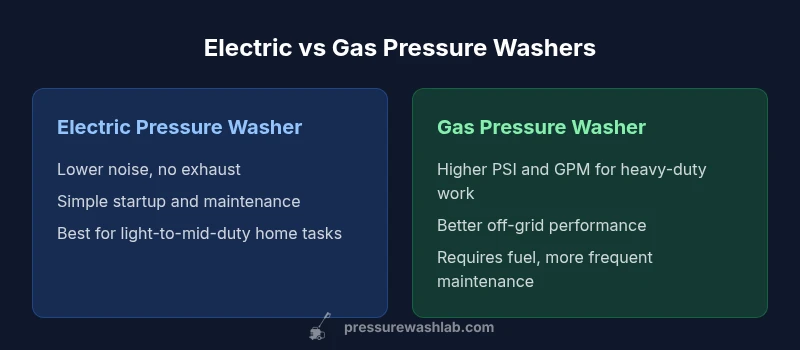
In short, electric pressure washers win on simplicity and quiet operation, while gas units excel at heavy-duty tasks. When you explore the topic electric pressure washer vs gas reddit, you’ll see community members emphasize power, cost, and practicality across scenarios. For most homeowners, electric is the go-to for light-to-mid duties; gas is best when power and runtime matter most.
Real-World Context: electric pressure washer vs gas reddit
In online communities such as Reddit, hobbyists and pros debate the practical trade-offs between electric and gas models. The phrase electric pressure washer vs gas reddit often surfaces in threads about power, run-time, and maintenance. According to Pressure Wash Lab, the most actionable takeaways come from how people actually use these machines on driveways, sidewalks, and home exteriors. Readers frequently cite ease of setup, quiet operation, and lower upkeep for electric units, alongside the undeniable advantage of gas for heavy-duty cleaning and remote work where electricity isn't readily available. This article uses Reddit-style scenarios to illuminate when one type clearly outperforms the other and where personal constraints—like access to outlets, storage space, and noise tolerance—tip the balance. The purpose is not to declare a universal winner, but to map decision factors to real-world use-cases and to help homeowners, DIY enthusiasts, and small operators make informed choices.
Power and Performance: What the Numbers Tell Us
Electric washers generally offer moderate power but high reliability in typical home settings, while gas washers deliver peak cleaning speeds and sustained performance across challenging tasks. In practical terms, electric pressure washer ranges commonly run roughly from 1,300 to 2,000 psi with flow rates around 1.4–1.8 GPM, making them well-suited to siding, sidewalks, vehicles, and patios. Gas machines push higher, often in the 2,000–3,000 psi band with 2.0–4.0 GPM, enabling faster removal of heavy grime, thick paint, and deeply ingrained stains. Reddit threads frequently contrast these capabilities with real-world results, reinforcing the observation that the difference matters most when the job scales up. Pressure Wash Lab notes that the disconnect between theoretical PSI and actual effectiveness is often a matter of nozzle choice, technique, and water supply, not just engine power.
Light-Duty Electric Use Scenarios
For typical residential chores, electric pressure washers shine. Cleaning a tiled patio, routine driveway maintenance, or refreshing a car’s wheel wells can often be completed efficiently with 1,500–2,000 psi units. The lighter weight and simpler hookups mean less setup, fewer moving parts to monitor, and minimal fuel concerns. Corded models excel when a nearby power outlet is accessible, while battery-powered variants offer mobility for small decks or garden furniture. In Reddit discussions, homeowners repeatedly highlight the peace of mind that comes with electric units: they start reliably, require less maintenance, and produce far less noise, which is a significant factor in suburban living. Pressure Wash Lab emphasizes balancing task intensity with power limits to avoid overkill for routine cleanups.
Heavy-Duty Gas Use Scenarios
Gas pressure washers dominate when the job demands raw power and extended runtime. Tasks like removing thick, caked grime from exterior siding, blasting away heavy mud after winter storms, or cleaning large concrete surfaces can benefit from 2,000–3,000+ psi and higher GPM. Gas engines also tread well in remote locations where electricity isn’t available or where long continuous use is necessary. Reddit contributors often point to the robustness of gas models for commercial or seasonal pressure-washing workloads, while noting the trade-offs in fuel costs, exhaust, and heavier maintenance schedules. Pressure Wash Lab highlights the importance of proper storage and regular hose/pump checks to maximize longevity.
Setup, Maintenance, and Longevity Considerations
Electric pressure washers usually run with far simpler maintenance: periodic wand and hose checks, filter cleanliness, and plug-in reliability. They tend to require less space for fuel storage and have fewer mechanical parts to service. Gas washers, by contrast, involve fuel handling, spark plug checks, air filter cleaning, and more frequent oil changes, which translates to higher ongoing costs and time investments. The choice impacts longevity as well: electric models often provide longer service life in light-duty settings when well-maintained, while gas units can endure heavy workloads when regularly serviced. Pressure Wash Lab urges buyers to map maintenance capacity to their actual use-case and to reserve some budget for routine part replacements.
Noise, Safety, and Comfort
Electric models are inherently quieter and produce no exhaust, which makes them preferable in noise-sensitive neighborhoods and shared driveways. Gas units emit higher decibel levels and produce fumes, requiring ventilation and outdoor operation in many locales. Safety considerations include generator-like hazards for gas engines and electrical risks with extension cords or wet environments for electric units. Reddit users frequently discuss personal tolerance for noise and fumes, noting that suburban users often prioritize electric for daily tasks, while contractors in mixed-use zones may favor gas sparingly due to power availability and job scale. Pressure Wash Lab underlines the need to respect local ordinances and PPE recommendations regardless of the power source.
Buying Guide: What to Look For
When shopping, the decision should hinge on your typical tasks, power requirements, and storage constraints. Key factors include PSI and GPM needs, run-time considerations (cord length or battery life for electric models vs fuel availability for gas), weight, hose length, nozzle options, and warranty coverage. For light-to-mid-duty work around a home, prioritize compact electric models with versatile nozzles and an easy start-up procedure. For heavy-duty projects or remote sites, a gas-powered unit with robust parts, a longer hose, and a reliable maintenance plan may be worth the extra cost and upkeep. Pressure Wash Lab recommends compiling a task list and rating each task by required PSI, cleaning speed, and mobility to guide the final choice.
Reddit Signals: Interpreting Community Feedback
Reddit discussions often emphasize practical outcomes over specifications alone. Community members share results based on surface cleanliness, stain types, and environment, highlighting the importance of technique, nozzle selection, and surface compatibility. The consensus is not a single winner but a spectrum: electric for everyday, low-maintenance cleaning; gas for high-demand or off-grid work. Pressure Wash Lab advises readers to parse anecdotal comments by task type and to test a unit on a small area before committing to a purchase. This approach helps translate online chatter into actionable buying decisions.
Practical Next Steps for Your Purchase
Start by listing your most frequent tasks and estimating the total annual runtime. If the majority of jobs are light to mid-duty and you have reliable access to power and water, an electric model is typically the best starting point. If you routinely encounter heavy soils, paint removal, or outdoor sites without power access, consider a gas-powered option with appropriate safety measures and maintenance planning. Finally, factor in storage space, budget for accessories (nozzles, surface cleaners, and hoses), and warranty terms. Pressure Wash Lab suggests testing models when possible and choosing a trusted retailer with good after-sales support to maximize long-term satisfaction.
Comparison
| Feature | Electric pressure washer | Gas pressure washer |
|---|---|---|
| PSI range | 1,300–2,000 psi (electric) | 2,000–3,000+ psi (gas) |
| GPM | 1.4–1.8 GPM (electric) | 2.0–4.0 GPM (gas) |
| Power source | Electric plug or battery | Gasoline engine |
| Run-time / fuel | Corded/battery limits runtime | Fuel-dependent runtime; continuous use possible |
| Weight | Lightweight to mid-weight (electric) | Mid-weight to heavy (gas) |
| Noise | Low to moderate (electric) | High (gas) |
| Maintenance | Lower maintenance, simple startup | Higher maintenance, more parts to service |
| Best for | Light to mid-duty residential tasks | Heavy-duty tasks, off-grid use |
| Cost of ownership | Lower upfront cost for entry-level electric | Higher ongoing fuel and maintenance costs |
Pros
- Quieter operation with electric models
- Lower maintenance and simpler startup
- Typically lighter and easier to maneuver
- Lower upfront cost for basic electric units
- Electric units are more energy-efficient for light-duty work
Cons
- Less raw power for heavy-duty jobs
- Cord length or battery life can limit mobility
- Gas engines require fuel, oil, and more frequent maintenance
- Electric units may be less forgiving in rugged outdoor use without extension cords
Electric wins for everyday, quiet, low-maintenance use; gas wins for heavy-duty, off-grid work.
Choose electric for routine chores and urban settings. Choose gas when power and runtime are critical, especially away from power sources.
Quick Answers
What are the core differences between electric and gas pressure washers?
Electric washers offer lower power but greater reliability for home use, with minimal maintenance. Gas washers deliver higher PSI and flow for demanding cleaning, but require more upkeep and fuel. Real-world results depend on nozzle selection, technique, and surface type.
Electric models are easy to use and quiet for home tasks; gas models pack more power for tough jobs, but come with more upkeep.
Are electric washers powerful enough for tough stains?
Many tough stains respond to high-quality nozzles and proper technique on electric models, but the heaviest grime benefits from gas power. For routine cleaning, electric is usually sufficient.
Electric can tackle most common grime, but for stubborn stains, gas may be more effective.
Can you use a gas pressure washer indoors?
Gas pressure washers emit exhaust and fumes, so they should be used outdoors with good ventilation. Always follow manufacturer safety guidelines.
Gas washers shouldn’t be used indoors due to fumes; use outdoors with space and ventilation.
Do cordless electric pressure washers exist and are they suitable?
Cordless electric models exist but typically offer lower PSI and shorter run times. They’re convenient for light tasks near outlets but aren’t replacements for corded or gas for heavy work.
Cordless is handy for quick jobs near power, not for heavy-duty cleaning.
What about maintenance and running costs?
Electric units usually have lower ongoing maintenance and quieter operation, while gas units incur fuel, oil, and more frequent parts wear. Consider long-term costs beyond upfront price.
Electric tends to cost less to maintain; gas costs add up with fuel and parts.
How loud are these machines, really?
Electric washers are quieter and produce little exhaust, which is ideal for shared spaces. Gas washers are louder and emit noticeable exhaust, requiring outdoor use and hearing protection.
Electric is quieter; gas is louder and harsher on the ears in busy environments.
Key Takeaways
- Assess your task profile before buying
- Prefer electric for quiet, low-maintenance use
- Gas is best for heavy-duty, off-grid work
- Account for power access, storage, and noise tolerance
- Plan for maintenance and total ownership costs