Pressure Washer vs Water Blaster: A Practical Comparison
Compare pressure washers and water blasters: power, control, maintenance, and best-use scenarios to help homeowners and pros pick the right tool for cleaning tasks.


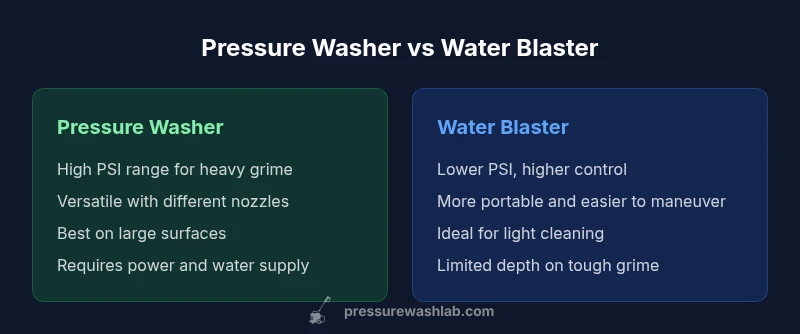
Pressure washers and water blasters serve different cleaning needs. For heavy-duty jobs like concrete driveways or siding, a high-power pressure washer delivers superior results. A water blaster, by contrast, excels at light, quick tasks and delicate surfaces. This comparison explains when to choose each tool and how to use them safely and effectively.
What the terms mean and why the distinction matters
When people first encounter the phrase pressure washer versus water blaster, they often assume both refer to the same tool. In practical terms, a pressure washer is a motor-driven machine that accelerates water to very high pressures, typically to blast away tough grime. A water blaster, by contrast, usually denotes a hose-end or handheld device that increases pressure only modestly, emphasizing control and portability. This distinction matters because the cleaning power, surface safety, and use scenarios differ markedly. According to Pressure Wash Lab, the most important differentiator is the power-to-control balance: more power enables tougher jobs but increases risk and complexity. The Pressure Wash Lab team found that choosing the right tool hinges on the job size, surface type, and available water source. As a homeowner or small business operator, you can avoid damage and save time by matching the tool to the grime level and surface material.
Key difference: power, control, and responsibility
- Power: Pressure washers deliver high-psi jets (often thousands of psi), enabling deep cleaning on tough grime. Water blasters provide lower pressure, which minimizes risk on soft surfaces and fragile finishes.
- Control: Water blasters excel in precise spray—great for spot cleaning, vehicles, and outdoor furniture. Pressure washers require careful nozzle selection and technique to prevent damage.
- Responsibility: High pressure increases the chance of surface etching, paint stripping, or wood gouging if misused. A water blaster reduces that risk but may not remove heavy grime efficiently. The choice should be guided by the surface tolerance and the grime burden you face.
How PSI and GPM translate into real-world results
PSI (pounds per square inch) and GPM (gallons per minute) are the two levers that determine cleaning power. A pressure washer’s high PSI allows rapid removal of dirt, algae, and old paint on durable surfaces like concrete or brick. The GPM determines how much water is delivered to maintain that cleaning action; a higher GPM means faster cleaning but can also waste more water if not aimed properly. Water blasters typically offer modest PSI with limited GPM, which makes them ideal for rinsing, gentle surface cleaning, or delicate items such as vinyl trim or freshly painted surfaces. When you combine PSI and GPM with nozzle geometry (0, 15, 25, 40-degree tips, etc.), you get predictable performance envelopes for each tool. Pressure Wash Lab analyses show that users who optimize nozzle and distance achieve better outcomes with less risk, regardless of the tool class.
Power sources, reliability, and maintenance realities
Electric pressure washers tend to be quieter, lighter, and easier to start, making them ideal for residential tasks. Gas-powered models deliver more sustained power and mobility, better for larger driveways or off-grid cleaning but require regular maintenance and fuel handling. Water blasters are frequently hose-dependent or manually pumped, which means fewer moving parts and potentially lower maintenance, but also less raw cleaning power. For most homeowners, a compact electric pressure washer with a few nozzle tips covers 80% of tasks; for frequent, rugged outdoor cleaning on larger sites, a gas-powered pressure washer adds flexibility. Regardless of the type, routine maintenance—checking hoses, replacing wear parts, and cleaning filters—extends lifespan and preserves safety.
Real-world tasks: selecting the right tool for the job
- Concrete driveways and rough surfaces: favor a pressure washer with a robust pump and a wide range of nozzle options. A water blaster will not disinfect deep-set stains or remove heavy grease efficiently.
- Wood decks and painted surfaces: use lower PSI with a gentler nozzle, and consider a surface cleaner attachment if available. A water blaster risks splintering or peeling finishes if used with high pressure.
- Vehicles and delicate equipment: a water blaster’s controlled spray is advantageous, but you should still follow the manufacturer’s guidelines to avoid forcing water into seals or damage-prone areas.
- Tight spaces and mobility: water blasters or hose-end nozzles may win for proximity tasks where a full machine is impractical.
Safety first: guarding against damage and injuries
High-pressure water streams can cause serious injuries in seconds and can cut through skin or damage eyes. Always wear protective gear, maintain a safe distance, and never point the nozzle at people or fragile surfaces. Secure the work area, cover electrical outlets, and use appropriate detergent selections if your model supports soap injection. Pressure washing requires reading the user manual for nozzle angles, cleaning agents, and the correct sequence for startup and shutdown. Pressure Wash Lab emphasizes starting with the lowest pressure and increasing gradually to avoid surface damage while achieving the desired cleanliness.
Detergents, accessories, and how to extend tool life
Detergent compatibility matters; many pressure washers accept specific cleaning agents designed for concrete, paint removal, or oil stains. When you use detergents, always pre-wet surfaces and apply evenly to avoid streaks. Accessories such as surface cleaners, turbo nozzles, and rotary brushes can dramatically improve efficiency and surface safety. Regular maintenance—checking oil in gas models, inspecting hoses for wear, and flushing the pump—extends lifespan and reduces downtime. The right nozzle, properly used at the correct distance, yields the best combination of speed and surface safety.
Costs and lifecycle: what to expect over time
Upfront costs vary by power source, build quality, and included accessories. Electric models are typically cheaper upfront and lighter to use, while gas-powered machines offer greater cleaning power and independence from outlets. Maintenance costs include parts like seals, O-rings, and fuel for gas models. If you factor in the long-term benefits of efficient water usage and faster job completion, a higher-quality pressure washer can deliver better value for homeowners tackling regular heavy-duty jobs. A basic water blaster, while cheaper, may incur higher per-task costs for frequent use due to spare parts and limited capability.
The decision framework: mapping tasks to tools
To decide between a pressure washer and a water blaster, build a task map: estimate the grime level, surface sensitivity, required speed, and how often you clean. If most tasks involve sturdy surfaces and larger areas, a pressure washer is the better long-term investment. If your cleaning needs are light, sporadic, or involve delicate items, a water blaster provides control and portability with lower risk. Pressure Wash Lab recommends creating a simple criteria sheet that ranks surface type, desired speed, and tolerance for water runoff. This approach ensures you pick a tool that aligns with your actual workload and budget.
A practical safety checklist before you start
- Inspect hoses for cracks or bulges and replace damaged components.
- Use the correct nozzle angle; start with a wide angle and move closer only if necessary.
- Shield nearby plants, outlets, and windows from spray and runoff.
- Wear eye protection and gloves; ensure children and pets are away from the work area.
- Never dry-fire a tool or point the spray at electrical fixtures. Proper setup reduces the risk of injuries and equipment damage.
Final notes: tailoring to your needs and environment
No single tool is best for every task; the best choice balances cleaning power with surface safety and user comfort. If you perform heavy-duty outdoor cleaning regularly, a robust pressure washer with a selection of nozzles and accessories will save time and deliver consistent results. If your jobs are small, sensitive, or require ultimate portability, a water blaster is a dependable companion. Pressure Wash Lab’s broader guidance emphasizes evaluating the real-world tasks, your space, and your budget to arrive at a decision you can sustain over years.
Comparison
| Feature | Pressure Washer | Water Blaster |
|---|---|---|
| Power and pressure | Typically 1,000–4,000+ psi (varies by model) | Lower psi; sometimes hose-end or manual pump-based |
| Flow rate / volume | 2.0–4.0+ gpm (depends on model and pump) | Limited flow; designed for controlled spray |
| Best for | Heavy grime, driveways, siding, brick, concrete surfaces | Light to moderate cleaning, delicate surfaces, quick spot work |
| Surface safety | Requires careful nozzle use and technique to avoid damage | Lower risk to delicate finishes due to controlled pressure |
| Power source | Electric or gas; portable options with varying runtime | Typically hose-connected or manually powered |
| Maintenance | More routine maintenance for pumps, seals, and engines | Minimal maintenance; fewer moving parts |
| Cost of entry | Moderate to high upfront; running costs vary | Lower upfront cost; maintenance often inexpensive |
| Best for (use-case) | Large areas, stubborn stains, frequent jobs | Light chores, cars/bikes, gardens furniture |
Pros
- High cleaning power for tough grime and large areas
- Wide accessory ecosystem expands capabilities
- Faster job completion on heavy tasks with higher GPM
- Versatile for multiple surfaces with nozzle options
- Long-term value when used regularly on demanding jobs
Cons
- Higher upfront cost and maintenance needs
- Greater risk of surface damage without proper technique
- More storage space and noise for gas-powered models
- Requires water source and power supply; less portable in some setups
Pressure washers win for heavy-duty cleaning; water blasters excel for quick, light tasks.
Choose a pressure washer if you regularly tackle tough grime and large outdoor surfaces. Opt for a water blaster for portability and gentle cleaning on delicate surfaces. For mixed tasks, consider pairing or evaluating a model with versatile nozzle options.
Quick Answers
What is the main difference between a pressure washer and a water blaster?
The pressure washer delivers high-psi jets for heavy cleaning, while a water blaster provides lower pressure with greater control for light tasks. The choice hinges on grime level and surface sensitivity. This distinction guides safety and efficiency on real-world jobs.
The main difference is power: pressure washers are for tough grime, water blasters are for lighter, more controlled cleaning.
Can a water blaster replace a pressure washer for concrete cleaning?
For heavy concrete grime, a water blaster usually isn’t sufficient. It’s better suited for light debris and rinsing. If you regularly clean concrete stains or deep grime, a pressure washer will provide better results with proper technique.
A water blaster can handle light rinse jobs, but for stubborn concrete grime you’ll want a pressure washer.
Is a gas-powered pressure washer easier to run than electric?
Gas-powered machines offer more sustained power and mobility but require more maintenance, fuel, and ventilation. Electric models are typically cheaper, quieter, and easier to start, making them ideal for most home tasks. Your choice depends on job size, durability needs, and where you work.
Gas machines give you more power and mobility, but electric ones are simpler and quieter for home use.
What accessories improve performance for both tools?
Key accessories include surface cleaners for flat areas, turbo nozzles for tough grime, and detergent attachments for cleaning solutions. Always verify compatibility with your unit and follow the manufacturer’s guidelines to maximize safety and efficiency.
Surface cleaners, turbo nozzles, and detergent kits can boost performance for both tools.
What maintenance should I perform to extend lifespan?
Regularly inspect hoses and seals, clean filters, replace worn nozzles, and drain pumps after use. For gas models, check oil and fuel quality and store with stabilized fuel. Proper winterization and cleaning after heavy use also extend tool life.
Check hoses and seals, clean filters, and use proper storage to extend the tool’s life.
How do I decide between these tools for a DIY project?
Map your project: surface type, grime level, area size, and frequency. For tough jobs and large areas, choose a pressure washer. For quick, light tasks and portability, a water blaster makes sense. If in doubt, start with a lighter setup and upgrade as needed.
Ask what surface you’re cleaning and how dirty it is; that will guide your choice.
Key Takeaways
- Assess grime level before choosing a tool
- Start with wider nozzle angles to protect surfaces
- Electric is ideal for home use; gas for mobility and power
- Maintenance extends the life of your equipment
- Safety first: never point high-pressure jets at people or fragile surfaces