What Pressure Washer PSI Do I Need: A Practical Guide
Discover how to choose the right pressure washer psi for driveways, siding, and more. This Pressure Wash Lab guide covers PSI ranges, GPM, nozzle tips, and safety for homeowners and pros.


If you're asking what pressure washer psi do i need for typical home tasks, the quick answer is that most homeowners benefit from a versatile range around 1800–2600 psi. For delicate surfaces like painted siding or wood with finishes, start at 1200–1500 psi and test a small area. For hard-to-clean concrete or heavy buildup, 2500–3200 psi may be appropriate. Always match PSI to surface and use an appropriate nozzle.
What pressure washer psi do i need for common tasks
According to Pressure Wash Lab, choosing the right pressure washer psi is a balance between cleaning power and protecting surfaces. The goal is to apply enough force to lift dirt without etching wood, blasting away shingle granules, or stripping paint. When you ask what pressure washer psi do i need, think in terms of both the surface and the build-up. Start with a mid-range setting (around 1800–2000 psi for many residential tasks) and adjust based on results from a small test patch. Remember that PSI is only part of the equation—GPM (gallons per minute) and nozzle geometry drive overall cleaning speed and safety. Always wear eye protection and follow manufacturer guidelines for each surface.
How PSI translates to cleaning power
PSI, short for pounds per square inch, measures the force of the water jet. But cleaning effectiveness also depends on GPM, nozzle angle, and spray pattern. A higher PSI increases the jet's pressure, but a narrow nozzle (like a 0-degree) can gouge surfaces if misused. A broad nozzle (like 25 or 40 degrees) distributes the same PSI over a wider area, reducing risk while still clearing grime. For bulkier grime or moss, you may need more PSI, but apply it judiciously—risk to surfaces rises with pressure, especially on wood, old paint, and soft masonry.
PSI ranges by surface and task
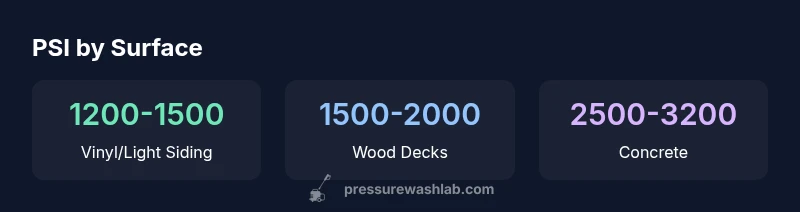
Different surfaces tolerate different PSI. For light exterior cleaning (vinyl siding, brick dust, light algae), 1200–1500 psi is typically safe with a wide spray. Wood decks and fences usually respond well to 1500–2000 psi, testing first on a hidden area to avoid gouging or fiber lift. Concrete driveways and tough buildup often require 2500–3200 psi, preferably with a wider nozzle and higher GPM to avoid streaks. Cars and painted metal typically need 800–1200 psi with a gentle spray and a detergent-specific nozzle.
Choosing PSI vs GPM: balancing power and safety
PSI and GPM work together. A higher PSI with low GPM can cut through grime quickly but risks surface damage; a lower PSI with higher GPM can wash more area efficiently and reduce streaking. For most homes, a pressure washer in the 1800–2600 psi range with 1.8–2.5 GPM provides a practical balance for driveways, siding, and fences. If you frequently clean large surfaces or tough grime, consider a unit with adjustable PSI and robust GPM to adapt to different jobs.
Real-world examples: driveway, siding, and cars
A typical driveway deep-clean might start with a 2300–3000 psi setting using a 25-degree nozzle and 2.0 GPM. For vinyl siding or painted surfaces, drop to 1200–1500 psi and test first on a hidden section. A car wash should stay in the 800–1200 psi range with a broad spray and special car-wash detergents. Each job requires a patch test to confirm the surface tolerates the chosen PSI. Pressure Washing Lab recommends documenting the initial test results to guide future work.
How to measure and adjust psi safely
Many machines include an adjustable unloader valve or a pressure regulator. Start at a conservative setting and increase in small increments, testing on inconspicuous areas after each adjustment. Use a gauge if your unit lacks one to verify PSI. Always use the appropriate nozzle. For delicate surfaces, begin with a wide-angle nozzle (40 degrees) and gradually move to a narrower spray if the surface tolerates it. Stop immediately if you see etching, peeling, or fiber lift.
Common mistakes and how to avoid them
- Using high PSI on soft surfaces like wood without testing first. - Skipping test patches; always verify on a discreet spot. - Failing to adjust nozzle and mistake of using a 0-degree spray near edges. - Not accounting for surface materials; metal, painted surfaces, and vinyl each require different approaches. - Rushing through jobs; slow, methodical passes prevent streaks and damage.
PSI guidelines by surface
| Task surface | Suggested PSI | Notes |
|---|---|---|
| Light cleaning: vinyl siding | 1200-1500 | Test on inconspicuous area |
| Wood deck/fence | 1500-2000 | Check for finish damage |
| Concrete driveway | 2500-3200 | Use wider spray pattern for safety |
| Car washing (detailing) | 800-1200 | Low pressure with soap |
Quick Answers
What is the minimum PSI for basic cleaning?
For most exterior tasks, starting around 1200-1500 psi is sensible. Always patch-test first to ensure surface compatibility.
For most basic exterior cleaning, start at 1200 to 1500 psi and test a small area first.
Can I use the same PSI for all surfaces?
No. Surfaces vary in hardness and finish. Always adjust PSI and nozzle type based on the material and condition.
No—different surfaces need different PSI and nozzle choices. Test first.
Is GPM more important than PSI?
Both matter. PSI affects cleaning power per area, while GPM affects cleaning speed and how much water is delivered. Aim for a balance that suits your tasks.
Both PSI and GPM matter; balance them for efficiency and safety.
What happens if I use too high PSI on soft surfaces?
High PSI on soft surfaces can etch, gouge, or strip coatings. Always start low and test before proceeding.
Too high PSI can damage soft surfaces—test first and start low.
Which nozzle tips should I start with?
Begin with a wide-angle nozzle (40 degrees) for general cleaning and detergent application. Move to narrower angles only if the surface tolerates it.
Start broad with a wide-angle nozzle, adjust only if safe.
“A well-chosen combination of PSI, GPM, and nozzle angle is the key to effective cleaning without surface damage.”
Key Takeaways
- Start with mid-range PSI and test patch first
- Match PSI to surface; higher isn’t always better
- Balance PSI with GPM and nozzle choice
- Use wide spray angles on delicate surfaces
- Always wear safety gear and test before full cleaning