Pressure Washer No Pressure: Troubleshooting Guide
Urgent, practical troubleshooting for when your pressure washer has no pressure. Learn quick checks, common causes, and step-by-step fixes to get back to cleaning fast, with expert guidance from Pressure Wash Lab.


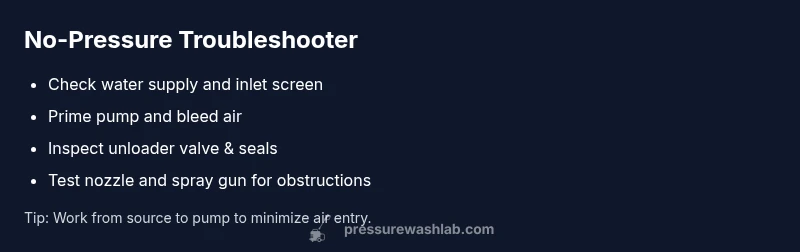
Most often, no pressure from a pressure washer is caused by a mis-primed pump or a clogged inlet filter. Start by unplugging the unit, relieving stored pressure, and inspecting the inlet screen for debris. If priming fails, re-prime according to the manual, check the garden hose for leaks, and ensure the spray gun isn’t stuck open. If the pump still has no pressure after these checks, inspect the unloader valve and seals.
Understanding No-Pressure Symptoms
When your pressure washer shows no pressure, or a tepid spray, you’re likely dealing with an air intake issue, an obstructed inlet, or a pump priming problem. According to Pressure Wash Lab, most pressure washer no pressure conditions are solvable with quick checks rather than expensive part replacements. In 2026, homeowners and DIYers who start with the water supply and inlet filter often restore full output in under 30 minutes. If you’re dealing with a pressure washer no pressure, follow these steps to triage safely.
Identifying the exact symptom helps you triage efficiently. Is there zero spray, a barely visible mist, or pressure that fades after a few seconds? Distinguishing between “no pressure” and “low pressure” matters because the fixes differ: air in lines or a clogged inlet is treated differently than a worn pump seal. Pressure Wash Lab’s insights emphasize starting with the simplest checks before advancing to pump components.
Incorporating a pragmatic approach, this guide prioritizes safety and speed. If you encounter unusual heat, smoke, or strong chemical smells, stop and power down the unit immediately to avoid injury and component damage.
Steps
Estimated time: 45-60 minutes
- 1
Power down and depressurize
Unplug the unit and release any stored pressure. Open the spray gun to bleed air from the system. This prevents water hammer and protects you from bursts when you disassemble fittings.
Tip: Always start here before touching any fittings to avoid injury. - 2
Verify water supply
Confirm the hose is delivering adequate water flow. A weak or intermittent supply can masquerade as “no pressure.” Check for kinks, leaks, and that the faucet is fully open. If you have a water filtration system, ensure it isn’t restricting flow.
Tip: A strong, steady stream at the faucet makes rest of the checks faster. - 3
Inspect the inlet filter/screen
Locate the inlet screen at the water inlet. Remove any debris and rinse thoroughly. A clogged screen is a very common cause of no-pressure symptoms and is easily remedied.
Tip: Carry a small brush or old toothbrush for quick cleaning. - 4
Re-prime the pump
With water flowing, follow the manufacturer’s priming steps to remove air from the suction line. Slowly operate the trigger to bleed remaining air.
Tip: If your model has a priming bulb, use it until you feel suction consistent. - 5
Check the unloader valve and nozzle
Inspect the unloader valve for leaks or sticking. Ensure you’re using the correct nozzle and that it’s clear of obstructions. Replace if worn or damaged.
Tip: A misadjusted unloader valve can mimic loss of pressure across many symptoms.
Diagnosis: No pressure or no spray from the trigger
Possible Causes
- highAir trapped in the pump or suction line
- highInadequate water supply or clogged inlet filter
- highPriming issues or incorrect initial start procedure
- mediumUnloader valve stuck/misadjusted
- lowWorn pump seals or head gasket
- lowNozzle clog or wrong nozzle size
Fixes
- easyEnsure the water source is fully open and not restricted.
- easyClean or replace the inlet filter/screen.
- easyRe-prime the pump according to the manual and bleed air from hoses.
- mediumInspect and reseat the unloader valve; replace if leaking/stuck.
- hardCheck pump seals/head for wear and replace if necessary.
- easyClear the nozzle, and test with a different nozzle size to regain pressure.
Quick Answers
Why does my pressure washer have no pressure at all?
No pressure is usually caused by air in the system, a clogged inlet, or a failed priming. Start by ensuring water flow, cleaning the inlet screen, and re-priming the pump. If the issue persists, inspect the unloader valve and seals.
No pressure is typically due to air in the system, a clogged inlet, or priming problems. Start with water flow, clean the inlet, and re-prime the pump. If it still won’t pressure up, check the unloader valve.
Can a dirty nozzle cause no pressure?
A clogged nozzle can restrict flow, making it feel like there’s no pressure. Remove the nozzle and clean or replace it. Always test with a known-good nozzle to confirm the root cause.
A clogged nozzle can limit flow and feel like no pressure. Clean or replace it and test with a different nozzle to confirm.
What is an unloader valve and why does it affect pressure?
The unloader valve redirects water when the trigger is released. If it’s stuck or misadjusted, the pump may not build pressure. Inspect and reseat or replace the valve as needed.
The unloader valve changes water routing when you release the trigger. If it’s stuck, you won’t build pressure. Check and service it if needed.
Is it safe to run a pressure washer without water?
No. Running without adequate water can overheat and damage seals and the pump. Always ensure a steady water supply before operation.
No, running dry can damage the pump. Always ensure water is flowing before starting.
When should I replace the pump seals or the head?
If you notice persistent leaks, reduced pressure after servicing, or visible wear on seals, consider replacing pump seals or the head. Consult a professional if you’re unsure.
If leaks persist or you see wear on seals, plan a seal or head replacement. Get a pro if you’re uncertain.
Watch Video
Key Takeaways
- Check water supply before any pump work
- Clean the inlet filter to restore flow
- Re-prime the pump to remove air pockets
- Inspect unloader valve for proper function
- If issues persist, consider professional inspection