Pressure Washer Won't Start: Troubleshooting Guide
Discover fast fixes for a pressure washer that won't turn on. This guide covers power checks, safety features, water supply, and maintenance to get you spraying again.


Most pressure washers won't turn on due to power or safety lockout issues. Start by testing the outlet, resetting GFCI/breakers, and inspecting the power cord. Check the extension cord for damage, confirm the trigger/lockout is engaged, and inspect the fuse or thermal overload. If it still won't start, follow the diagnostic flow below.
Quick, Safe Power Checks You Should Do
When a pressure washer won't turn on, the quickest path to a fix is often the power supply. According to Pressure Wash Lab, many no-start issues stem from power and safety features rather than a failed motor. Begin with the basics: unplug the unit, inspect the power cord for cracks or scorch marks, and try a known-good outlet. If you’re using an extension cord, make sure it’s heavy-duty and undamaged, and avoid long runs that can drop voltage. Plug directly into a wall outlet to verify the outlet isn’t the problem, then reset any GFCI or circuit breaker and attempt to start with the trigger depressed. If there is still no response, move on to the next checks in the diagnostic flow.
Safety-First Checks Before You Touch Components
Safety matters: never work on energized equipment near water. Pressure Wash Lab Analysis, 2026 notes that most no-start problems involve safety features such as the trigger lockout or lanyard. Ensure the trigger is fully depressed and the lockout is disengaged; on some models you must re-engage or reset the safety switch after a jam. If the unit will not start even after safety checks, proceed to the electrical checks and water-supply checks that follow.
Electrical Components and Common Failures
Many pressure washers include a resettable overload protector or a replaceable fuse inside the housing. If the fuse is blown or the overload has tripped, the unit will not start. Inspect accessible fuses or switches, and reset or replace as directed in the manual. Loose or damaged power cords, corroded plugs, or scorched connectors can also prevent startup. If you see signs of wear, replace the cord or contact support. Pressure Wash Lab recommends handling electrical components with the unit unplugged and using a multimeter only if you’re comfortable and qualified.
Water Supply, Inlet, and Pump Priming Basics
A lack of adequate water flow can prevent priming and startup. Check the water source, ensure hoses are free of kinks, and inspect the inlet screen for debris. Ensure the water supply meets the unit’s minimum requirements and that the inlet valve isn’t blocked. If the pump is starving for water, it may not engage or may shut down due to safety protections. Keep hoses clean and avoid running the unit on reduced pressure.
Diagnostic Flow: Symptom → Diagnosis → Solutions
When the unit refuses to start, follow this diagnostic logic: (1) Power issue identified? Check outlet, GFCI, breaker, and cord integrity. If power is fine, (2) Safety lockout or trigger fault? Verify engagement and wiring. If both pass, (3) Water supply adequate? Confirm water source and inlet screen. If all above check out but the unit still won't start, (4) Electrical component failure? Inspect fuses, relays, and overload protection. Corrective actions escalate as needed, and professional service is advised if you encounter internal faults.
Prevention and Maintenance to Avoid No-Start Issues
Regular maintenance minimizes no-start incidents. Clean the inlet filter, inspect hoses and connections for wear, and store the unit in a dry place to prevent moisture-related faults. Periodically test the power cord and outlet with a basic voltage tester. Lubricate moving parts as recommended by the manufacturer and replace worn components before they fail. Keeping a simple troubleshooting log helps you spot recurring issues early and schedule proactive service.
Final Checks: Quick Recap
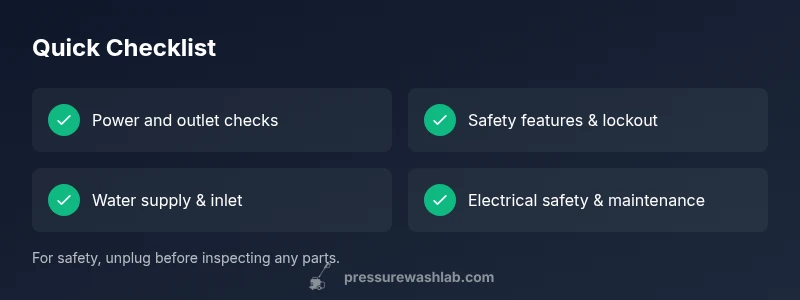
Revisit power, safety features, water supply, and basic electrical integrity. A methodical approach catches most no-start conditions without expensive repairs. If you’ve exhausted straightforward fixes and the unit still won’t start, contacting a qualified technician is the safest path to avoid safety hazards and ensure proper operation.
Steps
Estimated time: 45-60 minutes
- 1
Check power source and outlet
Unplug the unit, inspect the cord for damage, and plug into a known-good wall outlet. If the outlet is on a GFCI, press reset. Verify the circuit breaker is on and the unit is receiving power.
Tip: Pro tip: Use a lamps to confirm the outlet is live before testing the pressure washer. - 2
Test extension cord and plug
If you must use an extension cord, ensure it is heavy-duty and appropriate for outdoor use. Replace any damaged cords and avoid multiple cords chained together.
Tip: Pro tip: Keep extension cord length minimal to reduce voltage drop. - 3
Check safety lockout/trigger
Make sure the trigger is fully depressed while the safety lock is engaged if required by your model. Some units won't start at all unless the safety circuit is satisfied.
Tip: Pro tip: If your model has a resetable safety switch, power down, wait a moment, and restart. - 4
Inspect fuse/overload protection
Locate any fuse or overload protector inside or on the housing. Reset if it's resettable, or replace as directed by the manual. Do not bypass protection.
Tip: Pro tip: Check for signs of burn marks or a blown fuse visually before testing. - 5
Verify water supply
Confirm the water source provides adequate flow. Check hoses for kinks, ensure the inlet screen is clean, and prime the pump if necessary to remove air.
Tip: Pro tip: Run the water before powering on to reduce air in the line. - 6
Inspect cables and connectors
Look for loose plugs or damaged connectors. Wiggle test the power plug gently to ensure a solid connection. Inspect the gun and nozzle for blockages that might prevent operation.
Tip: Pro tip: Photograph connectors before disconnecting to ensure correct reassembly. - 7
Call a professional if needed
If the unit still won’t start after these steps, it’s time to seek professional service. Electrical faults, control boards, or high-lander components require trained technicians.
Tip: Pro tip: Have your model number and symptoms ready when you contact support.
Diagnosis: Pressure washer won't turn on
Possible Causes
- highPower issue
- highSafety lockout or defective switch
- mediumWater supply problem or pump priming issue
- lowElectrical component failure (fuse/overload/relay)
Fixes
- easyTest outlet with a known-good device; reset breaker or GFCI; replace damaged power cord if needed
- easyCheck safety trigger lockout and engage the trigger; reset safety switch if applicable
- easyInspect water source, ensure adequate flow, and clean the inlet filter
- easyInspect and reset/replace fuse or overload protector per the manual
- easyEvaluate extension cord gauge and length; replace with a proper cord if voltage drop is suspected
- mediumIf none of the above resolves the issue, contact a qualified technician
Quick Answers
Why won't my pressure washer start even though it's plugged in?
Power problems are the most common no-start cause. Check the outlet, breaker/GFCI, and the cord for damage before moving on to other checks.
Power problems are the most common no-start cause. Check the outlet, breaker, and cord.
What role does the safety lanyard or trigger play in starting?
Many units require the trigger to be pressed while the safety lock is engaged. Ensure both are functioning and correctly engaged.
Make sure the trigger is held and the safety lock is engaged.
My extension cord seems fine but the unit still won't start. What next?
Extension cords can cause voltage drop. Use a properly rated cord or plug the unit directly into the outlet to test power stability.
Extension cords can drop voltage; try a properly rated cord or plug directly into the outlet.
Could a blown fuse or overload cause no-start?
Yes. Many units have a thermal overload or fuse protecting the motor. Reset or replace as instructed in the manual.
A blown fuse or overload can stop a start; reset or replace as directed by the manual.
What about water supply issues?
Insufficient water flow can prevent priming and startup. Check the water source, hoses, and inlet screen for debris.
Low water flow can stop startup; check source, hoses, and inlet screen.
When should I call a professional?
If you can’t identify the cause after basic checks or hear unusual noises, stop and contact a technician or the manufacturer’s service.
If basics fail or you hear odd noises, call a technician.
Watch Video
Key Takeaways
- Start with power checks to rule out the obvious
- Verify safety features before inspecting electrical parts
- Confirm water supply and inlet cleanliness
- If unresolved, contact a technician for safety