Ryobi Pressure Washer Won't Start: Step-by-Step Troubleshooting
If your Ryobi pressure washer won't start, follow this urgent, step-by-step troubleshooting guide to diagnose power, interlock, fuel, and safety issues. Pressure Wash Lab shares practical checks and safe fixes to get you back to cleaning fast.


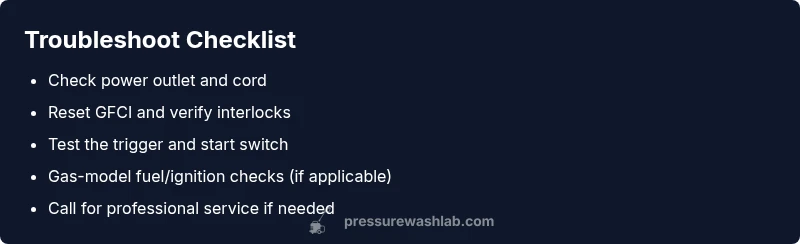
Most Ryobi pressure washer start failures stem from power, safety interlocks, or simple wiring issues. Quick fixes: test a live outlet, inspect the power cord for damage, reset the GFCI, and ensure the start switch and trigger interlock are engaged. If it still won’t start, consult the manual for model-specific interlocks and consider service.
Common Start Failures
When a Ryobi pressure washer won't start, the root causes are almost always simple and observable. In many cases, power delivery fails, the GFCI trips, or a safety interlock remains engaged when it shouldn’t be. According to Pressure Wash Lab, the majority of no-start problems are linked to power supply issues or overlooked safety features rather than a seized motor. Start by confirming the unit is plugged into a live outlet, the power switch is on, and the extension cord (if used) is undamaged. If you notice a warm plug, a scorch mark on the outlet, or a buzzing outlet that trips immediately, stop and replace the cord or receptacle before attempting to restart. Remember, a no-start condition can also be caused by a loose connection at the plug or a damaged power cord, so this block focuses on the fastest, safest checks you can perform before disassembly or service.
Keyword usage note: The phrase ryobi pressure washer won’t start appears frequently in support queries, and addressing power and interlock issues often resolves the majority of cases. These are the most common, high-lailure factors to verify first.
Safety Considerations for Quick Diagnostics
Before you begin, unplug the machine and ensure you’re wearing non-slip footwear and eye protection. Safety interlocks and the ground-fault circuit interrupter (GFCI) are designed to protect you but can complicate starting if tripped or miswired. Do not bypass interlocks or force components; these are safety features, not optional steps. A quick reset—unplugging for 60 seconds and then plugging back in—can rearm interlocks and clear minor inverter or contactor faults that prevent startup. If the unit has a dedicated cold-start lever or primer, confirm it’s in the correct position.
Key reminder: Never operate a washer with a damaged cord, exposed wiring, or a damaged inlet hose. These conditions pose shock hazards and can void warranties. If you suspect any damage, stop and replace components before testing again.
Quick Checks You Can Do (No Tools Needed)
- Verify the power source: Try a different outlet or power strip. If you’re using an outdoor outlet, ensure it’s protected and still powered.
- Inspect the power cord and plug: Look for cuts, exposed copper, or bent prongs. A damaged cord should be replaced immediately.
- Check the GFCI outlet: Press the reset button and test with a small device to confirm it’s supplying power. A tripped GFCI is the most common external failure for outdoor equipment.
- Confirm the unit is in the start position: Some Ryobi models require a specific switch position or trigger engagement to bypass the safety interlock. Engage the trigger slightly (without water flow) to see if the motor whirs.
- Look for a near-immediate trip or fuse blow: If a fuse or breaker trips as soon as you plug in, there’s likely a short or damaged cord. In that case, stop and inspect wiring contrast or seek professional help.
When to Move to Deeper Diagnostics
If the washer still won’t start after those checks, you’re likely dealing with an interlock fault, a faulty start switch, or an internal wiring issue. This is when it’s worth consulting the manual for model-specific safety features and considering service if basic checks fail. Keeping a log of all attempts—including which outlet you used, what switch setting was active, and whether the GFCI reset helped—will help you and any technician diagnose faster.
Common Mistakes to Avoid (and Why)
- Skipping safety checks to save time: skipping unplugging and inspecting cords can lead to electric shock.
- Forcing the trigger: excessive pressure on the trigger can damage internal components and worsen the fault.
- Replacing parts without testing: swapping random components without verifying the root cause wastes time and money.
- Ignoring model-specific features: Ryobi models differ; consult the manual for exact safety interlocks and priming steps.
- Assuming a lack of power equals a failed motor: electrical faults are far more common and easier to fix than a seized motor; start with power and wiring.
Steps
Estimated time: 60-120 minutes
- 1
Check power source
Unplug, inspect the cord for damage, and plug into a known-good outlet. Make sure the power switch is in the ON position and there is no loose connection at the plug. If you’re using an extension cord, test without it to rule out cord fault.
Tip: Use a dedicated outdoor outlet; extension cords can cause voltage drop and no-start conditions. - 2
Inspect cord and connector
Carefully examine the entire length of the cord for nicks, cuts, or exposed conductors. Replace any damaged cord immediately. Ensure the plug prongs are not bent and the connection to the machine is snug.
Tip: Never run a washer with a damaged cord; it’s a shock and fire hazard. - 3
Reset GFCI and test interlocks
Locate the GFCI outlet and press the reset button. Then, try starting the unit again with the trigger pressed lightly; if the interlock is engaged, ensure it’s fully released before retrying.
Tip: If the GFCI trips again, there may be an internal fault or water intrusion in the outlet. - 4
Test the trigger and start switch
Squeeze the trigger with a firm but steady grip and listen for a motor hum or switch click. If there’s no response, the start switch or interlock could be defective and require replacement.
Tip: Do not force the trigger; repeated force can damage the interlock. - 5
Gas-model fuel and ignition checks
If you own a gas Ryobi model, verify fuel is fresh, the carburetor is clean, and the choke is in the correct position. Prime the engine according to the manual and inspect the spark plug.
Tip: Gas engines require fresh fuel and proper storage; poor fuel can cause hard starting. - 6
Escalation to professional service
If none of the above steps resolve the issue, do not continue to disassemble; contact an authorized service center or technician for diagnosis and repair.
Tip: Document symptoms and steps tried to speed up diagnosis.
Diagnosis: Ryobi pressure washer won't start
Possible Causes
- highNo power at outlet or damaged cord
- highGFCI trip or safety interlock engaged
- mediumFaulty start switch or trigger interlock
- lowGas model fuel delivery or ignition issue
- lowLow oil shutoff or safety feature (gas models)
Fixes
- easyTest outlet with a known-working device; replace damaged cord; ensure outlet is powered
- easyReset GFCI and verify water protection features; try a different outlet or circuit
- easyInspect and clean the trigger interlock and start switch; reseat or replace if faulty
- mediumFor gas models, check fuel level, prime carburetor, ensure correct choke position and spark
- mediumCheck oil level and confirm safety shutoff status; if in doubt, seek professional service
Quick Answers
Why won't my Ryobi pressure washer start even when plugged in?
Most start failures are due to power delivery problems, a tripped GFCI, or an engaged safety interlock. Start with power and interlock checks, then inspect wiring and switches.
Most start failures come from power or safety interlocks; check outlet and interlock first.
What should I check first if it won't start?
Confirm the outlet has power, the cord is intact, and the washer is switched to ON. Reset any GFCI outlet and try a different outlet if needed.
First, ensure power, cord, and the on switch are solid.
Is there a difference between electric and gas Ryobi units when starting?
Electric models rely on power and interlocks; gas models require fuel, ignition, and carburetor checks. Follow the applicable routine for your model.
Electric units start with power; gas units need fuel and ignition checks.
What if the start interlock won’t reset?
If the interlock won’t reset after powering off and unplugging, the switch or interlock may be faulty and require professional service.
If the safety interlock won't reset, get it inspected by a tech.
Can lack of water flow prevent starting?
Yes, some models require a water supply to start; ensure water is connected and open before attempting to start.
Make sure water is flowing before starting.
When should I seek professional repair?
If basic diagnostics fail or you smell fuel leaks, contact an authorized service center or technician.
If basic checks don’t fix it, seek service.
Watch Video
Key Takeaways
- Check power and outlet integrity first
- Reset GFCI and test safety interlocks
- Inspect the start switch and trigger mechanism
- Follow model-specific fuel and ignition steps for gas units
- Seek professional help when in doubt